
Chef Lupita
Acambaritas de Acámbaro
Guanajuato's daily bread from Acámbaro, a small glazed roll built on pata, enriched with manteca de cerdo, and baked until the top shines lightly for merienda.
A cooking platform built around craft, culture, and the stories behind what we eat.
Created by
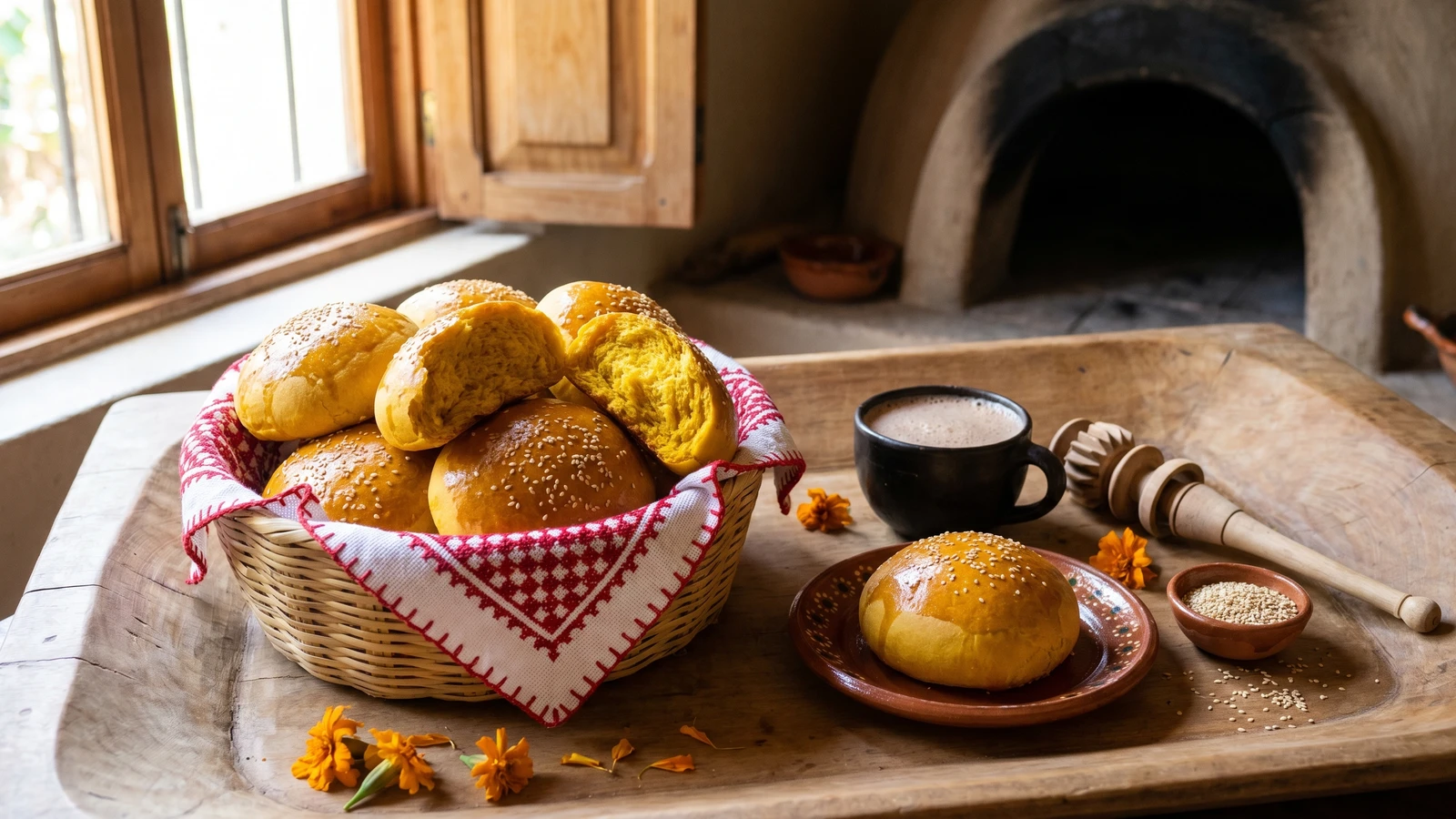
From the Valles Centrales of Oaxaca, a round, faintly sweet bread tinted gold by egg yolks and azafrancillo. The daily companion to café de olla and chocolate de agua, baked the way the panaderas of Zaachila and Mitla have always done it.
This bread is from the Valles Centrales of Oaxaca. Not from Mexico City, not from a generic 'pan dulce' tradition, from Oaxaca. You will find it in the panaderías of Zaachila, Mitla, Tlacolula, and Miahuatlán, sitting in baskets lined with embroidered servilletas, sold by the piece for a few pesos. It is breakfast bread. It is merienda bread. It is what you tear into and dip into chocolate de agua at six in the morning before the market opens.
The yellow does not come from food coloring and it does not come from saffron. It comes from azafrancillo, the dried flower of the cártamo plant, steeped in hot water until the liquid runs marigold. Combined with eight yolks from huevos de rancho, the orange-yolked eggs from country hens, the dough turns the color of a Oaxacan sunset. Pale eggs give you a pale bread. The eggs matter. The azafrancillo matters. La manteca matters. Cada estado, su propia cocina.
My mother did not bake pan amarillo. She was from Jalisco. But on my second trip through the Valles Centrales, a panadera at Mercado Alarii in Zaachila taught me her version one morning before sunrise, in a bakery with a wood-fired clay oven and an artesa polished smooth by three generations of hands. She would not let me write anything down until I had kneaded the dough myself. 'Si no lo sientes en las manos, no lo vas a saber hacer.' If you do not feel it in your hands, you will not know how to make it. She was right. This is the version I make now, scaled for a home kitchen but faithful to the one she taught me. Saber cocinar es saber vivir.
Pan amarillo belongs to a broader Oaxacan panadería tradition that emerged after Spanish wheat cultivation took hold in the Valles Centrales in the late 16th century, but the bread itself is a mestizo creation: European yeast and wheat technique colored with azafrancillo (Carthamus tinctorius), a cártamo flower grown across central Mexico and used as an inexpensive alternative to imported saffron since the colonial period. The bread is distinct from the more famous Oaxacan pan de yema and pan de muerto, which carry ceremonial weight, while pan amarillo remains everyday bread, the daily loaf of working families across the valley towns. Its survival in markets like Mercado de Tlacolula and Mercado Alarii in Zaachila reflects an unbroken bakery culture that has resisted homogenization by national industrial bread brands.
Quantity
500 grams
plus more for shaping
Quantity
10 grams
Quantity
120 grams
Quantity
8 grams
Quantity
8
at room temperature
Quantity
1
at room temperature
Quantity
1 teaspoon
steeped in 60 milliliters hot water for 15 minutes
Quantity
120 milliliters
lukewarm
Quantity
120 grams
softened to room temperature
Quantity
1 tablespoon
for the tops
Quantity
1
for brushing
| Ingredient | Quantity |
|---|---|
| harina de trigoplus more for shaping | 500 grams |
| active dry yeast | 10 grams |
| azúcar morena | 120 grams |
| sal fina | 8 grams |
| yemas de huevo de ranchoat room temperature | 8 |
| huevo enteroat room temperature | 1 |
| azafrancillo (cártamo) flowerssteeped in 60 milliliters hot water for 15 minutes | 1 teaspoon |
| leche enteralukewarm | 120 milliliters |
| manteca de cerdosoftened to room temperature | 120 grams |
| ajonjolífor the tops | 1 tablespoon |
| yema de huevo beaten with 1 tablespoon milkfor brushing | 1 |
Place the azafrancillo flowers in a small heatproof cup and pour 60 milliliters of hot tap water over them. Hot, not boiling. Let them steep for 15 minutes while you gather everything else. The water will turn a deep marigold yellow. This is the color of pan amarillo. Saffron is not a substitute. Turmeric is not a substitute. Azafrancillo, also called cártamo, is what the panaderas in the Valles Centrales have always used and it is sold by the gram in every market in Oaxaca.
In a small bowl, combine the lukewarm milk, the yeast, and one tablespoon of the sugar from the measured amount. Stir once. Leave it for 10 minutes. It should bloom into a foamy cap. If it does not foam, your yeast is dead. Throw it out and start over with fresh yeast. No me vengas con atajos.
In a large bowl or on a clean wooden artesa, combine the flour, the remaining sugar, and the salt. Make a well in the center. Pour in the yeast mixture, the egg yolks, the whole egg, and the strained azafrancillo water. Stir with your hand from the center outward, pulling in the flour from the walls of the well. Work it until you have a shaggy, deeply yellow dough. The yolks of huevo de rancho are what give this bread its color. Pale supermarket yolks will give you a pale bread. Find the orange-yolked eggs.
Turn the dough onto a lightly floured surface. Knead for 10 minutes, pushing with the heel of your hand and folding back. The dough will go from sticky to elastic. Now begin adding the softened manteca de cerdo, a tablespoon at a time, working each addition fully into the dough before the next. La manteca es el sabor and it is also what gives pan amarillo its tender, slightly crumbly bite. Butter is not the same. Vegetable shortening is not the same. Manteca.
Place the dough in a lightly greased bowl. Cover with a clean cotton servilleta. Let it rise in a warm corner of the kitchen for two to three hours, until doubled. Oaxacan kitchens are warm. If yours is cold, the dough will take longer. Do not rush it with high heat. The slow rise builds the flavor. Asi se hace y punto.
Punch the dough down gently. Divide into 12 equal pieces, about 90 grams each. Roll each piece into a tight, round bola, pulling the surface taut over your palm and pinching the seam underneath. Place them seam-side down on a sheet pan lined with parchment, spaced four fingers apart. They will spread.
Cover the shaped panes with a cotton cloth and let them rise again, one to one and a half hours, until they look puffy and the dough springs back slowly when poked. Heat the oven to 190°C (375°F) during the last 20 minutes of this rise. A wood-fired oven gives the best crust, but a home oven preheated thoroughly will do honest work.
Brush each pan gently with the egg yolk wash. Be careful not to deflate them. Scatter ajonjolí over the tops. Bake for 22 to 25 minutes, until the tops are deep golden and the bottoms sound hollow when tapped. The egg wash should set into a glossy mahogany-yellow finish. Pull them out the moment the bottoms are firm. Overbaked pan amarillo turns dry and the whole point of this bread is its tender, faintly sweet crumb.
Cool on a wire rack for at least 20 minutes before tearing one open. Eat with café de olla, with chocolate de agua frothed in a jícara with a molinillo, or with atole de granillo if you can get the right corn. This is daily bread in Oaxaca, not Sunday bread. It belongs at the breakfast table and at the merienda. Recetas probadas y garantizadas.
1 serving (about 85g)
Culinary guides, cultural storytelling, and the editorial depth that makes cooking meaningful.
Discover Culinary ExplorerChef Lupita
Guanajuato's daily bread from Acámbaro, a small glazed roll built on pata, enriched with manteca de cerdo, and baked until the top shines lightly for merienda.

Chef Lupita
Michoacan's Tinguindin aguacatas are flat, leaf-scored sweet breads made with harina de trigo, piloncillo, anise, and manteca de cerdo, shaped by hand for the wood oven.

Chef Lupita
From Ajijic on Lake Chapala, Pan Tachihual is a lightly sweet wedding loaf built with harina de trigo, harina de maiz, piloncillo, manteca, anise, and the old Guadalajara pata.

Chef Lupita
Comitán's pan de yema shaped into little pigs, birds, and rabbits, a Chiapas bakery bread rich with egg yolks, manteca de cerdo, and anís, baked golden on hoja de plátano.