Culinary Explorer

A cooking platform built around craft, culture, and the stories behind what we eat.
Discover Culinary Explorer
Hojaldra Oaxaqueña

Hojaldra Oaxaqueña

Created by

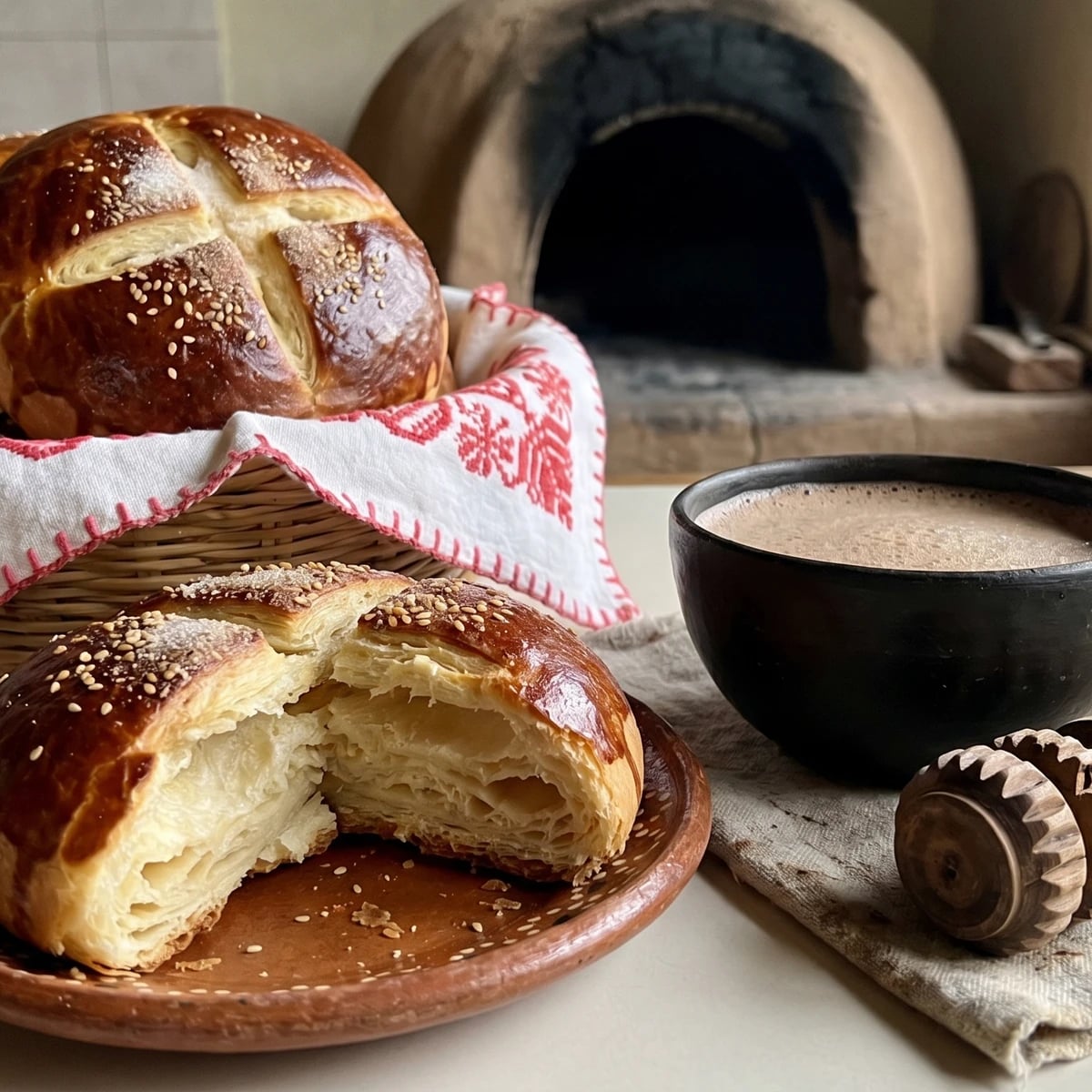
Oaxaca's round individual bread, laminated with manteca de cerdo and scored on top with a deep cross. Flakier than pan de manteca, perfumed with toasted anise, built to be dunked into chocolate de agua at six in the morning.

Breads
Mexican
Weeknight
Comfort Food
Make Ahead
45 min
Active Time
25 min cook4 hr 10 min total
Yield12 individual hojaldras

Hojaldra is from Oaxaca. Not Mexico City, not Puebla, not the generic Mexican panadería. It is a Valles Centrales bread, sold in the panaderías of Tlacolula, Zaachila, Mitla, and Miahuatlán, and it has nothing to do with the puff pastry the same word describes in Spain. The name carries over because of the lamination, the layers, but the dough is enriched with eggs and manteca and the result is a soft, flaky individual roll, scored on top with a cross, that you eat with hot chocolate de agua and nothing else.

This is not pan de yema and it is not pan de manteca. People confuse the three. Pan de yema is the everyday yolk-rich Oaxacan bread, eaten at breakfast year-round and not, no matter what the gringo travel articles say, only for Día de Muertos. Pan de manteca is denser and saltier, closer to a biscuit. The hojaldra sits between them: flakier than pan de manteca because of the lamination, less yolk-heavy than pan de yema, perfumed with anise toasted on the comal until the kitchen smells like the bakery at dawn.

My mother did not make hojaldras. She was from Jalisco and Jalisco has its own breads. I learned this one from doña Estela in Zaachila, who has been pressing dough on the same wooden artesa since 1972 and who corrected my hand position three times before she let me shape my first round. She told me the cross is not optional, the manteca is not optional, and the chocolate is not a suggestion. Saber cocinar es saber vivir, and in Oaxaca, the morning bread teaches you what kind of day you are about to have.

The Oaxacan panadería tradition descends from the colonial fusion of Spanish wheat-baking, brought by Dominican friars who established mills in the Valles Centrales in the 16th century, with indigenous Zapotec and Mixtec techniques for working with maize and lard rendered from Spanish-introduced pigs. Hojaldra as it exists in Oaxaca today is not the puff pastry of the Spanish hojaldre, but a colonial-era enriched bread whose name preserved the Iberian word for laminated dough even as the technique adapted to local fats and tastes. The wood-fired clay ovens of towns like Tlacolula and San Antonino Castillo Velasco have produced hojaldras and pan de yema continuously for at least two centuries, and the cross score on top, often interpreted as a Catholic gesture, also functions practically: it allows the laminated dough to expand cleanly without splitting at the side.

The technique, the tradition, and the story behind every dish.

Discover Culinary Explorer

Ingredients

all-purpose wheat flour

Quantity

500 grams (about 4 cups)

plus more for dusting

granulated sugar

Quantity

100 grams (about 1/2 cup)

instant yeast

Quantity

10 grams (1 tablespoon)

fine sea salt

Quantity

8 grams (1 1/2 teaspoons)

anise seeds

Quantity

1 tablespoon

lightly toasted on a comal and crushed

manteca de cerdo

Quantity

150 grams (about 2/3 cup)

at room temperature

large eggs

Quantity

3

at room temperature

whole milk

Quantity

180 milliliters (3/4 cup)

warm to the touch

orange zest

Quantity

1 teaspoon

finely grated

manteca de cerdo (for laminating)

Quantity

100 grams (about 1/2 cup)

softened

egg wash

Quantity

1 large egg beaten with 1 tablespoon milk

granulated sugar for finishing

Quantity

2 tablespoons

ajonjolí (sesame seeds) (optional)

Quantity

1 tablespoon

for finishing

Equipment Needed

  • Heavy comal or cast iron skillet for toasting anise
  • Large mixing bowl or stand mixer with dough hook
  • Wooden artesa or large work surface for kneading and laminating
  • Sharp paring knife or razor blade for scoring
  • Two parchment-lined sheet pans
  • Wire cooling rack
  • Pastry brush for the egg wash

Instructions

  1. 1

    Toast the anise

    Set a dry comal over medium-low heat. Scatter the anise seeds across the surface and toast them for about 90 seconds, shaking the pan, until the kitchen smells sweet and faintly licorice. Tip them onto a cutting board and crush them with the bottom of a heavy glass. Toasted anise is what gives Oaxacan hojaldra its perfume. Use the seeds raw and the bread will taste flat.

    If the anise turns dark or smells bitter, throw it out and start again. Burned spice is burned spice and there is no recovering from it in a sweet dough.
  2. 2

    Mix the dough

    In a large bowl, whisk together the flour, sugar, yeast, salt, and crushed anise. Make a well in the center. Add the room-temperature manteca de cerdo, the three eggs, the warm milk, and the orange zest. Use your hand or a wooden spoon to draw the flour into the wet ingredients until a shaggy dough forms. The manteca should disappear into the flour as you go. La manteca es el sabor, and in this bread it is also the structure.

  3. 3

    Knead until smooth

    Turn the dough onto a lightly floured surface. Knead for 10 to 12 minutes by hand, or 6 to 7 in a stand mixer with the dough hook on medium-low. The dough starts sticky and tightens as the gluten develops. It is ready when it pulls cleanly off the counter and feels soft like an earlobe. Do not add more flour than you need. A dry dough makes a dry hojaldra.

  4. 4

    First rise

    Place the dough in a lightly greased bowl, cover with a damp cotton servilleta, and rest in a warm corner of the kitchen for 90 minutes, until visibly puffed and roughly doubled. Oaxacan kitchens at altitude are warm and dry, and the dough rises confidently. In a cold kitchen, give it more time. The dough is ready, not the clock.

  5. 5

    Laminate with manteca

    Turn the risen dough onto a lightly floured surface and press it flat. Roll it into a rectangle about 40 by 25 centimeters. Spread the softened laminating manteca evenly across the surface with the back of a spoon, leaving a thin border. Fold the dough into thirds like a letter. Turn it 90 degrees, roll it back out to the same rectangle, and fold into thirds again. This is what makes a hojaldra a hojaldra. The layers of manteca between the dough are why this bread is flakier than pan de manteca. Wrap the folded block in plastic and rest in the refrigerator for 30 minutes.

    If the manteca starts to melt and ooze out the sides, the dough is too warm. Refrigerate for 15 minutes between folds. The fat needs to stay distinct from the dough, not blend into it.
  6. 6

    Shape the hojaldras

    Divide the rested dough into 12 equal pieces, about 90 grams each. Working with one piece at a time and keeping the others covered, roll each piece into a tight ball. Press the seam closed underneath and round it under your cupped palm against the counter until the surface is taut and smooth. Place the rounds on two parchment-lined sheet pans, leaving four fingers of space between them. They will spread.

  7. 7

    Score the cross

    Dip a sharp paring knife or razor blade in flour. Score each round with a deep cross on top, about 1/2 centimeter deep, two clean strokes that meet in the center. The cross is the signature of the Oaxacan hojaldra. It is not decoration. It is what lets the bread open in the oven and shows the flaky layers underneath. Asi se hace y punto.

  8. 8

    Final proof

    Cover the shaped rounds loosely with a cotton cloth and let them proof at room temperature for 45 to 60 minutes, until they look softly inflated and a gentle press with a fingertip springs back slowly, leaving a faint dent. Underproofed hojaldras stay dense. Overproofed ones collapse in the oven. Watch the dough, not the timer.

  9. 9

    Heat the oven and finish

    Heat the oven to 200 degrees Celsius (400 Fahrenheit) with a rack in the middle. Brush each hojaldra gently with the egg wash, working into but not flooding the scored cross. Sprinkle the tops with the finishing sugar. Scatter ajonjolí across the top if using. The Sánchez family in Miahuatlán uses sesame on theirs and the seed crackles in the oven heat.

  10. 10

    Bake

    Bake for 22 to 25 minutes, rotating the pans halfway through. The hojaldras are done when the tops are deep golden, the cross has opened cleanly, and the bottoms sound hollow when tapped. Pull them out the moment they are dark gold. A few extra minutes turns the manteca crumb dry. Cool on a wire rack for at least 15 minutes before serving. Eat with chocolate de agua, frothy from the molinillo. That is the pairing the bread was built for.

Chef Tips

  • Manteca de cerdo means real rendered pork lard, not the hydrogenated white block in the Mexican grocery aisle. Find a carniceria that renders its own, or render it yourself from pork fatback. The flavor of the bread depends on it. Vegetable shortening will give you a hojaldra-shaped object that does not taste like a hojaldra.
  • The anise must be toasted. Raw anise tastes medicinal in this dough. Thirty seconds too long and it tastes burned. Stand at the comal and pay attention. This is one of those small steps that decides whether the bread tastes Oaxacan or just sweet.
  • If the kitchen is hot, work fast and refrigerate between folds. The lamination only works if the manteca stays in distinct layers. A warm kitchen turns the fat into a smear and you lose the flake.
  • Eat them the day they are baked. Hojaldras stale fast because of the lamination. Day-old hojaldras get split and toasted on the comal with butter, or torn into a bowl of chocolate de agua. Nothing wasted.

Advance Preparation

  • The dough through the first rise can be made the night before and refrigerated. Bring it back to room temperature for 30 minutes before laminating with the manteca.
  • Shaped, scored hojaldras can be frozen on the sheet pan, then transferred to a bag. Thaw, proof, and bake from there. The cross stays clean.
  • Baked hojaldras keep for one day at room temperature wrapped in a cotton servilleta. Past that, split them and toast on the comal.

Frequently Asked Questions

Nutrition Information

1 serving (about 110g)

Calories
420 calories
Total Fat
24 g
Saturated Fat
9 g
Trans Fat
0 g
Unsaturated Fat
15 g
Cholesterol
85 mg
Sodium
290 mg
Total Carbohydrates
44 g
Dietary Fiber
1 g
Sugars
11 g
Protein
7 g

Note: Chef personas and recipes are created with AI assistance. Cook with care: follow safe food-handling practices, check doneness with a thermometer when needed, and adapt for allergies and your kitchen.

Where cooking meets culture.

Culinary guides, cultural storytelling, and the editorial depth that makes cooking meaningful.

Discover Culinary Explorer

More from Oaxacan Breads

Browse the full collection