
Chef Lupita
Acambaritas de Acámbaro
Guanajuato's daily bread from Acámbaro, a small glazed roll built on pata, enriched with manteca de cerdo, and baked until the top shines lightly for merienda.
A cooking platform built around craft, culture, and the stories behind what we eat.
Created by
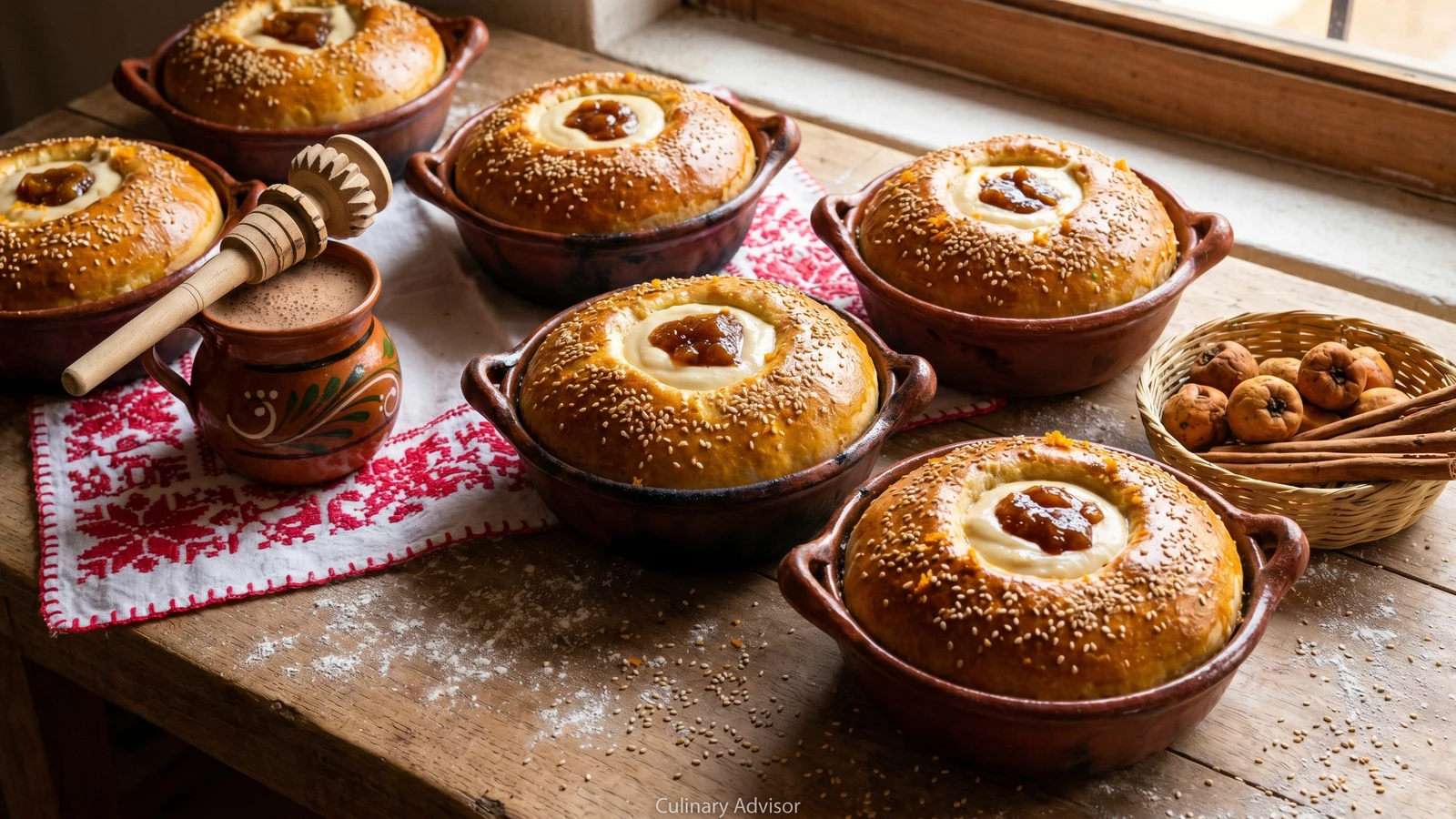
Tlacolula's Sunday tianguis bread, baked into individual cazuelas of barro rojo from Atzompa, the hollow center waiting for crema agria, mermelada de tejocote, or whatever fruit the Valles Centrales has ripened that week.
This bread belongs to Tlacolula de Matamoros, in the Valles Centrales of Oaxaca, where the Sunday tianguis has run continuously since long before the Spanish drew the road that connects it to the capital. Walk the bread aisle of that market on a Sunday morning and you will see them stacked: small bowl-shaped breads with deep golden tops, each one baked into its own cazuela of barro rojo from Atzompa, sold beside the pan de yema and the hojaldras and the marquesote. This is not Mexico City pan dulce. This is Oaxacan bread, and the cazuela is not a serving dish. The cazuela is the mold.
The dough takes manteca de cerdo and six egg yolks, anise and ajonjolí and the zest of an orange. The clay does the rest. Unglazed barro pulls moisture from the bottom of the dough as it bakes, giving the underside a toasted crackle that no metal pan can produce. The hollow at the top, formed by your own thumbs as you press the dough into the cazuela, is what makes this bread a vessel. After it cools, the panadera fills the well with crema agria and mermelada de tejocote, or whatever fruit the season has put on her table. In late summer it is tuna roja from the nopal. In autumn it is membrillo. In winter it is a thick guayaba paste. Cada estado, su propia cocina, and inside Oaxaca, cada valle su propio pan.
My mother never baked this. She was from Jalisco and her notebook holds no Oaxacan recipes. I learned it from Doña Reyna at Mercado Alarii in Zaachila, who let me sit on a stool beside her artesa for three Sunday mornings while she pressed the dough into her cazuelas with the heels of her hands and corrected me every time I tried to thin the walls. The walls are the bread, she told me. Make them thin and you have made a galleta. Make them thick and you have made pan de cazuela. Saber cocinar es saber vivir. La cocina no es decoracion, es trabajo.
Tlacolula's Sunday market is one of the oldest continuously operating tianguis in the Americas, established in pre-Columbian Zapotec times and never interrupted, even during the colonial period when many indigenous markets were displaced or absorbed. Pan de cazuela emerged from the convergence of Zapotec ceramic tradition, the cazuelas of barro rojo from nearby Santa María Atzompa have been produced for over a thousand years, with the Spanish wheat and dairy economy that took hold in the Valles Centrales after the conquest, producing a hybrid bread that uses indigenous clay as both oven and serving vessel. The use of manteca de cerdo and abundant egg yolks places it firmly within the Oaxacan panadería tradition codified in the 18th and 19th centuries, distinct from the French-influenced breads that dominate Mexico City's pan dulce repertoire.
Quantity
500 grams (about 4 cups)
plus more for kneading
Quantity
100 grams (1/2 cup)
Quantity
10 grams (2 1/2 teaspoons)
Quantity
8 grams (1 1/2 teaspoons)
Quantity
6
at room temperature
Quantity
2
at room temperature
Quantity
180 milliliters (3/4 cup)
warmed to 100F
Quantity
120 grams (1/2 cup plus 1 tablespoon)
softened
Quantity
1 tablespoon
toasted
Quantity
from 1 orange
Quantity
1 tablespoon
lightly crushed
Quantity
1 yolk beaten with 1 tablespoon whole milk
Quantity
as needed
softened
Quantity
for filling
Quantity
for filling
Quantity
for serving
| Ingredient | Quantity |
|---|---|
| bread flourplus more for kneading | 500 grams (about 4 cups) |
| granulated sugar | 100 grams (1/2 cup) |
| instant yeast | 10 grams (2 1/2 teaspoons) |
| fine sea salt | 8 grams (1 1/2 teaspoons) |
| large egg yolksat room temperature | 6 |
| whole eggsat room temperature | 2 |
| whole milkwarmed to 100F | 180 milliliters (3/4 cup) |
| manteca de cerdosoftened | 120 grams (1/2 cup plus 1 tablespoon) |
| ajonjolí (white sesame seeds)toasted | 1 tablespoon |
| orange zest | from 1 orange |
| anise seedlightly crushed | 1 tablespoon |
| egg yolk glaze | 1 yolk beaten with 1 tablespoon whole milk |
| manteca de cerdo for greasingsoftened | as needed |
| crema agria oaxaqueña (optional) | for filling |
| mermelada de tejocote or fresh seasonal fruit compote (optional) | for filling |
| chocolate de agua (optional) | for serving |
Take eight small individual cazuelas of barro rojo from Atzompa, each about 4 to 5 inches across and 2 inches deep. New cazuelas need to be cured first, soaked in water overnight, rubbed with manteca, and warmed slowly in a low oven. The clay drinks the fat and stops cracking under heat. Once cured, grease the inside of each cazuela generously with softened manteca de cerdo. The fat is what releases the bread cleanly. Vegetable oil will not do it.
In a large bowl or the bowl of a stand mixer, whisk together the flour, sugar, yeast, salt, anise seed, orange zest, and toasted ajonjolí. Make a well in the center. Add the egg yolks, whole eggs, and warm milk. Mix on low with the dough hook, or by hand with a wooden spoon, until a shaggy dough forms. Let it rest for ten minutes. This is the autolyse. The flour drinks the liquid and the gluten starts to organize itself before you ask it to do real work.
Add the softened manteca de cerdo a tablespoon at a time, kneading on medium speed or by hand on a lightly floured surface, waiting until each addition is fully absorbed before adding the next. This takes patience. The dough will look broken and ugly halfway through. Keep going. After 12 to 15 minutes the dough will pull together into something smooth, glossy, and elastic. La manteca es el sabor and it is also the texture. Butter will not give you the same crumb. Asi se hace y punto.
Shape the dough into a ball and place it in a lightly greased bowl. Cover with a damp cloth, the kind of clean cotton servilleta the panaderas use, never plastic film. Let it rise in a warm spot for 90 minutes to 2 hours, until doubled. Oaxaca's altitude makes the dough lazy. Mexico City makes it fast. Adjust by feel, not by clock. Press a finger gently into the dough. If the indent springs back slowly, it is ready.
Turn the dough onto a lightly floured wooden artesa or cutting board. Divide into eight equal pieces, about 130 grams each. Weigh them. Eyeballing this is how you end up with three breads that brown and five that are still pale. Round each piece into a tight ball, pinching the seam closed underneath. Let them rest five minutes so the gluten relaxes before the final shape.
Take each ball and press it into the bottom of a greased cazuela, working it up the sides with your thumbs to form a thick bowl shape with a hollow well in the center. The walls should be about half an inch thick. Do not stretch the dough thin. The whole point of pan de cazuela is the cup that holds the cream and the fruit later, so build it like a real bowl. The dough will rise and the well will close in slightly. That is fine. You want a soft hollow, not a chasm.
Cover the filled cazuelas loosely with a cloth and let them rise for 45 minutes to an hour. The dough will swell to fill the cazuela and the well will close partway. Toward the end of the rise, position a rack in the center of the oven and heat it to 350F (175C). The slow oven is what gives this bread its tender crumb. A hot oven sets the crust before the inside has time to finish.
Brush the tops of the breads gently with the egg yolk and milk glaze. Be generous but careful. Press a few extra ajonjolí seeds into the glaze if you want the panadería look. Bake on the center rack for 30 to 35 minutes, rotating the pan halfway through, until the tops are deep golden brown and the bread sounds hollow when tapped. The kitchen should smell like a Tlacolula bakery at six in the morning, anise and toasted yolks and warm clay.
Let the breads rest in their cazuelas for 10 minutes after they come out. The crumb is too tender to unmold hot. Run a thin knife around the edge and turn each one out onto a wire rack. If a cazuela holds its bread, slip the knife under the bottom and lift gently. The manteca should release it cleanly. Cool to just barely warm before filling, otherwise the cream weeps and the bread turns soggy.
Press your thumb into the soft well at the top of each bread to deepen the hollow if it has closed too much. Spoon in a generous tablespoon of crema agria oaxaqueña and top with mermelada de tejocote, fresh tuna fruit when it is in season, or a compote of whatever the mercado is selling that week. Serve with chocolate de agua frothed at the table with a molinillo. This is how Sunday looks at the tianguis in Tlacolula. Recetas probadas y garantizadas.
1 serving (about 130g)
Culinary guides, cultural storytelling, and the editorial depth that makes cooking meaningful.
Discover Culinary ExplorerChef Lupita
Guanajuato's daily bread from Acámbaro, a small glazed roll built on pata, enriched with manteca de cerdo, and baked until the top shines lightly for merienda.

Chef Lupita
Michoacan's Tinguindin aguacatas are flat, leaf-scored sweet breads made with harina de trigo, piloncillo, anise, and manteca de cerdo, shaped by hand for the wood oven.

Chef Lupita
From Ajijic on Lake Chapala, Pan Tachihual is a lightly sweet wedding loaf built with harina de trigo, harina de maiz, piloncillo, manteca, anise, and the old Guadalajara pata.

Chef Lupita
Comitán's pan de yema shaped into little pigs, birds, and rabbits, a Chiapas bakery bread rich with egg yolks, manteca de cerdo, and anís, baked golden on hoja de plátano.