
Chef Elsa
Allerheiligenstriezel
A rich, buttery braided bread that Austrian godfathers bring their godchildren on All Saints' Day. The golden six-strand braid is as much ritual as recipe, and the kitchen smells like love while it bakes.
A cooking platform built around craft, culture, and the stories behind what we eat.
Created by
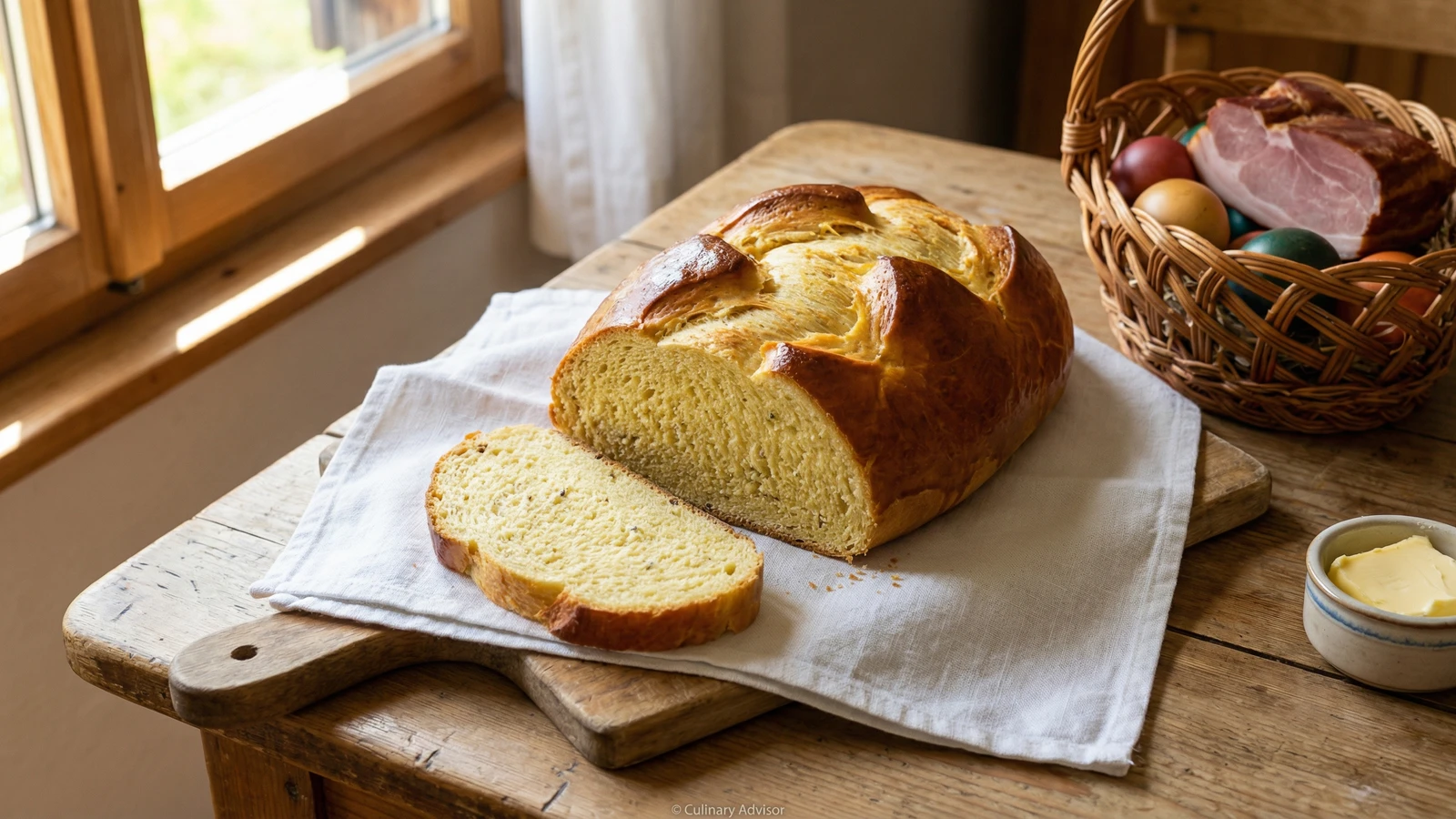
Styria's golden anise-scented Easter bread, cut three times for the Holy Trinity and carried to church in a linen-covered basket to be blessed before the family sits down to eat.
Every Easter, the Styrians bake Osterpinze. Not Osterzopf, not Striezel, not the braided breads you'll find in other parts of Austria. Pinze. A round, golden dome of enriched dough scented with anise, scored with three deep cuts across the top, and carried to church on Holy Saturday morning in a basket lined with a clean white cloth. Gretel always said the Osterjause was the meal that told you the most about a family. What went into the basket said everything: the Pinze, a piece of smoked ham, fresh horseradish root, dyed eggs, maybe a wedge of Osterkren (creamed horseradish). All of it blessed by the priest before it touched anyone's plate.
I remember the smell of anise filling my grandmother Eva's kitchen when she made this at Easter. It's a warm, faintly sweet scent that doesn't belong to any other season. The dough is rich with butter and eggs, softer than bread but sturdier than brioche. You knead it until it turns silky, let it rise in a warm place until it doubles, then shape it into a tall round and cut those three lines across the top. The cuts are the signature. They open during baking, pulling apart to reveal pale golden seams against the burnished crust.
Osterpinze is not complicated. It's an enriched yeast dough, and if you've ever made brioche or challah you already know the feel of this kind of baking. What makes it Austrian is the anise, the shape, and the purpose. This bread belongs to a specific morning, a specific table, a specific tradition. When you pull it apart at the Easter breakfast, still slightly warm, and eat it with cold ham and sharp horseradish, you understand why Styrians have been baking it for centuries.
Osterpinze originated in Styria and southern Austria, where the word 'Pinze' derives from the Latin 'pinza,' meaning to press or stamp, referring to the three characteristic cuts. The three-fold cut symbolizes the Holy Trinity and dates to at least the 17th century, when the tradition of the Fleischweihe (blessing of Easter foods) was already well established in Austrian parishes. The Osterjause, the Easter breakfast eaten after the Saturday blessing or Sunday morning mass, remains one of Austria's most carefully preserved food rituals, with regional variations across Styria, Carinthia, and the Salzburg countryside.
Quantity
500g
plus extra for dusting
Quantity
20g
Quantity
150ml
lukewarm
Quantity
80g
softened
Quantity
2 large plus 1 yolk
Quantity
60g
Quantity
1 teaspoon
Quantity
1.5 teaspoons
Quantity
1
zested
Quantity
1 tablespoon
Quantity
1
beaten with 1 tablespoon milk, for egg wash
| Ingredient | Quantity |
|---|---|
| plain flourplus extra for dusting | 500g |
| fresh yeast | 20g |
| whole milklukewarm | 150ml |
| unsalted buttersoftened | 80g |
| eggs | 2 large plus 1 yolk |
| granulated sugar | 60g |
| fine salt | 1 teaspoon |
| ground anise | 1.5 teaspoons |
| unwaxed lemonzested | 1 |
| rum (optional) | 1 tablespoon |
| egg yolkbeaten with 1 tablespoon milk, for egg wash | 1 |
Warm the milk until it's just lukewarm, about body temperature. If you dip your finger in and it feels neither warm nor cool, that's right. Crumble the fresh yeast into the milk with a pinch of the sugar and stir gently until dissolved. Let it sit for ten minutes until a thin foam appears on the surface. If nothing happens, your yeast is dead and you need to start with a new packet. Better to find out now than after you've mixed everything together.
Put the flour in a large bowl and make a well in the center. Pour in the yeast mixture, then add the eggs, egg yolk, remaining sugar, salt, ground anise, lemon zest, and rum if you're using it. Stir from the center outward, pulling flour into the wet ingredients gradually. When it forms a shaggy mass, turn it out onto a lightly floured surface.
Knead the dough for about ten minutes. It will feel sticky and heavy at first. Resist the urge to add more flour. After three or four minutes the gluten develops and the dough starts to come together under your hands. Now add the softened butter, a little at a time, working each piece in before adding the next. The dough will go slippery and resist you. Keep kneading. After another five minutes it should be smooth, elastic, and slightly tacky but no longer sticking to the surface. When you poke it, it should spring back slowly.
Shape the dough into a ball and place it in a lightly oiled bowl. Cover with a clean kitchen towel and set it somewhere warm and draught-free. The top of the fridge, a turned-off oven with the light on, a sunny windowsill. Let it rise until doubled in size. This takes about one and a half to two hours depending on the warmth of your kitchen. Don't rush it. The anise flavor deepens during a slow rise.
Punch the dough down gently and turn it out onto a lightly floured surface. Knead it briefly, just thirty seconds, to redistribute the air. Now shape it into a tall, tight round. You want height, not a flat disc. Tuck the edges under firmly, rotating the dough against the counter with cupped hands to build surface tension. The tighter the surface, the better it holds its shape during the second rise and in the oven. Place it on a baking sheet lined with parchment.
Using a very sharp knife or a razor blade, make three deep cuts across the top of the dough. Each cut should go about two centimeters deep, spaced evenly. These are the Dreierschnitt, the mark of the Holy Trinity. They're not decoration. They're the signature of the Osterpinze and they define how the bread opens and rises in the oven. Cover the shaped loaf loosely with a towel and let it prove for another forty-five minutes until puffy and risen by about half again.
Preheat your oven to 180°C (fan) or 190°C (conventional). Beat the egg yolk with a tablespoon of milk and brush the entire surface of the Pinze gently and evenly. Don't let the glaze pool in the cuts. Bake on the middle rack for thirty to thirty-five minutes until the crust is a deep, burnished gold and the bottom sounds hollow when you tap it. If the top darkens too quickly, tent it loosely with foil for the last ten minutes.
Let the Osterpinze cool on a wire rack for at least thirty minutes before slicing. The crumb needs time to set. If you cut into it straight from the oven it will be gummy and you'll think something went wrong when really you were just impatient. Serve it at the Osterjause with cold ham, horseradish, hard-boiled eggs, and butter. Pull it apart with your hands or slice it thick. Mahlzeit!
1 serving (about 97g)
Culinary guides, cultural storytelling, and the editorial depth that makes cooking meaningful.
Discover Culinary ExplorerChef Elsa
A rich, buttery braided bread that Austrian godfathers bring their godchildren on All Saints' Day. The golden six-strand braid is as much ritual as recipe, and the kitchen smells like love while it bakes.

Chef Elsa
Austria's rye sourdough farmhouse loaf, dark-crusted and tangy, laced with hand-crushed Brotgewürz, the kind of bread that fills a kitchen with the smell of caraway and makes everything else on the table taste better.
Chef Elsa
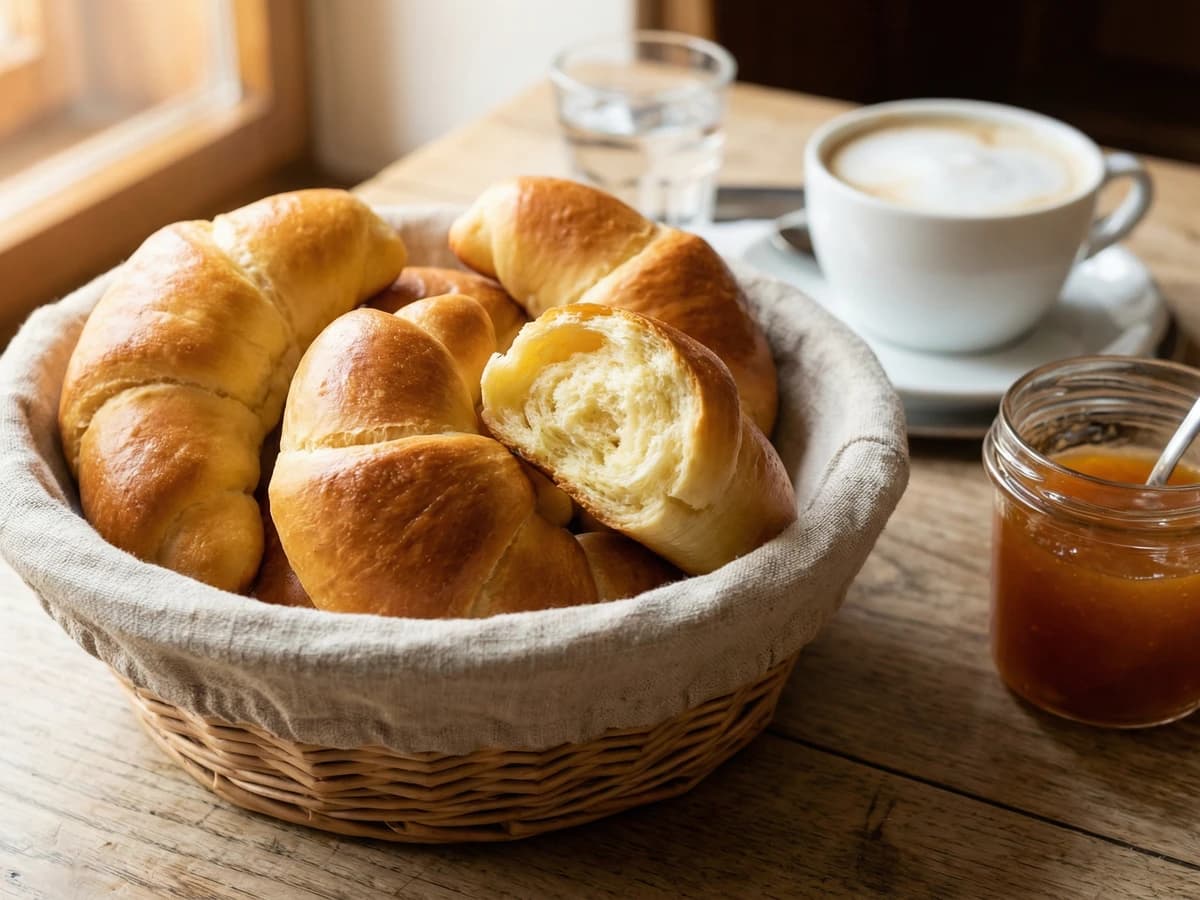
Buttery Viennese crescents, golden with egg wash and soft as a Sunday morning, shaped the way Viennese bakers have shaped them for eight hundred years.

Chef Elsa
Vienna's five-petaled imperial roll, hand-folded into a star and baked until the crust shatters at first touch, with a crumb so soft and airy it barely weighs a thing.