
Chef Graziella
Agnello al Forno con Patate
The Sunday lamb of Puglia, roasted with potatoes until they absorb every precious drop of rendered fat. In this dish, the potatoes become the reason you came to the table.
A cooking platform built around craft, culture, and the stories behind what we eat.

Created by
The pasta of Puglia, shaped one ear at a time by dragging semolina dough across a wooden board. No machine can replicate this texture. Your hands are the only tools that matter.
Orecchiette cannot be made by machine. I tell you this not to discourage you but to prepare you. The little ears of Puglia require your hands, a wooden board, and the patience to shape them one at a time. There are no shortcuts.
The women of Bari's old town still sit outside their doors shaping orecchiette, their hands moving with the speed of decades. You will not match their pace on your first attempt. You may not match it on your hundredth. This does not matter. What matters is that you learn the motion: press, drag, turn. The dough curls over your thumb and becomes an ear.
Semolina dough is different from the egg pasta of Emilia-Romagna. It is firmer, more resistant, and requires more water than you expect. The texture should be rough, almost sandy. This roughness is not a flaw. It is what makes orecchiette cling to sauce as no smooth pasta can. When you bite through a properly made orecchietta dressed with cime di rapa, you understand why Pugliese cooks have refused to abandon this shape for generations.
Orecchiette likely arrived in Puglia during the 12th or 13th century, possibly brought by Angevin rulers from Provence, where similar shapes existed. The women of Bari Vecchia transformed the shape into something distinctly Pugliese, passing the technique from mother to daughter. In the Strada delle Orecchiette, grandmothers still shape pasta on wooden boards set across doorways, selling their morning's work to neighbors.
Quantity
300g
Quantity
150ml, plus more as needed
Quantity
1/2 teaspoon
Quantity
as needed
| Ingredient | Quantity |
|---|---|
| semola di grano duro (fine semolina flour) | 300g |
| warm water | 150ml, plus more as needed |
| fine sea salt | 1/2 teaspoon |
| semolina for dusting | as needed |
Pour the semolina onto a wooden board or into a large bowl. Make a well in the center. Dissolve the salt in the warm water and pour it into the well. Using a fork, gradually incorporate the flour from the inner walls of the well into the liquid. When the mixture becomes too stiff to stir, begin kneading with your hands. The dough will feel dry and crumbly at first. This is correct. Continue kneading.
Knead the dough vigorously for 10 to 15 minutes. Push it away from you with the heel of your hand, fold it back, rotate it a quarter turn, and repeat. The dough should become smooth, firm, and slightly tacky but not sticky. If it remains too dry after 10 minutes and refuses to come together, add water one teaspoon at a time. If it sticks to your hands, dust with semolina. The finished dough should feel like a firm rubber ball.
Wrap the dough tightly in plastic wrap and let it rest at room temperature for 30 minutes. This relaxes the gluten and makes the dough easier to shape. Do not skip this step. Do not shorten it. The dough knows if you are impatient.
Cut the dough into four pieces. Keep the pieces you are not working with covered under an inverted bowl or damp towel. Roll one piece between your palms and the board into a rope about the thickness of your little finger, roughly one centimeter in diameter. The rope should be even in thickness. Uneven ropes make uneven orecchiette.
Using a butter knife or a bench scraper, cut the rope into small pieces approximately one centimeter wide. Each piece should be nearly a cube. Work in batches, cutting from one rope while you shape from another, so the cut pieces do not dry out.
This is the motion that defines orecchiette. Place one piece of dough on an unfloured wooden board. The wood should be bare and slightly rough. Press the tip of a butter knife or the rounded end of a table knife into the center of the dough piece. Press down firmly and drag the knife toward you in one smooth motion. The dough will curl around the knife, forming a small shell with a rough exterior surface. Remove the knife.
Take the curled shell and place it over your thumb. Push the center outward while curling the edges inward. The rough exterior surface should now be on the inside of the dome. This is the traditional orecchietta shape: a little ear with a rough inner surface that catches sauce. Place the finished orecchietta on a semolina-dusted tray. They should not touch each other.
Repeat with all remaining dough pieces. Your first orecchiette will be clumsy. By your twentieth, you will find a rhythm. By your fiftieth, the motion will feel natural. The shaped pasta can sit at room temperature for up to two hours before cooking, or be frozen on the tray and transferred to a bag once solid.
Bring abundant salted water to a vigorous boil. The water should taste of the sea. Add the orecchiette and stir immediately to prevent sticking. Fresh orecchiette cook in 3 to 5 minutes, depending on thickness. They are done when tender but still firm at the center, with pleasant resistance when you bite through. Drain, reserving a cup of pasta water for finishing with sauce.
1 serving (about 190g)
Culinary guides, cultural storytelling, and the editorial depth that makes cooking meaningful.
Discover Culinary ExplorerChef Graziella
The Sunday lamb of Puglia, roasted with potatoes until they absorb every precious drop of rendered fat. In this dish, the potatoes become the reason you came to the table.

Chef Graziella
The little hollowed shells of Puglia and Molise, shaped with nothing more than two fingers and a wooden board. The motion takes practice. The result catches sauce like nothing else.
Chef Graziella
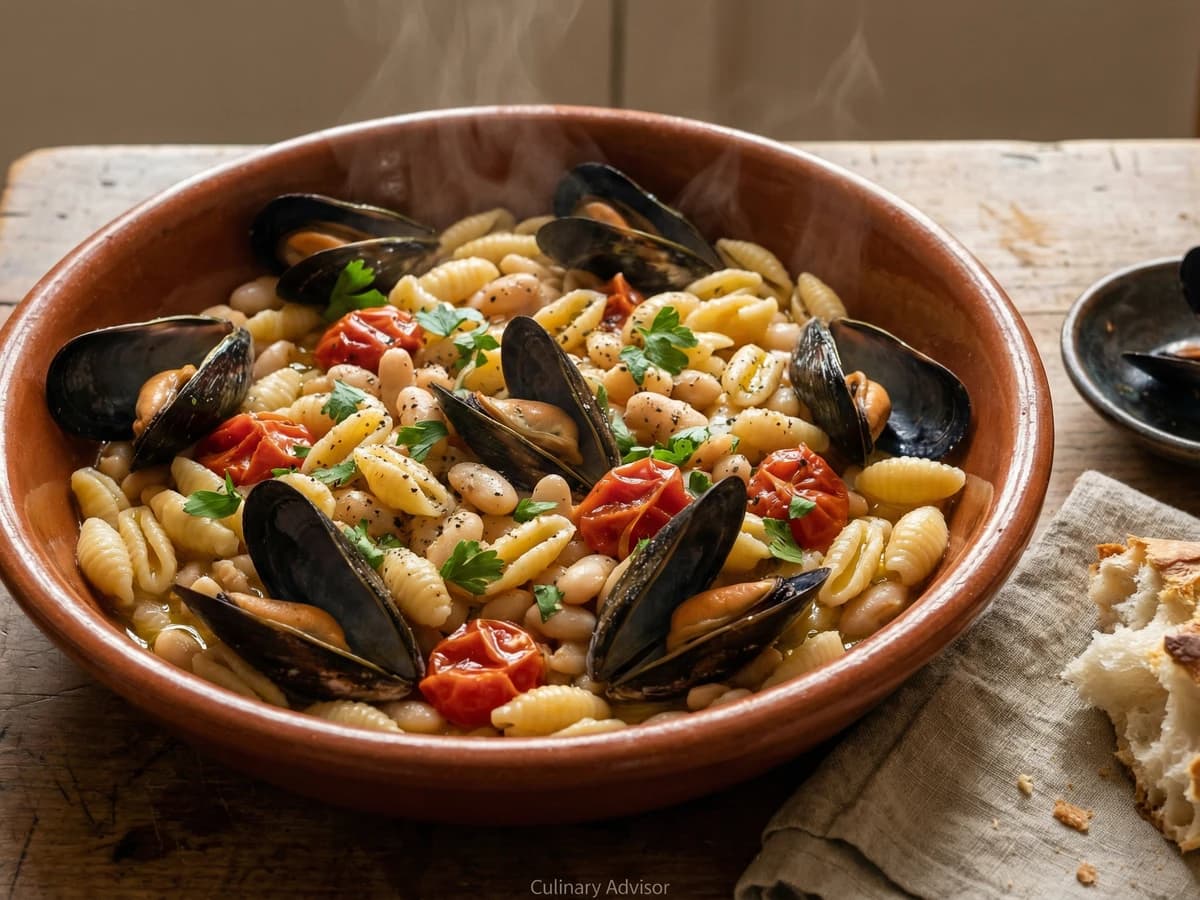
Where the Adriatic meets the wheat fields of Puglia: briny mussels, creamy cannellini, and chewy cavatelli dressed in nothing but good olive oil and the juice the shellfish surrender.

Chef Graziella
Puglia's beloved gratinated mussels, where briny shellfish meet a golden crust of breadcrumbs, pecorino, and parsley. Simple enough for a weeknight, impressive enough to close a dinner party.