Sardinia's ancient hand-rolled semolina pasta, toasted until golden brown to develop the nutty, almost bread-like flavor that makes it unlike any other pasta in the Italian repertoire.
Main Dishes
Italian, Sardinian
Weeknight
Date Night
45 min
Active Time
25 min cook•1 hr 10 min total
Yield1 pound (about 6 servings)
Fregola does not behave like other pasta. You do not roll it, cut it, or extrude it through bronze dies. You create it through an almost meditative process of sprinkling and circling, coaxing semolina and water into irregular pearls that you then toast until golden. The toasting is what sets fregola apart from every other pasta shape. It transforms simple semolina into something with depth and complexity, a nutty sweetness that emerges only through dry heat.
Sardinians have made fregola this way for centuries, long before the island became part of Italy. The technique resembles North African couscous, a reminder that Sardinia's history includes Phoenician traders and Arab merchants. But fregola is not couscous. It is larger, irregular, and crucially, it is toasted. That toasting changes everything.
The motion of the hand takes practice. You will not master it on your first attempt, and your pearls will be uneven. This is not failure. Uneven pearls are the mark of handmade fregola. The small ones toast darker, the large ones stay lighter, and when you cook them together, you get texture and interest that no factory can replicate. Simple does not mean easy.
Fregola predates Italian unification by many centuries, emerging from Sardinia's position at the crossroads of Mediterranean trade routes. Phoenicians, Carthaginians, and Arabs all influenced Sardinian cuisine, and the technique of forming grain into small spheres by hand clearly echoes North African couscous traditions. The crucial innovation was toasting, which allowed fregola to be stored through harsh island winters.
The technique, the tradition, and the story behind every dish.
•Large wide bowl (at least 14 inches diameter) or wooden board with raised edges
•Two large rimmed baking sheets
•Coarse sieve or colander (optional)
Instructions
1
Prepare the saffron water
Dissolve the salt in the warm water. If using saffron, crumble the threads into the water and let them steep for 10 minutes. The water should turn a deep gold. Traditional fregola from Sardinia often includes saffron, which grows wild on the island. You may omit it, but you will lose both color and a subtle floral note.
The water must be warm, not hot. Hot water will cook the semolina on contact, creating lumps instead of pearls. Aim for about 100°F, warm to the touch but not uncomfortable.
2
Create the work surface
Pour the semolina into a large, wide bowl or onto a large wooden board with a raised edge. Sardinian cooks use a scivedda, a wide terracotta basin. A large stainless steel bowl works adequately. The container must be wide enough for your hands to move freely in circular motions. Spread the semolina into an even layer.
3
Begin forming the pearls
Dip your fingers into the saffron water and sprinkle droplets over the semolina, flicking your fingers as you would to bless someone with holy water. Immediately begin moving your flattened hand in circular motions over the surface, pressing lightly. The wet semolina will begin to clump and roll into tiny balls. This is the technique. Sprinkle, circle, press. Sprinkle, circle, press.
4
Continue the rolling motion
Add water gradually, never pouring, always sprinkling. Keep your hand flat with fingers spread, moving in continuous circles. The pearls will form unevenly. Some will be the size of peppercorns, others like small peas. This irregularity is correct. It is what distinguishes handmade fregola from the uniform pellets sold in boxes. Work until all the water is incorporated and no dry semolina remains, about 15 to 20 minutes.
If the mixture becomes too wet, add more semolina a tablespoon at a time. If it remains too dry and will not form pearls, sprinkle a bit more water. The semolina should feel like damp sand that holds together when pressed.
5
Sieve for uniform size
Pass the fregola through a coarse sieve or colander to separate the formed pearls from any remaining loose semolina. The loose bits can be worked again with a few more drops of water. For a more traditional varied texture, skip this step entirely. Sardinian grandmothers did not fuss over uniformity.
6
Toast the fregola
Preheat your oven to 350°F (175°C). Spread the fregola pearls in a single layer across two large baking sheets. The layer should be thin enough that the pearls do not pile on top of each other. Bake for 10 minutes, then stir and rotate the pans. Continue baking until the pearls turn golden brown, with some darker than others. This takes 15 to 25 minutes total, depending on the size of your pearls and your oven.
Watch carefully after the first 15 minutes. The difference between golden and burnt is a matter of two minutes. The fregola should smell nutty and toasted, like good bread crust.
7
Cool and store
Remove from the oven and let the fregola cool completely on the baking sheets. It will crisp further as it cools. Once completely cold, store in an airtight container at room temperature. It keeps for several months, though it rarely lasts that long once you taste it.
8
Cook when ready to use
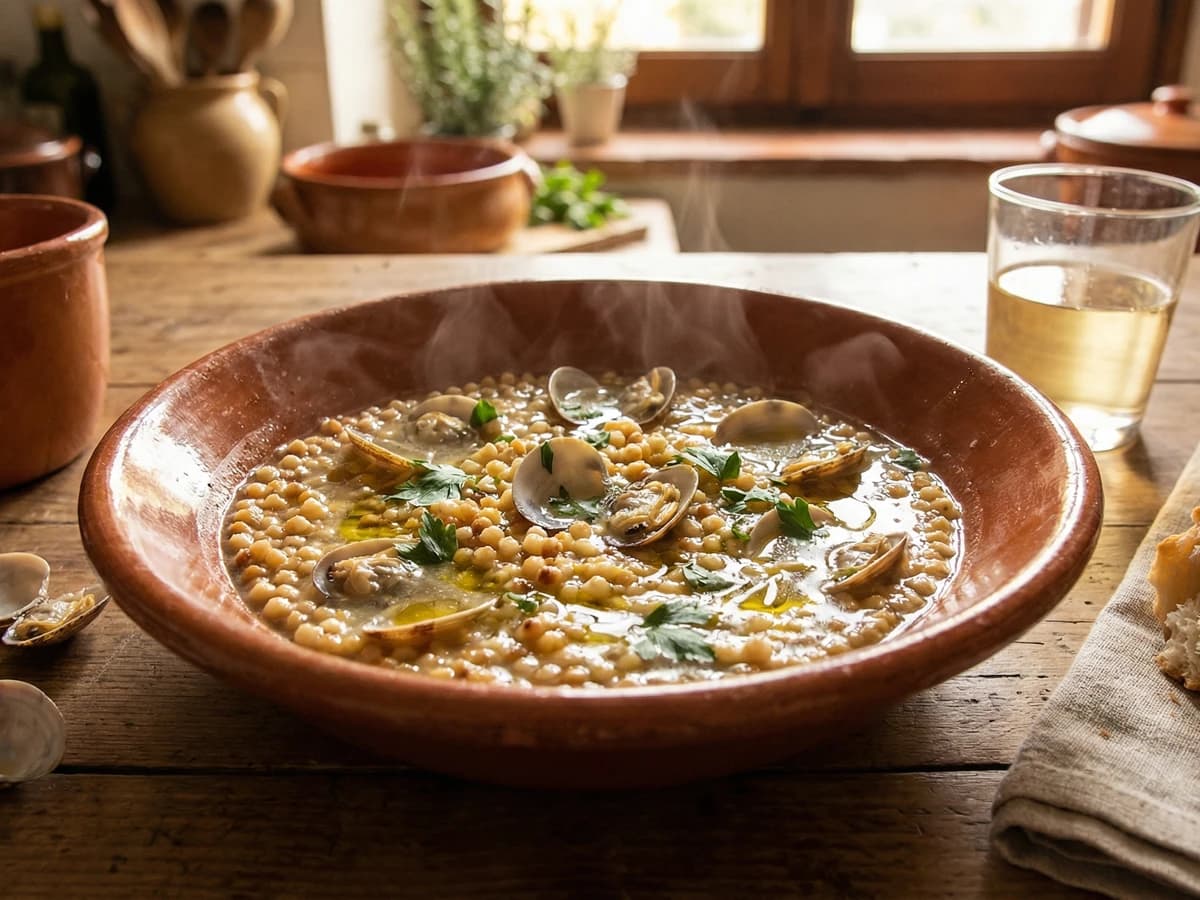
To cook fregola, treat it as you would risotto rice or boil it like pasta. For fregola risottata, toast it briefly in olive oil, then add hot broth gradually, stirring as it absorbs. For a simpler preparation, boil in well-salted water for 12 to 15 minutes until tender with pleasant resistance. The toasted flavor will perfume your kitchen.
Chef Tips
•Seek out semola rimacinata (twice-milled semolina) for finer, more delicate pearls. Coarser semolina produces a more rustic texture. Both are authentic.
•Saffron is traditional in much of Sardinia, where it has grown since the Phoenicians brought it. If you can find Sardinian saffron from San Gavino, use it. Otherwise, good Spanish saffron works well.
•The color variation after toasting is desirable. Some pearls will be pale gold, others amber, a few deep brown. This creates complexity when you cook and eat them.
•Store toasted fregola away from humidity. The toasted pearls absorb moisture from the air and will lose their crispness. A glass jar with a tight lid in a cool pantry is ideal.
Advance Preparation
•Fregola must be made ahead. It cannot be formed, toasted, and cooked in one session. Allow at least 2 hours for the pearls to dry slightly before toasting.
•Toasted fregola keeps in an airtight container for 3 months at room temperature. Make a large batch when you have time, and you will have it ready whenever you want it.
•Untoasted fregola can be dried overnight and toasted the following day if you prefer to break the work into sessions.
Frequently Asked Questions
Nutrition Information
1 serving (about 75g)
Calories
300 calories
Total Fat
1 g
Saturated Fat
0 g
Trans Fat
0 g
Unsaturated Fat
1 g
Cholesterol
0 mg
Sodium
190 mg
Total Carbohydrates
61 g
Dietary Fiber
3 g
Sugars
1 g
Protein
11 g
Where cooking meets culture.
Culinary guides, cultural storytelling, and the editorial depth that makes cooking meaningful.