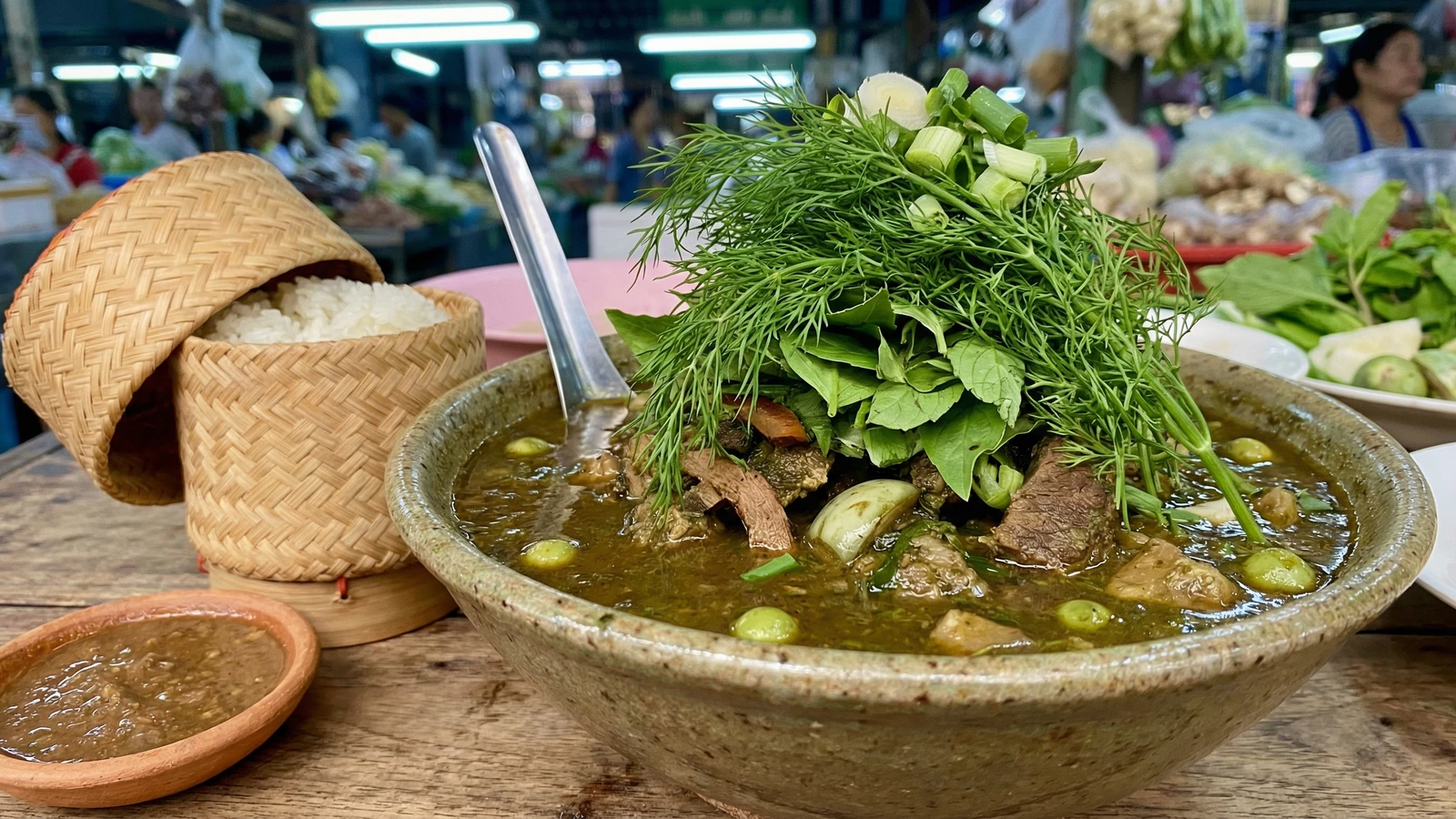
Sakhan pepper wood simmers in a thick, dark stew that follows no Central Thai rule. Padaek for funk, yanang for earth, dill by the fistful. This is Isan-Lao cooking on its own terms, and it will rewire everything you think you know about Thai food.
Soups & Stews
Thai
Special Occasion
Comfort Food
40 min
Active Time
1 hr 30 min cook•2 hr 10 min total
Yield4-6 servings
Forget the four pillars. Or lam doesn't play by Central Thai rules.
Ajarn always said Thai food is a system. He was right. But what he also taught me, and what most people miss, is that Thailand doesn't have one system. It has several. Isan operates under its own governing logic, and or lam is the dish that proves it. No coconut cream. No palm sugar sweetness. No sweet-sour balance. No tom yum aromatics. This is a water-based, herb-forward stew driven by padaek (ปลาแดก, fermented fish) and a piece of wood that numbs your tongue.
That wood is sakhan (สะค้าน, Piper ribesioides), a forest vine native to the Mekong corridor. You break it into pieces, drop it into the simmering broth, and it releases a slow, tingling numbness that sits behind every other flavor. It's not Sichuan peppercorn. It's not black pepper. It's its own thing entirely, and without it, you don't have or lam. You have beef stew with dill.
My mother's side is from Isan. She didn't cook or lam often in Bangkok because she couldn't get sakhan at Khlong Toei market. But when she did, when someone brought dried sakhan back from a trip upcountry, the whole kitchen changed. The pot went on, the padaek came out, the dill piled up on the cutting board. She'd simmer it for hours and the apartment smelled like the Mekong.
The kreung tam still exists here, but it's stripped down. Lemongrass, galangal, shallots, garlic, dried chilies. Pounded and added to the broth. No shrimp paste. The umami comes entirely from padaek, which delivers a different funk than nam pla. Deeper. Murkier. More alive. If you substitute fish sauce alone, you lose the soul of the dish. Padaek is the foundation. Do not skip it.
Then there's the dill. Pak chi lao (ผักชีลาว), literally "Lao coriander." In or lam, dill isn't a garnish. It's structural. You add fistfuls of it at the end, off the heat, and it defines the dish. The stew should smell like dill more than anything else when it hits the table. Yanang leaf extract (ใบย่านาง) gives the broth its dark green-brown color and an earthy, mineral quality that ties everything together. The eggplant breaks down and thickens the liquid into something closer to a gravy than a soup. This is a stew. It should coat a spoon.
Sticky rice only. Always. You tear off a piece, press it into the thick broth, scoop up meat and herbs. That's the design. Jasmine rice has no business here.
Or lam (ເອາະຫລາມ) originates in Luang Prabang, the ancient royal capital of Laos, where it's considered the city's signature dish. The stew likely predates any court refinement, rooted in village cooking that used foraged sakhan wood, game meat, and whatever grew along the Mekong. It crossed into Thailand's Isan region through the shared Lao-Isan cultural corridor, where Mekong River communities on both sides cook from the same tradition. Sakhan pepper wood (Piper ribesioides) is a wild-foraged vine found in the forests of northern Laos and upper Isan, and its numbing compound distinguishes or lam from every other stew in Southeast Asia.
The technique, the tradition, and the story behind every dish.
dried sakhan pepper wood (mai sakhan)about 4 inches long each
4-5 pieces
water
6 cups
shallots (hom daeng)peeled
6
garlic (kratiam)
8 cloves
dried red chilies (prik haeng)soaked in warm water 15 minutes
5
lemongrass (takhrai)lower 3 inches, sliced
3 stalks
galangal (kha)sliced
2-inch piece
padaek (fermented fish)liquid strained
3-4 tablespoons
yanang leaf extract (nam bai yanang)
1 cup
Asian eggplant (makheua yao)cut into 1-inch chunks
200g
pea eggplant (makheua phuang)stems removed
100g
wing beans (thua phu) or long beanscut into 2-inch pieces
100g
fish sauce (nam pla)for adjusting
1 tablespoon
fresh dill (pak chi lao)
3 large handfuls
lemon basil (maenglak)
1 handful
green onions (ton hom)cut into 2-inch lengths
4
sticky rice (khao niew)
for serving
Equipment Needed
•Heavy granite mortar and pestle (krok hin) for pounding the kreung tam
•Large heavy-bottomed pot or clay pot (mo din)
•Kratip sticky rice basket for serving
•Fine strainer for padaek liquid
Instructions
1
Prepare the sakhan wood
Break or snap the dried sakhan pepper wood into 3-4 inch pieces. Rinse under cold water to remove any dust. Set aside. These pieces go into the pot whole. They're not eaten. They simmer in the broth and release their numbing compound slowly. If you bite into one by accident, you'll know. Your whole mouth goes tingly. Think of sakhan like a bay leaf: it flavors the broth, then you work around it in the bowl.
Dried sakhan is available at Lao and Isan specialty grocers, or online. There is no real substitute. Some people suggest Sichuan peppercorn, but that's a different plant with a different numbing profile. If you can't get sakhan, acknowledge you're making a different dish. The wood is the soul of or lam.
2
Pound the kreung tam
In a heavy granite mortar (krok hin), pound the soaked dried chilies with the garlic and shallots until you get a rough, chunky paste. Not smooth. Isan pastes have texture. Add the lemongrass and galangal and pound again until everything is incorporated but still coarse. The aroma should be sharp and raw, heavy on the lemongrass and galangal. No shrimp paste in this one. The umami comes from padaek later. This kreung tam is pure aromatics.
This paste is simpler than a Central Thai curry paste. No shrimp paste, no coriander root, no peppercorns. Isan kreung tam follow different rules. Fewer ingredients, rougher texture, letting the fermented fish carry the depth.
3
Simmer the meat with sakhan
Bring the water to a boil in a heavy-bottomed pot or clay pot. Add the beef chunks and the sakhan wood pieces. Reduce to a steady simmer. Skim any foam that rises in the first few minutes. Let the meat and sakhan simmer together for 30 minutes. The broth will start to develop a faint tingling quality on your lips if you taste it. Good. That's the sakhan waking up. The meat should be tender but not falling apart yet. It has more time in the pot.
Buffalo meat (neua kwai) is traditional and has a deeper, gamier flavor than beef. If you can source it, use it. Venison or wild boar also work. Or lam is a forager's stew. Whatever the hunter brought home went in the pot.
4
Add the paste and padaek
Stir the pounded kreung tam directly into the simmering broth. Add the strained padaek liquid. Stir well. The broth will cloud and darken. Let this simmer for another 15 minutes so the paste cooks out its raw edge and the padaek integrates. Taste the broth now. It should be savory, funky, with that background tingle from the sakhan. If the padaek isn't strong enough, add more. This broth should have backbone. It shouldn't taste polite.
Padaek varies wildly in strength between brands and homemade batches. Start with 3 tablespoons, taste, and build. You want that deep fermented-fish funk that sits under everything else. If you can only find Thai pla ra, use it, but know that padaek from Lao producers tends to be thicker and more pungent.
5
Add yanang and eggplant
Pour in the yanang leaf extract. The broth will darken to a deep green-brown. This is correct. Yanang gives or lam its signature color and an earthy, almost mineral undertone that no other ingredient provides. Add the Asian eggplant chunks and the pea eggplant. Simmer for 20 minutes. The Asian eggplant will start breaking down and thickening the stew. This is the point. Or lam is a stew, not a soup. You want it thick enough to coat the back of a spoon. The pea eggplant stays intact and pops with a gentle bitterness when you bite into them.
Yanang leaf extract (nam bai yanang) is sold frozen or as a paste at Lao and Isan grocery shops. If using fresh yanang leaves, knead a handful of leaves in 1.5 cups of water, squeeze and strain the green liquid. There is no substitute that replicates yanang's earthy minerality. Without it, you lose half the character of the broth.
6
Add the beans and adjust
Add the wing beans or long beans to the pot. Simmer for another 10 minutes until the beans are tender but still have some bite. Taste the stew. Adjust with fish sauce if it needs more salt, or more padaek if it needs more depth. The stew should be thick, deeply savory, with that unmistakable sakhan tingle sitting behind every spoonful. The eggplant should have mostly dissolved into the broth. If it's too thin, simmer uncovered for a few more minutes to reduce.
7
Finish with herbs off heat
Kill the heat. This is the critical moment. Add the green onions, then pile in the fresh dill. Three fistfuls. It looks like too much. It's not. Dill is the defining herb of or lam. Toss gently to wilt the dill into the hot stew. Then add the lemon basil (maenglak), torn roughly. Stir once. The dill and basil should wilt but stay bright green. If you cook them, you've lost the fragrance. Cover the pot and let it rest for 3 minutes. When you lift the lid, the dill should hit you before anything else. That's how you know it's right.
Fresh dill is called pak chi lao (ผักชีลาว) in Thai, literally 'Lao coriander.' In Isan and Lao cooking, dill is structural, not decorative. If you're used to dill as a Western herb garnish, reset your thinking. Here it's a primary flavor. You want the stew to smell like dill first, everything else second.
8
Serve with sticky rice
Ladle into a communal bowl or individual bowls. The sakhan wood pieces should be visible as a warning: they're in there, work around them. Serve with sticky rice (khao niew) from a kratip basket. Tear off a piece of sticky rice, press it into the thick stew, scoop up meat and herbs. That's a bite. The glutinous rice absorbs the broth, the sakhan tingles, the dill floods your nose. This is Isan-Lao food at its most honest. Fai Thai, baby.
Chef Tips
•Sakhan pepper wood (mai sakhan, ไม้สะค้าน) is the ingredient that makes or lam what it is. It's a wild-foraged vine from the forests of northern Laos and upper Isan (Piper ribesioides), and it releases a slow, tingling numbness into the broth. It's not Sichuan peppercorn. It's not black pepper. There is no direct substitute. Search Lao grocery shops or online Southeast Asian ingredient suppliers. If you can't find it, make the stew and enjoy it, but know that you're missing the defining element.
•Padaek is not interchangeable with Central Thai fish sauce (nam pla). Both come from fermented fish, but padaek is thicker, funkier, and often still has pieces of fish and rice bran in it. Strain the liquid for or lam. The depth it provides is irreplaceable. Nam pla can supplement and adjust salt, but it can't replace the fermented backbone that padaek builds. Lao-produced padaek from brands available at Southeast Asian grocers is your best bet.
•The stew should be thick. This is not a soup. The eggplant (especially the Asian eggplant) is meant to break down during simmering and thicken the broth naturally. If your stew is still too thin after the eggplant has cooked, simmer uncovered to reduce. Some traditional versions add dried buffalo skin (nang kwai) for body and richness, slow-simmered until it becomes gelatinous. If you can source it, add it with the meat.
•Yanang leaf extract (nam bai yanang, น้ำใบย่านาง) is the dark green liquid that gives or lam and many Isan dishes their distinctive color. It tastes earthy and mineral, almost like liquid forest floor. Frozen yanang extract is available at well-stocked Lao and Isan grocers. No substitute captures that exact quality. If you absolutely cannot find it, the stew will still taste good, but it won't look or taste like or lam.
•Or lam improves with resting. After finishing with herbs, let the pot sit covered for 10-15 minutes before serving. The flavors consolidate and the sakhan continues to infuse. Leftovers are even better the next day, reheated gently, with a fresh handful of dill stirred in right before serving to restore the herb freshness.
Advance Preparation
•The kreung tam can be pounded a day ahead and refrigerated in a sealed container. The dried chilies should be soaked fresh on the day of cooking.
•Yanang leaf extract can be prepared a day ahead if using fresh leaves: knead and strain, then refrigerate the liquid.
•The stew base (meat with sakhan, paste, padaek, and eggplant) can be made the day before and refrigerated. Reheat gently and add fresh dill and lemon basil just before serving. The herbs must always be fresh and added off heat.
•Sticky rice should be soaked overnight (at least 4 hours) and steamed fresh before serving. It does not reheat well.
Frequently Asked Questions
Nutrition Information
1 serving (about 500g)
Calories
335 calories
Total Fat
18 g
Saturated Fat
7 g
Trans Fat
0 g
Unsaturated Fat
11 g
Cholesterol
90 mg
Sodium
1060 mg
Total Carbohydrates
14 g
Dietary Fiber
4 g
Sugars
3 g
Protein
29 g
Where cooking meets culture.
Culinary guides, cultural storytelling, and the editorial depth that makes cooking meaningful.