Culinary Explorer

A cooking platform built around craft, culture, and the stories behind what we eat.
Discover Culinary Explorer
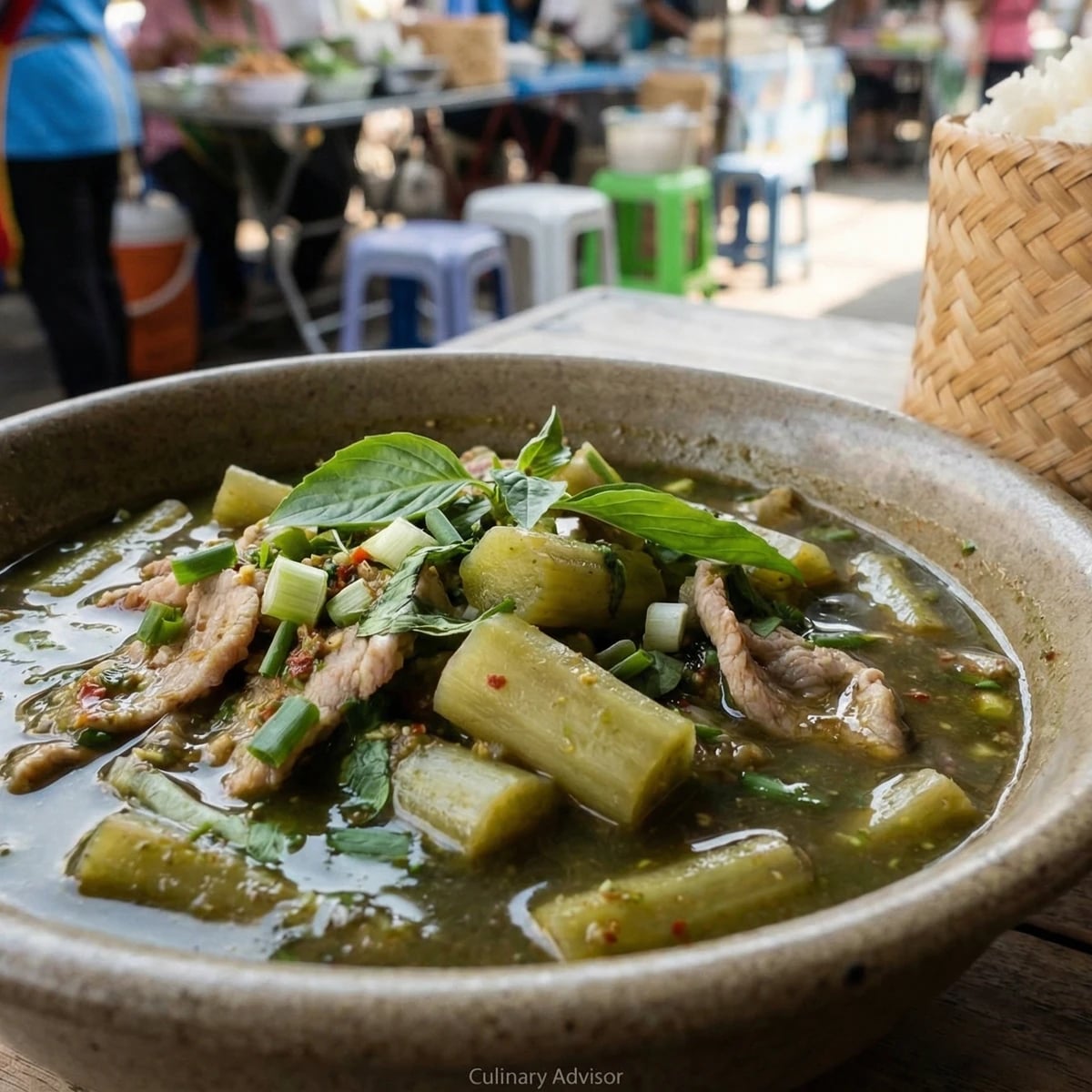
Isan Taro Stem Curry (Gaeng Bon / แกงบอน)

Isan Taro Stem Curry (Gaeng Bon / แกงบอน)

Created by

Isan foraging in a bowl: wild taro stems stripped of their sting, simmered in padaek broth with a pounded chili paste and yanang leaf extract. The land feeds you if you know the rules.

Main Dishes
Thai
Weeknight
Comfort Food
1 hr
Active Time
30 min cook1 hr 30 min total
Yield4 servings

Isan cooking follows a different governing system. I need you to hear that before we start. If you come to gaeng bon expecting Central Thai curry logic, coconut cream cracked in a wok, sweet-sour-salty-spicy in neat balance, you'll be lost. Isan curries are water-based, fermented-fish-driven, herb-forward. The foundation isn't coconut. It's padaek (ปลาแดก), the funky, deep, protein-fermented brine that is to Isan what nam pla is to Central Thailand. Don't substitute with fish sauce alone. Fish sauce gives you salinity. Padaek gives you salinity plus a month-long funk that sits in the back of your throat and makes everything around it taste like the earth it came from.

Gaeng bon is a foraging dish. Bon (บอน), taro stems, grow wild across Isan's rice paddies and waterways. They cost nothing. They feed families. But they carry a price if you don't know what you're doing: calcium oxalate crystals packed into every fiber. Eat them raw or undercooked and your mouth, throat, and hands will burn, itch, and swell. This isn't a minor discomfort. It's a real hazard. The preparation, peeling, soaking in salt water, boiling and discarding the water, is non-negotiable. This is the knowledge Isan grandmothers carry. The land feeds you, but only if you respect the rules.

The kreung tam is still everything here. Dried chilies, shallots, garlic, lemongrass, galangal, kapi. Pounded in the krok hin until the paste is fragrant and rough. That paste goes into water and yanang leaf extract (น้ำใบย่านาง), the dark green, mineral-rich liquid squeezed from yanang leaves that gives Isan curries their distinctive murky color and earthy backbone. Then padaek. Then the prepared taro stems. It simmers until the bon is tender and the broth has thickened slightly from the starch the stems release.

Ajarn always said principles are transferable across regions. The method changes, the ingredients shift, but the logic holds: a pounded paste, a primary salt source, aromatics, technique. Gaeng bon proves it. Different system, same discipline.

Gaeng bon belongs to the Isan and Lao foraging tradition, where wild and semi-wild plants form the backbone of daily cooking. Taro (Colocasia esculenta) grows in waterlogged paddies and canal edges across the Khorat Plateau, and the knowledge of neutralizing its calcium oxalate crystals through soaking and boiling is generational wisdom passed from mother to daughter, never written in cookbooks. The dish has no restaurant pedigree: it exists in village kitchens and roadside homes where cooking means using what the land provides, and where bitter, funky, and earthy are flavors to embrace, not correct.

The technique, the tradition, and the story behind every dish.

Discover Culinary Explorer

Ingredients

taro stems (bon / บอน)

Quantity

400g

peeled and cut into 2-inch pieces

coarse salt

Quantity

2 tablespoons

for soaking taro stems

dried red chilies (prik haeng)

Quantity

7

seeded and soaked in warm water 15 minutes

shallots (hom daeng)

Quantity

5

roughly sliced

garlic (kratiem)

Quantity

4 cloves

lemongrass (takhrai)

Quantity

2 stalks

lower third only, thinly sliced

galangal (kha)

Quantity

1-inch piece

thinly sliced

shrimp paste (kapi)

Quantity

1 tablespoon

pork shoulder or belly (optional)

Quantity

150g

thinly sliced against the grain

yanang leaf extract (nam bai yanang)

Quantity

2 cups

water

Quantity

3 cups

padaek (pla ra Isan) liquid

Quantity

3 tablespoons

strained through a fine sieve

fish sauce (nam pla)

Quantity

1 tablespoon

for adjusting

pea eggplants (makhuea phuang) (optional)

Quantity

1 handful

lightly crushed

spring onions (ton hom)

Quantity

2

cut into 1-inch pieces

lemon basil leaves (maenglak)

Quantity

1 large handful

sticky rice (khao niew)

Quantity

for serving

Equipment Needed

  • Heavy granite mortar and pestle (krok hin) for pounding the kreung tam
  • Large pot for boiling taro stems and building the curry
  • Fine-mesh sieve for straining padaek and yanang extract
  • Gloves for handling raw taro stems (recommended)

Instructions

  1. 1

    Prepare the taro stems

    This step is not optional. It is the difference between food and a trip to the hospital. Peel the taro stems, stripping away the tough outer skin to reveal the pale, spongy interior. Wear gloves if your skin is sensitive: the raw stems can irritate on contact. Cut into 2-inch pieces. Submerge the pieces in a large bowl of water with 2 tablespoons of coarse salt. Soak for at least 30 minutes. This begins drawing out the calcium oxalate crystals. Drain, rinse thoroughly, then transfer to a pot of fresh water. Bring to a rolling boil and cook for 10 minutes. Drain and discard the water. Rinse the stems again under cold water. Taste a tiny piece: it should feel clean on your tongue with no prickling or itching. If there's any irritation at all, boil again in fresh water for another 5 minutes. Only when the stems are completely neutral do you proceed.

    Isan grandmothers test bon by touching a small piece to the inside of their wrist or lip. If it prickles, it's not ready. This knowledge is how families have eaten wild taro safely for generations. Don't skip it. Don't rush it.
  2. 2

    Prepare yanang leaf extract

    If using fresh yanang leaves (bai yanang / ใบย่านาง), take about 30 leaves and knead them vigorously in 2 cups of water, squeezing and pressing until the water turns a deep, opaque green. Strain through a fine sieve, pressing out every drop. The liquid should look like dark green ink and smell earthy, mineral, almost vegetal. If using frozen yanang extract from an Asian market, thaw and use directly. This gives gaeng bon its signature murky green color and that distinctive Isan earthiness that no other ingredient replicates.

    Frozen yanang leaf extract is sold in bags at Isan and Lao grocery stores. If you can't find yanang at all, the curry will still work with just water, but it'll be a paler, thinner version. Yanang provides body, color, and a mineral quality that water alone cannot.
  3. 3

    Pound the kreung tam

    Start with the soaked, drained dried chilies in the granite mortar (krok hin). Pound to a rough paste. Add the garlic and shallots. Pound again until the shallots break down and their juice mixes with the chili. Add the lemongrass and galangal. These are fibrous and stubborn. Keep pounding until you can smell them sharply, the lemongrass citrus cutting through the chili heat. Finally add the kapi (shrimp paste) and pound until everything is integrated into a rough, fragrant paste. Not smooth. Isan pastes are rustic. You want texture, not puree.

    The kreung tam for Isan curries tends to be simpler and rougher than Central Thai curry pastes. No coconut to smooth things out, no richness to hide behind. The paste has to carry its weight in water-based broth, which means every ingredient needs to be properly pounded to release its oils.
  4. 4

    Build the broth

    Combine the water and yanang leaf extract in a large pot over medium-high heat. Bring to a boil. Add the kreung tam paste and stir to dissolve it into the liquid. The broth will turn a murky dark green with flecks of chili and herb visible throughout. If using pork, add it now. Let it simmer for 5 minutes until the pork is cooked through and the broth smells deeply herbal and funky.

  5. 5

    Add taro stems and simmer

    Add the prepared taro stems and pea eggplants (if using) to the broth. Reduce heat to a gentle simmer. Cook for 15 to 20 minutes, stirring occasionally, until the taro stems are completely tender and yielding. They should be soft but not falling apart. As they cook, the bon will release starch into the broth, thickening it slightly. This is the texture you want: a broth with body, not thin soup. Add the padaek liquid and fish sauce. Stir. Taste. The flavor should be savory and deep, with the padaek funk sitting underneath the herbal paste. Adjust with more padaek if it needs depth, more fish sauce if it needs clean salt.

    Padaek and fish sauce serve different roles here. Padaek is the foundation: fermented, funky, complex. Fish sauce is the adjustment tool: cleaner, sharper, for fine-tuning. Use padaek for the base layer. Use fish sauce to correct the finish.
  6. 6

    Finish with herbs and serve

    Remove the pot from heat. Add the spring onions and lemon basil (maenglak) in one big handful. Stir once to wilt the basil in the residual heat. The maenglak should still be bright green and fragrant when you ladle the curry into bowls. If it's gone dark, you left it too long. Serve immediately with sticky rice (khao niew). Not jasmine rice. Sticky rice. You tear off a piece, press it into a small ball, dip it into the broth, pinch some bon and pork, and eat. That's the design. The sticky rice is part of the dish, not a side.

Chef Tips

  • Calcium oxalate in taro stems is no joke. It causes intense itching and swelling of the mouth and throat. The Isan method of soaking in salt water followed by boiling in fresh water is the standard neutralization. Some cooks add a squeeze of lime or tamarind to the soaking water, which the acid helps break down the crystals faster. Always test a small piece before adding to the curry. If there's even a hint of prickling on your tongue, boil again.
  • Padaek (ปลาแดก) is not the same as Central Thai pla ra, though they're related. Padaek is the Isan fermented fish preparation: whole small fish layered with rice bran and salt, fermented for months. The liquid is strained and used. Do not substitute with fish sauce alone. Fish sauce gives you salinity. Padaek gives you salinity plus a deep, earthy fermentation funk that defines Isan cooking. Find it at Isan or Lao grocery stores, or online.
  • Yanang leaf extract (น้ำใบย่านาง) is the ingredient that separates Isan curries from everything else. It's made from the leaves of Tiliacora triandra, a climbing plant native to Southeast Asia. The extract provides a dark green color, an earthy minerality, and a subtle thickness to the broth. It's sold frozen in Southeast Asian markets. If you can find fresh leaves, knead them in water yourself. The freshly squeezed version is always better.
  • This curry is better the next day. The taro stems absorb more broth as they sit, and the padaek flavor deepens overnight. Reheat gently. Add the maenglak fresh when you serve, not the day before. Herbs go in at the end, always.

Advance Preparation

  • Taro stems can be fully prepared (peeled, soaked, boiled, rinsed) up to a day ahead. Store in fresh water in the refrigerator. Drain before using.
  • The kreung tam can be pounded a day ahead and stored in an airtight container in the refrigerator. The flavors will meld and intensify overnight.
  • Yanang leaf extract can be made fresh and refrigerated for up to 2 days, or use frozen extract directly.
  • Do not add lemon basil (maenglak) until you are ready to serve. It wilts and loses its fragrance within minutes. Always finish fresh.

Frequently Asked Questions

Nutrition Information

1 serving (about 400g)

Calories
140 calories
Total Fat
6 g
Saturated Fat
2 g
Trans Fat
0 g
Unsaturated Fat
4 g
Cholesterol
25 mg
Sodium
1400 mg
Total Carbohydrates
10 g
Dietary Fiber
3 g
Sugars
1 g
Protein
11 g

Note: Chef personas and recipes are created with AI assistance. Cook with care: follow safe food-handling practices, check doneness with a thermometer when needed, and adapt for allergies and your kitchen.

Where cooking meets culture.

Culinary guides, cultural storytelling, and the editorial depth that makes cooking meaningful.

Discover Culinary Explorer

More from Isan Soups, Curries & Stews

Browse the full collection