Culinary Explorer

A cooking platform built around craft, culture, and the stories behind what we eat.
Discover Culinary Explorer
Okinawa Oden (沖縄おでん)

Okinawa Oden (沖縄おでん)

Created by

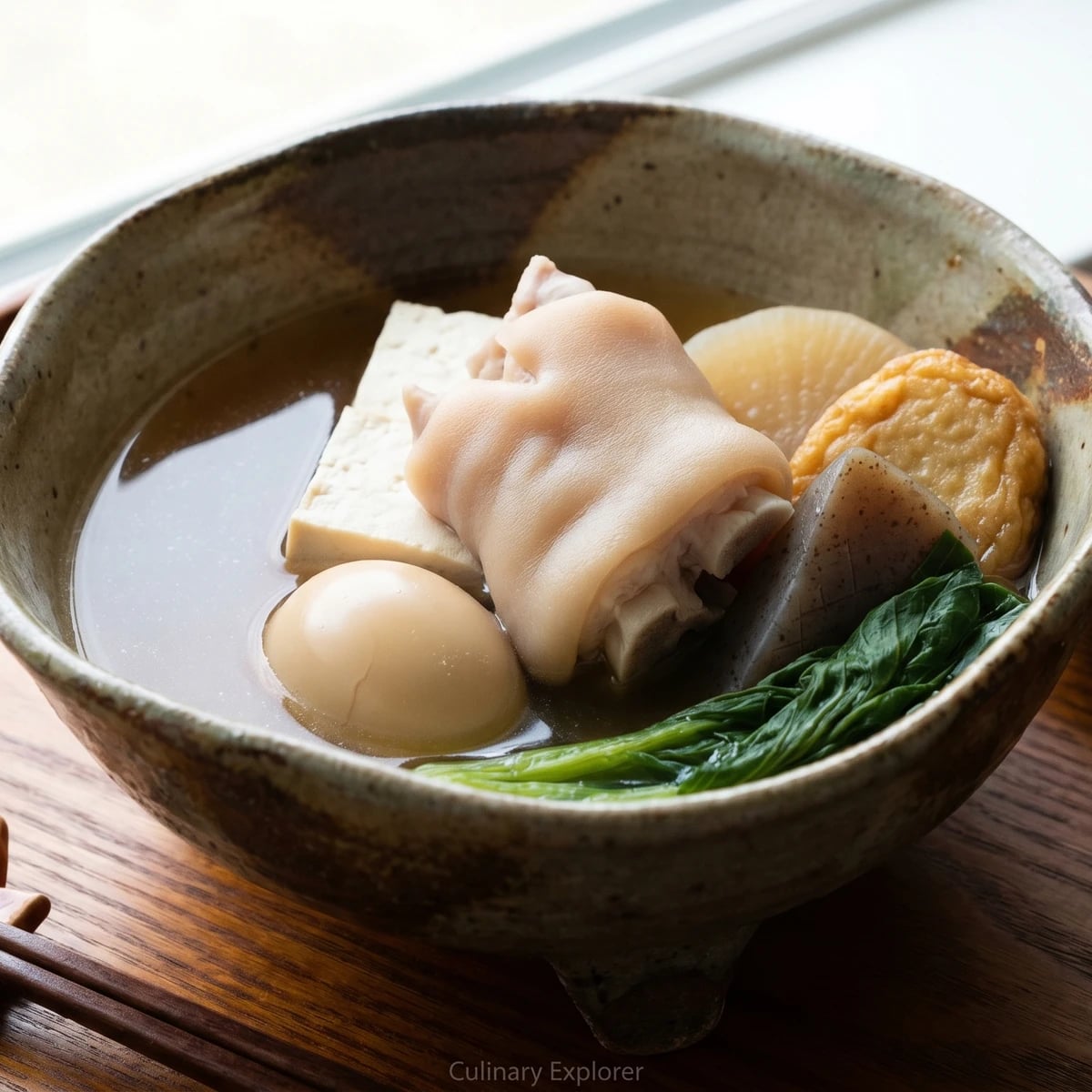
This is oden with Okinawan shoulders: porky but clear, tender with tebichi, brightened by katsuo, and finished with greens so the pot never feels heavy.

Soups & Stews
Japanese
Comfort Food
One Pot
Dinner Party
35 min
Active Time
3 hr 30 min cook4 hr 5 min total
Yield4 to 6 servings

Tebichi, pig's feet, frighten people more than they should. They look like a butcher's dare, but the cooking is plain: clean them well, simmer them quietly, and let time turn the collagen soft enough to give the broth body without making it muddy.

Okinawa oden is not the pale mainland pot many cooks know first. Here the broth carries pork bone and a little katsuo, light and porky at once, with daikon, konnyaku, tofu, egg, fish cake, and a handful of greens at the end. The greens matter. They keep the pot from becoming only richness, which is good cooking and also good manners.

The one detail that decides the dish is the first boil. Bring the tebichi and bones to a hard boil, drain them, then wash the pot and the meat before the real simmer begins. This isn't fuss. Blood and foam cloud the broth and give it a dull smell; rinse them away and the long cooking tastes clean. After that, the pot does the work. Japanese food is often less difficult than it is patient.

Serve it as we do with oden: each piece chosen from the pot, a little broth in the bowl, a dab of karashi if you like its bite. Leave the bowl room. A crowded oden looks like leftovers before anyone has eaten it.

Oden spread through Japan from Edo-period dengaku, skewered tofu or vegetables warmed and sauced, but each region remade the pot around local stock and ingredients. Okinawa's version reflects the islands' pork cookery, especially tebichi, and the strong place of katsuo in Ryukyuan and Okinawan broth culture. It is also closely tied to nighttime eating, served in bars and small restaurants as a final warm dish after drinking rather than only as a winter household stew.

The technique, the tradition, and the story behind every dish.

Discover Culinary Explorer

Ingredients

tebichi (pig's feet)

Quantity

900g

split lengthwise or cross-cut

pork neck bones or pork soup bones

Quantity

500g

cold water

Quantity

3 liters

plus more for blanching

konbu (dried kelp)

Quantity

1 piece (about 10g)

katsuobushi (bonito flakes)

Quantity

25g

daikon

Quantity

1 large (about 700g)

peeled and cut into thick rounds

hard-boiled eggs

Quantity

4

peeled

firm tofu

Quantity

1 block (about 350g)

drained and cut into 6 pieces

konnyaku

Quantity

1 block (about 250g)

satsuma-age or other Japanese fried fish cake

Quantity

4 to 6 pieces

awamori or sake

Quantity

2 tablespoons

usukuchi shoyu (light soy sauce)

Quantity

3 tablespoons

plus more to taste

regular soy sauce

Quantity

1 tablespoon

mirin

Quantity

1 tablespoon

sugar

Quantity

1 teaspoon

sea salt

Quantity

1 1/2 teaspoons

plus more to taste

shima-nā or mustard greens

Quantity

1 bunch

trimmed

karashi mustard (optional)

Quantity

for serving

Equipment Needed

  • Large heavy pot
  • Fine-mesh strainer lined with a clean cloth
  • Wooden drop-lid (otoshibuta), or a circle of parchment
  • Tongs or chopsticks for lifting tender tebichi

Instructions

  1. 1

    Blanch the pork

    Put the tebichi and pork bones in a large pot and cover them with cold water. Bring to a hard boil and let it roll for 5 minutes, until gray foam rises and the water looks unpleasant. Drain, rinse each piece under warm water, and scrub the pot clean before continuing. This first boil removes blood and loose protein, so the finished broth tastes clean instead of barnyard-heavy.

  2. 2

    Start the broth

    Return the washed tebichi and bones to the clean pot with 3 liters cold water and the konbu. Bring it up slowly over low to medium heat. When the water trembles and small bubbles climb the sides, lift out the konbu. Boiling konbu gives bitterness and a slick edge, and this broth already has pork for weight. We want clarity, not heaviness.

    Wipe konbu with a damp cloth if it looks dusty, but don't wash it. The pale powder on the surface is flavor.
  3. 3

    Simmer the tebichi

    Bring the pot to the gentlest simmer, skim any foam that appears, then add the awamori or sake. Cook partly covered for 2 to 2 1/2 hours, keeping the surface barely moving. A hard boil breaks fat into the broth and makes it cloudy; a quiet simmer melts the collagen until the tebichi turns tender and the broth gains body without losing its clean taste.

  4. 4

    Add katsuo

    When the tebichi is tender enough that a chopstick meets little resistance, turn off the heat. Add the katsuobushi all at once and leave it for 3 minutes, no stirring. Strain the broth through a fine sieve or cloth into a clean pot, then return the tebichi to the broth and discard the bones and flakes. Let the bonito drip on its own. Squeezing presses harsh, oily flavors into the stock, which is a poor reward for impatience.

  5. 5

    Prepare the vegetables

    While the pork simmers, boil the daikon rounds in plain water for 15 to 20 minutes, until a skewer enters but the centers still feel firm. Drain them. Parboiling daikon keeps its raw sharpness from taking over the oden broth, and it helps the seasoning enter evenly later.

  6. 6

    Treat the konnyaku

    Score the konnyaku lightly in a shallow crosshatch, cut it into triangles, and boil it in plain water for 3 minutes. Drain well. This removes its alkaline smell and roughens the surface a little, so it carries broth instead of sitting in the pot like a polite rubber eraser.

  7. 7

    Season the pot

    Add the usukuchi shoyu, regular soy sauce, mirin, sugar, and salt to the strained pork-katsuo broth. Taste it before the other ingredients go in. It should be gently salty, not strong, because the daikon, tofu, eggs, and konnyaku will sit in it and drink slowly. Add the daikon, eggs, tofu, konnyaku, and fish cakes.

  8. 8

    Set the oden

    Rest a wooden drop-lid, otoshibuta, on the surface, or use a circle of parchment with a small hole in the center. Simmer very gently for 45 minutes, then turn off the heat and let the pot rest 30 minutes if you have the time. The drop-lid keeps the pieces submerged without stirring, and the rest is when the seasoning settles into the center of the daikon and eggs.

  9. 9

    Finish with greens

    Just before serving, bring the pot back to a gentle simmer and add the shima-nā or mustard greens. Cook only 2 to 3 minutes, until the leaves turn deep green and tender. Add them early and they lose their color and become tired; add them at the end and the whole pot wakes up.

  10. 10

    Serve simply

    Place one piece of tebichi, a daikon round, tofu, egg, konnyaku, fish cake, and greens into each bowl, then ladle over enough broth to shine around them. Serve karashi mustard on the side. Don't flood the bowl and don't pile it high. Oden is chosen piece by piece, and each one deserves room.

Chef Tips

  • Ask the butcher for split pig's feet if you can. Split tebichi gives up collagen more evenly and becomes tender sooner; whole pieces work, but they ask for more time.
  • If the broth tastes flat, add a little more katsuo-rich dashi or salt in small amounts. Don't darken it with too much soy sauce. Okinawa oden should taste porky and clear, not like a soy stew.
  • Use shima-nā if you can find it. Komatsuna or mustard greens are sensible stand-ins, but spinach is too soft for the pot and turns weary before the tebichi is ready.
  • Oden improves after resting. The daikon and eggs take seasoning slowly, like students who pretend not to listen and then remember everything.
  • Karashi is a condiment, not a blanket. A small dab beside the bowl gives bite without hiding the broth.

Advance Preparation

  • Blanch the pork and simmer the pork-katsuo broth one day ahead. Chill it overnight, then lift off any set fat from the surface before seasoning the oden.
  • The completed oden can be made several hours ahead and rested off the heat. Rewarm it gently so the broth stays clear and the tofu doesn't toughen.
  • Add the greens only just before serving. Their color and clean bitterness are best when fresh.

Frequently Asked Questions

Nutrition Information

1 serving (about 850g)

Calories
560 calories
Total Fat
32 g
Saturated Fat
10 g
Trans Fat
0 g
Unsaturated Fat
22 g
Cholesterol
260 mg
Sodium
2050 mg
Total Carbohydrates
18 g
Dietary Fiber
5 g
Sugars
8 g
Protein
49 g

Note: Chef personas and recipes are created with AI assistance. Cook with care: follow safe food-handling practices, check doneness with a thermometer when needed, and adapt for allergies and your kitchen.

Where cooking meets culture.

Culinary guides, cultural storytelling, and the editorial depth that makes cooking meaningful.

Discover Culinary Explorer