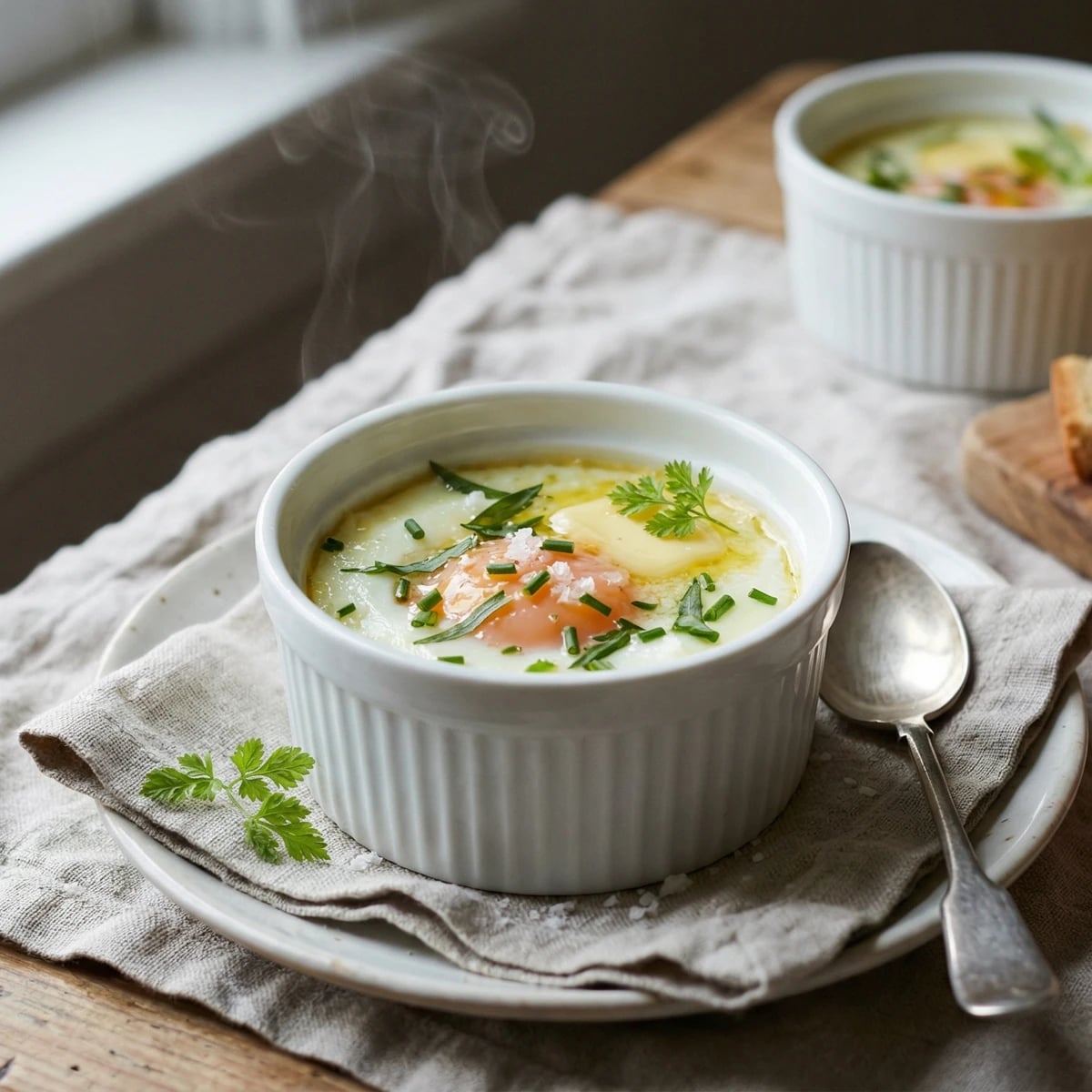
Eggs gently baked in butter and crème fraîche, the whites barely set, the yolks still trembling, finished with a scatter of herbs that taste like the garden on a spring morning.
Breakfast & Brunch
French
Weeknight
Special Occasion
10 min
Active Time
15 min cook•25 min total
Yield4 servings
Start with the eggs. They should come from hens that live outside, scratch in the dirt, and eat what chickens are meant to eat. You will know them by their yolks: deep orange, almost sunset-colored, standing proud in the shell. These eggs have aliveness. They taste like something.
Oeufs cocotte is French home cooking at its most honest. You butter a small dish, crack in an egg, add a spoonful of crème fraîche, and bake it in a water bath until the white just sets and the yolk stays liquid. That is the whole technique. When the ingredient is right, you get out of the way.
The herbs matter as much as the eggs. Snip them moments before serving. Chives, tarragon, chervil, parsley: the classic fines herbes of French cooking. If you grow even one pot of herbs on a windowsill, you understand why fresh ones cannot be replaced by dried. The oils are volatile. The fragrance is fleeting. Cut them and use them while they are still alive.
The technique, the tradition, and the story behind every dish.
Preheat your oven to 375°F. Generously butter the inside of four six-ounce ramekins using your fingers. Do not skimp here. The butter creates a silky base and helps the cooked egg release. Set the ramekins in a baking dish deep enough to hold water halfway up their sides.
Room temperature butter spreads more evenly than cold. Let it sit on the counter for twenty minutes before you begin.
2
Add crème fraîche base
Spoon one tablespoon of crème fraîche into the bottom of each buttered ramekin. Spread it gently with the back of the spoon to cover the base. This layer insulates the egg from direct heat and adds richness without heaviness.
3
Crack in the eggs
Crack one egg into each ramekin, letting it settle onto the crème fraîche. Work carefully. A broken yolk is still delicious, but the drama of cutting into that liquid center is half the pleasure. Season each egg with a pinch of flaky salt and a grind of pepper.
Crack each egg into a small bowl first, then slide it into the ramekin. This gives you control and catches any stray shell.
4
Set up the water bath
Place the baking dish on the pulled-out oven rack. Pour hot tap water into the dish until it reaches halfway up the sides of the ramekins. The water bath, called a bain-marie, surrounds the eggs with gentle, even heat. It is the difference between silky and rubbery.
5
Bake until just set
Bake for 12 to 15 minutes, watching carefully after 10 minutes. The whites should be opaque and barely set, with a thin film forming over the yolk that still jiggles when you shake the ramekin. Every oven is different. Trust what you see, not the clock.
The eggs continue cooking after they leave the oven. Pull them when they look slightly underdone. They will be perfect by the time you carry them to the table.
6
Finish with herbs
Lift each ramekin from the water bath with a dry towel. Scatter the fresh herbs over each egg while it is still hot, so the warmth releases their fragrance. A final pinch of flaky salt. Serve immediately on small plates with toast soldiers for dipping.
Chef Tips
•Seek out eggs from a farmer you can talk to. Ask what the hens eat, how they live. The difference in the yolk tells the whole story.
•If you cannot find crème fraîche, heavy cream works, though the flavor is less complex. Sour cream is too tangy for this gentle dish.
•Grow your own fines herbes in a windowsill pot. Even in winter, a small harvest of chives and parsley transforms a simple egg into something memorable.
•These eggs wait for no one. Gather everyone at the table before you pull the ramekins from the oven.
Advance Preparation
•Butter the ramekins up to a day ahead and refrigerate, covered. Bring to room temperature before using.
•Wash and dry herbs, then wrap loosely in damp paper towels and refrigerate for up to two days. Snip just before serving.
Frequently Asked Questions
Nutrition Information
1 serving (about 85g)
Calories
230 calories
Total Fat
22 g
Saturated Fat
12 g
Trans Fat
0 g
Unsaturated Fat
9 g
Cholesterol
235 mg
Sodium
380 mg
Total Carbohydrates
1 g
Dietary Fiber
0 g
Sugars
0 g
Protein
7 g
Where cooking meets culture.
Culinary guides, cultural storytelling, and the editorial depth that makes cooking meaningful.