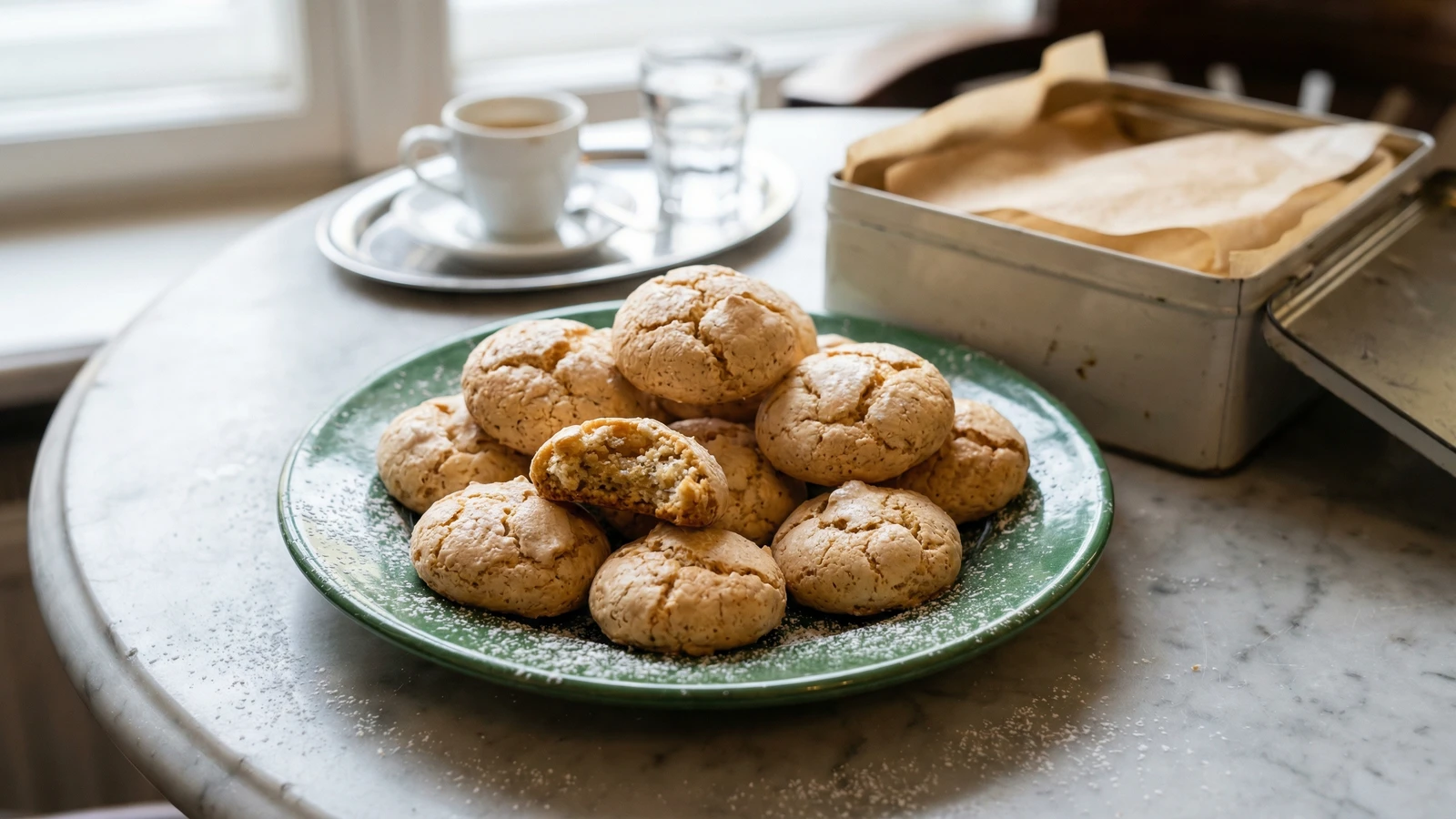
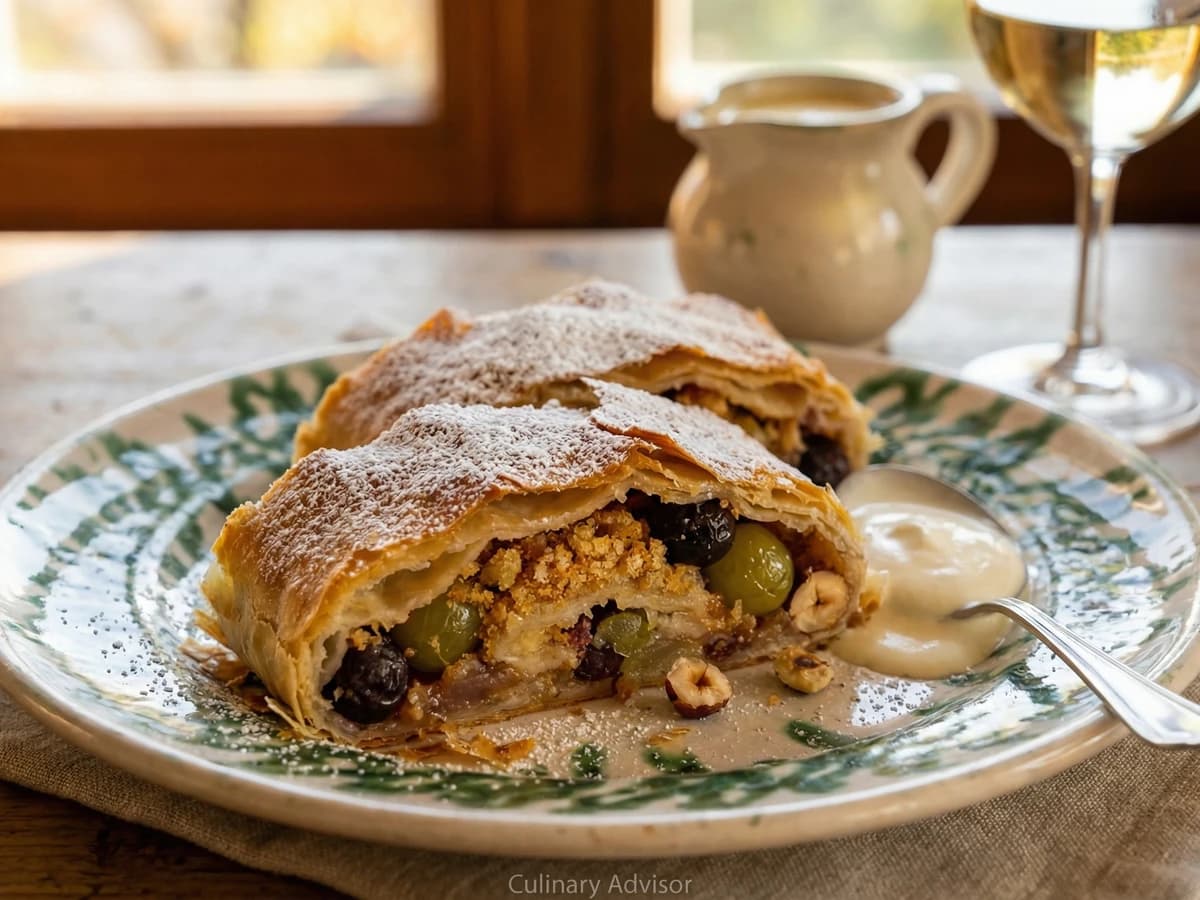
Roasted hazelnut meringue kisses baked on Oblaten wafers, the Austrian Christmas cookie that disappears from the plate before you've finished arranging the rest of the Kekse.
Pastries & Cookies
Austrian
Christmas
Holiday
Make Ahead
30 min
Active Time
20 min cook•50 min total
Yield30-36 cookies
Every December in my grandmother Eva's kitchen in Kent, the Weihnachtsbäckerei began. Gretel would arrive with her notebooks and her opinions, and the two of them would take over the kitchen for a full weekend. Vanillekipferl first, then Linzer Augen, then Lebkuchen if they were feeling ambitious. But the cookie I stole from the cooling rack before anyone could stop me, every single year, was the Nussbusserl.
Nussbusserl are hazelnut meringue kisses baked on thin Oblaten wafers. The mixture is nothing more than egg whites, sugar, and roasted ground hazelnuts, warmed together over a Wasserbad until the sugar dissolves and the whole thing turns thick and glossy. You pipe or spoon small mounds onto the wafers, press a whole hazelnut into each peak, and bake them low and slow. What comes out is something between a macaroon and a meringue: chewy in the center, with a thin shell that cracks when you bite through it, and a roasted nut flavor so deep it fills the room.
The Oblaten are part of the tradition, not decoration. Those thin wafer rounds keep the soft meringue from sticking to the baking sheet and give the bottom a quiet crunch that plays against the chewiness above. You can find them at Austrian specialty shops or online. If you can't, use baking parchment, but I'd encourage you to track down the real thing. Gretel always said the Oblaten make the Busserl, and after thirty years of baking them I still agree with her.
Busserl comes from the Austrian dialect word for 'little kiss,' and Nussbusserl appear in Viennese and Salzburg baking traditions dating to the 18th century, when the Weihnachtsbäckerei became a serious domestic ritual across the Habsburg lands. Oblaten, the thin unleavened wafers used as bases, descend from the communion wafers produced in monastery bakeries. Austrian home bakers adopted them for Lebkuchen and Busserl because the wafers solved the practical problem of sticky, high-sugar mixtures clinging to baking sheets. The tradition of baking dozens of different Kekse varieties for Christmas, often starting weeks in advance, remains one of the most deeply held customs in Austrian domestic life.
The technique, the tradition, and the story behind every dish.
Spread the hazelnuts on a baking tray and roast them at 170°C for ten to twelve minutes, shaking the tray once halfway through. You're looking for golden brown, not dark. The skins will crack and the kitchen will smell extraordinary. While they're still warm, rub them in a clean tea towel to remove as many loose skins as you can. Don't obsess over every last flake. Let them cool completely, then grind them fine in a food processor. You want a sandy, slightly oily texture, not paste. Pulse in short bursts and stop before the oils release too much.
Roasting the hazelnuts yourself makes all the difference. Pre-ground hazelnuts from a bag have lost most of their volatile oils. If you can smell the nuts across the kitchen while they roast, that's the flavor going into your Busserl.
2
Warm the egg whites and sugar
Set a heatproof bowl over a pot of gently simmering water. The bowl should not touch the water. Combine the egg whites, powdered sugar, and Vanillezucker in the bowl and whisk constantly with a hand whisk or electric beaters. You're dissolving the sugar and warming the whites, not cooking them. Keep whisking until the mixture reaches about 50°C, roughly when it feels noticeably warm against your finger and the sugar has completely dissolved. This takes four to five minutes. The mixture will turn thick, white, and glossy, like a soft marshmallow cream.
The warm method is what sets Nussbusserl apart from ordinary meringue cookies. Dissolving the sugar over heat creates a denser, chewier texture that holds up for weeks in a tin. If you skip this step and just whip cold whites, you'll get a cookie that's too dry and too fragile.
3
Fold in the nuts and spices
Remove the bowl from the heat. Fold in the ground roasted hazelnuts, lemon zest, cinnamon, and the pinch of ground cloves. Use a large spatula and work gently. The mixture will become thick and heavy, almost like a soft dough. You'll feel the warmth of the nuts releasing their oils into the meringue. That's exactly right. Don't stir it into submission. Fold until just combined, keeping as much air as you can.
4
Pipe onto the Oblaten
Preheat your oven to 150°C. Lay the Oblaten wafers on baking trays lined with parchment. Spoon the mixture into a piping bag fitted with a large round tip (about 1.5cm) and pipe small peaked mounds onto each wafer, filling to just inside the edge. If you don't have a piping bag, use two teaspoons to shape small mounds. The tops should come to a soft point, a little kiss. Press a whole blanched hazelnut gently into the peak of each one. Don't push it down flat. Let it sit there proudly.
If the mixture stiffens too much to pipe, warm your hands around the piping bag for a moment. The heat from your palms will soften it enough to work with.
5
Bake low and slow
Bake at 150°C for 18 to 20 minutes. The Busserl should develop a thin, dry shell on the outside while staying soft and slightly sticky inside. They'll feel set to the touch but give a little when you press gently. The tops will be pale gold, not brown. If they're coloring too fast, your oven is too hot. Drop it by ten degrees and give them a few more minutes. Remove from the oven and let them cool completely on the tray. They firm up as they cool, and the texture you're after, that crackly shell over the chewy hazelnut center, only arrives once they've rested.
6
Store and serve
Let the Busserl cool completely, then store them in a tin lined with baking parchment, layers separated by more parchment. They actually improve after two or three days as the flavors deepen and the chew softens. Serve them on a cookie plate alongside the rest of your Weihnachtsbäckerei, or box them up as a gift. They keep for three weeks in a sealed tin at room temperature, though I've never met a tin that lasted that long. Mahlzeit!
Chef Tips
•Buy your hazelnuts whole and in the shell if you can find them, or at least whole with skins on. The pre-blanched, pre-ground bags have been sitting in warehouses losing flavor. You want nuts that smell like nuts when you crack them open.
•Use real Vanillezucker, not vanilla extract. Austrian baking depends on vanilla sugar for a rounded, gentle sweetness that extract can't replicate. Keep a jar of caster sugar with a split vanilla pod buried in it. Refill the sugar as you use it. Gretel always had one going and so do I.
•The pinch of ground cloves is barely perceptible, but it's what lifts the hazelnut flavor into something more complex. Leave it out and the Busserl taste flat. Add too much and they taste like a candle shop. A pinch. Truly a pinch.
•If you can't find Oblaten, use baking parchment as a base, but know that the wafer contributes a quiet crunch at the bottom that parchment can't give you. Austrian or German online shops carry Oblaten, and they keep for months in the cupboard.
•These are perfect make-ahead Christmas cookies. Bake them in the first week of December and they'll be at their best by Christmas Eve. The chewy center actually needs those days in the tin to come into its own.
Advance Preparation
•Hazelnuts can be roasted and ground up to three days ahead. Store in an airtight container at room temperature.
•The finished Busserl improve after two to three days in a sealed tin and keep for up to three weeks. This makes them ideal for the Austrian tradition of baking Christmas cookies in stages throughout December.
•The Oblaten wafers keep indefinitely in a dry cupboard. Stock up when you find them.
Frequently Asked Questions
Nutrition Information
1 cookie (about 18g)
Calories
90 calories
Total Fat
6 g
Saturated Fat
1 g
Trans Fat
0 g
Unsaturated Fat
5 g
Cholesterol
0 mg
Sodium
10 mg
Total Carbohydrates
9 g
Dietary Fiber
1 g
Sugars
7 g
Protein
2 g
Where cooking meets culture.
Culinary guides, cultural storytelling, and the editorial depth that makes cooking meaningful.