
Chef Dimitra
Agrafa Batzina (Μπατζίνα), Courgette and Feta Pie
Agrafa's batzina is the no-phyllo pie of Karditsa: grated courgette, feta, eggs, milk, and flour poured thin into a hot oiled tapsi.
A cooking platform built around craft, culture, and the stories behind what we eat.
Created by
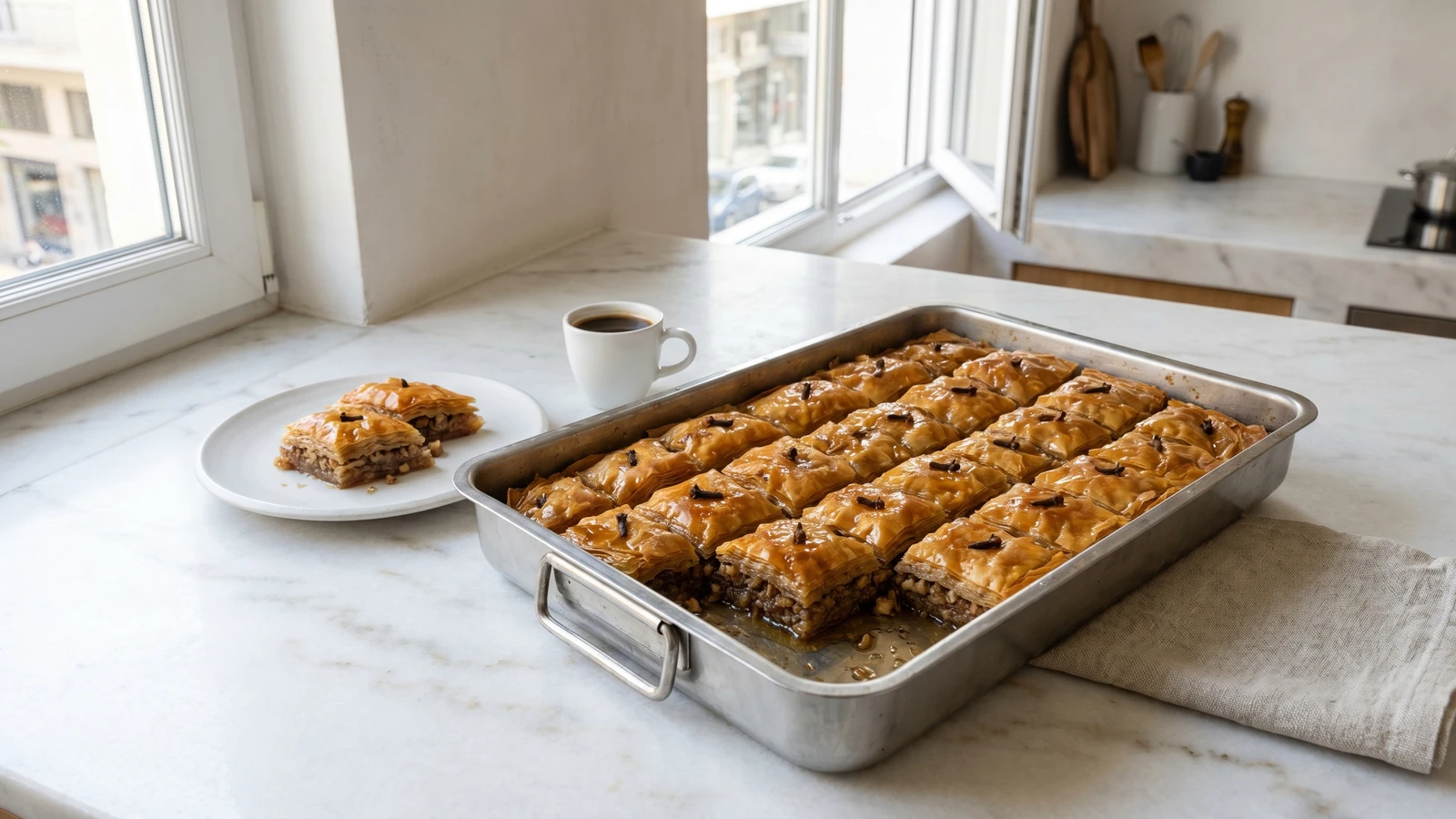
Northern Greek baklava is a Christmas tray of thin phyllo, walnuts, cinnamon, and honeyed syrup. The pastry goes hot, the syrup goes cold, and the layers stay crisp.
Northern Greek baklava is a walnut pastry first: thin phyllo, warm cinnamon, a little clove, and syrup that settles through the cuts without drowning the tray. In Macedonia and Thrace, this is the sweet that appears for Christmas, name-days, and the visits where coffee turns into an afternoon.
The one rule is temperature. Make the syrup first and let it cool completely, then pour it over the baklava the moment the hot tray leaves the oven. Hot pastry pulls in cold syrup quickly, while the buttered phyllo keeps its crisp leaves. Pour warm syrup onto warm pastry and you get sweetness, yes, but not baklava as it should be.
Use fresh walnuts. That matters more than any clever hand. If they smell dusty or bitter, wait and buy better ones. Λίγα και καλά, a few things, and good ones.
This is the kind of tray I like to write down exactly because every family says, by eye, until a young cook stands in front of the phyllo and doesn't know where to begin. Your grandmother cooked by eye because she'd made it a thousand times. Here are the numbers until you have.
Baklava entered Greek cooking through the long Ottoman urban pastry tradition, with Constantinople, Thessaloniki, Ioannina, and the northern trade towns all shaping local versions. In northern Greece the Christmas tray is most often walnut and cinnamon, because walnuts kept well through winter and belonged naturally to the festive store cupboard. Other Greek regions may use almonds, pistachios, or different cuts, but in this version the walnut is the region's signature.
Quantity
500g
thawed
Quantity
450g
coarsely chopped
Quantity
80g
Quantity
2 tsp
Quantity
1/4 tsp
Quantity
280g
melted and clarified if possible
Quantity
600g
Quantity
360ml
Quantity
200g
Quantity
1
Quantity
4
Quantity
1 wide strip
Quantity
1 tbsp
Quantity
24
| Ingredient | Quantity |
|---|---|
| thin phyllo pastrythawed | 500g |
| walnutscoarsely chopped | 450g |
| fine dry breadcrumbs or grated paximadi | 80g |
| ground cinnamon | 2 tsp |
| ground cloves | 1/4 tsp |
| unsalted buttermelted and clarified if possible | 280g |
| granulated sugar | 600g |
| water | 360ml |
| Greek honey | 200g |
| cinnamon stick | 1 |
| whole cloves | 4 |
| lemon peel | 1 wide strip |
| lemon juice | 1 tbsp |
| whole cloves for marking pieces (optional) | 24 |
Put the sugar, water, cinnamon stick, whole cloves, and lemon peel in a small saucepan. Bring to a boil, then simmer for 8 minutes until clear and lightly thickened. Stir in the honey and lemon juice, simmer 2 minutes more, then take it off the heat. Let it cool completely. Cold syrup on hot pastry is the trick that keeps the phyllo crisp instead of soggy.
Mix the chopped walnuts with the breadcrumbs, cinnamon, and ground cloves. Keep the walnuts coarse, with pieces you can feel under the knife. Powdered nuts make a heavy paste, and this tray wants layers with a little life in them.
Heat the oven to 160C fan, or 170C conventional. Brush a 30 x 40cm metal tapsi with melted butter. Cut the phyllo to fit the pan and keep the stack covered with a clean towel while you work. If the packet gives you more or fewer sheets, don't panic. Keep thick stacks for the bottom and top, and use the rest through the middle.
Lay 8 sheets of phyllo in the pan, brushing each sheet lightly with butter before the next one goes down. Scatter over one quarter of the walnut mixture. Add 3 buttered sheets, then another quarter of the walnuts, and repeat until the walnuts are used. Finish with 7 to 8 buttered sheets on top, smoothing them gently without pressing the pastry flat.
With a sharp thin knife, cut the baklava into diamonds or squares all the way to the bottom of the pan. If you like the old marking, press one whole clove into the center of each piece. Brush the top with the last of the butter. Bake for 55 to 65 minutes, until the top is deep gold and the edges look crisp and dry.
As soon as the baklava comes from the oven, ladle the completely cooled syrup over it slowly, especially along the cuts and edges. Leave it uncovered at room temperature for at least 6 hours, preferably overnight, so the syrup settles through the layers without trapping the top.
Serve small pieces at room temperature with Greek coffee. Keep the tray loosely covered at room temperature for up to 5 days. Don't refrigerate it unless your kitchen is very hot; cold air makes the phyllo lose its clean bite.
1 serving (about 95g)
Culinary guides, cultural storytelling, and the editorial depth that makes cooking meaningful.
Discover Culinary ExplorerChef Dimitra
Agrafa's batzina is the no-phyllo pie of Karditsa: grated courgette, feta, eggs, milk, and flour poured thin into a hot oiled tapsi.

Chef Dimitra
Zagori's flour pie skips phyllo completely: a loose egg-and-flour batter, crumbled feta, and a hot buttered tapsi that makes the edges crisp.

Chef Dimitra
Hydra and Andros give amygdalota their island surname: ground almond, sugar, egg white, and rosewater, baked pale so the center stays soft as marzipan.

Chef Dimitra
Asia Minor ekmek kataifi is built in three clear layers: crisp syruped kataifi, thick semolina custard, and cold kaimaki cream under pistachios.