
Chef Dimitra
Agrafa Batzina (Μπατζίνα), Courgette and Feta Pie
Agrafa's batzina is the no-phyllo pie of Karditsa: grated courgette, feta, eggs, milk, and flour poured thin into a hot oiled tapsi.
A cooking platform built around craft, culture, and the stories behind what we eat.
Created by
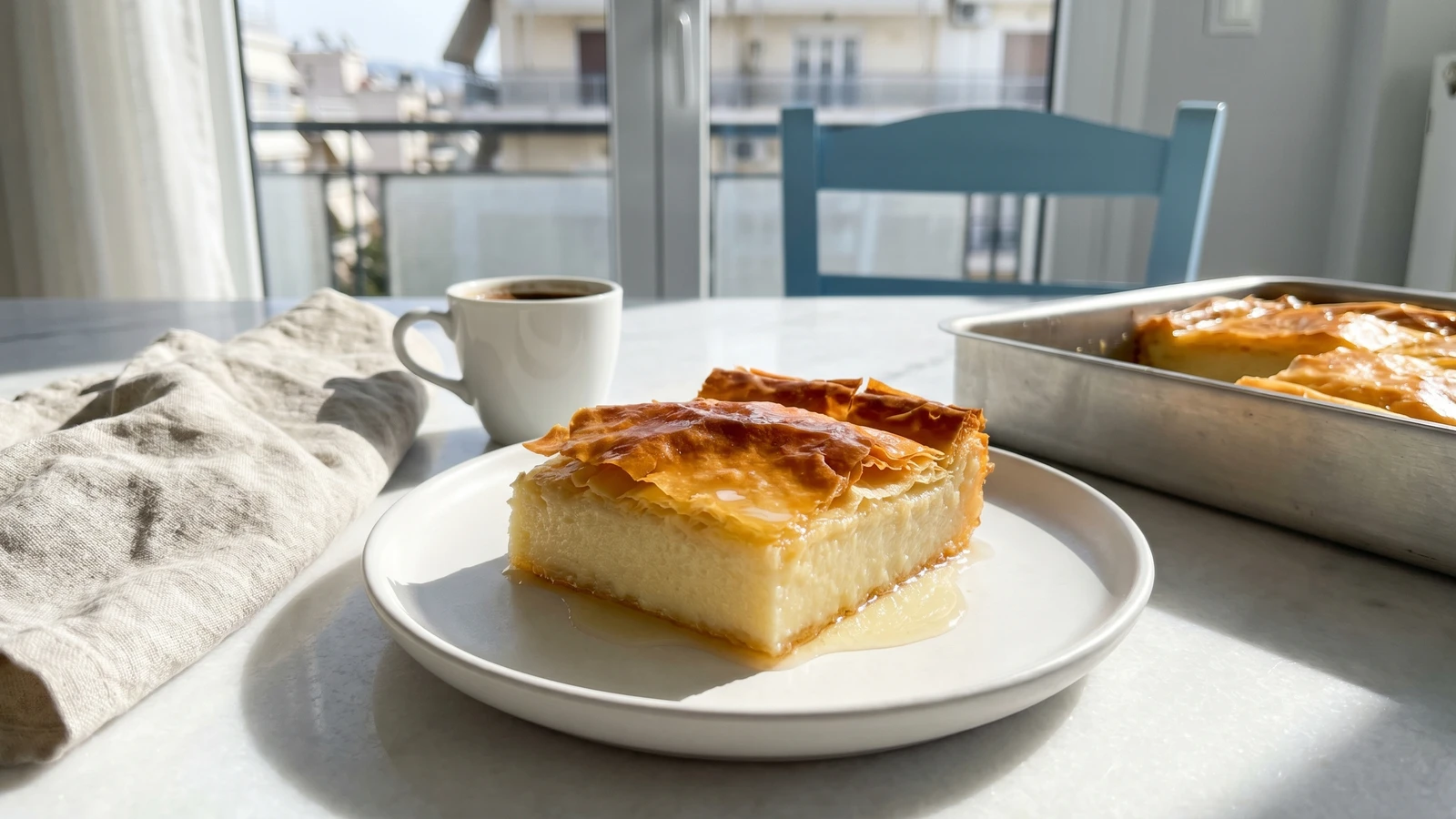
Urban mainland galaktoboureko is semolina custard under buttered phyllo, baked gold and syruped with cold lemon syrup over hot pastry for the celebration table.
Urban mainland galaktoboureko is the custard pie of the Greek celebration table: semolina custard held between buttered phyllo, baked until the top crackles under the knife, then given lemon syrup. It isn't bougatsa, the unsyruped breakfast pastry of Macedonia. Galaktoboureko is a tray sweet, set and soaked, made to be cut into squares and carried to the table whole.
The one method that decides the dish is temperature. Make the syrup first and let it go cold, then pour it over the hot pie as soon as it leaves the oven. The pastry drinks quickly, the custard stays soft, and the top keeps its bite. Warm syrup on warm pastry gives you a sweet sponge, and I won't pretend otherwise.
Use fine semolina, fresh phyllo if you can get it, and butter you like the smell of when it melts. Your hands do most of the work here: brush, layer, pour, score, bake. Once it rests, the knife follows the lines and the squares lift clean. My Thessaloniki notebook has three versions; this is the one that made the pan disappear at a name-day table.
Galaktoboureko belongs to the urban Greek sweet table rather than to one village: it is strongest in the pastry-shop culture of Athens, Thessaloniki, and other mainland towns. The name combines Greek galakto, meaning milk, with the Turkish-derived boureki, from börek, placing it in the family of layered phyllo sweets that moved through Greek kitchens under Ottoman rule. By the 20th century it had become a home celebration tray, baked whole and cut after syruping, unlike bougatsa, its unsyruped Macedonian cousin.
Quantity
600g
Quantity
450ml
Quantity
1 wide strip
yellow part only
Quantity
30ml
Quantity
1.2L
Quantity
180g
Quantity
150g
Quantity
4
Quantity
2
Quantity
1 small pinch
Quantity
80g
cut into pieces
Quantity
1 teaspoon
Quantity
zest of 1 lemon
Quantity
450g
thawed if frozen
Quantity
220g
melted
| Ingredient | Quantity |
|---|---|
| granulated sugar, for the syrup | 600g |
| water, for the syrup | 450ml |
| lemon peelyellow part only | 1 wide strip |
| fresh lemon juice | 30ml |
| whole milk | 1.2L |
| granulated sugar, for the custard | 180g |
| fine semolina | 150g |
| large eggs | 4 |
| large egg yolks | 2 |
| fine sea salt | 1 small pinch |
| unsalted butter, for the custardcut into pieces | 80g |
| vanilla extract | 1 teaspoon |
| unwaxed lemon zest | zest of 1 lemon |
| phyllo pastry (φύλλο)thawed if frozen | 450g |
| unsalted butter, for brushingmelted | 220g |
Put the 600g sugar, 450ml water, and lemon peel in a small saucepan. Bring to a boil, then simmer for 8 minutes without stirring hard. Stir in the lemon juice, take it off the heat, and leave it until completely cold. This is not a garnish. It is part of the structure of the pie.
Pour the milk into a wide saucepan with half the custard sugar. Warm it over medium heat until it is hot and lightly trembling at the edge, not boiling. Take your time here. Scorched milk announces itself, and not politely.
In a bowl, whisk the eggs, yolks, remaining sugar, semolina, and salt until smooth. Add two ladles of the hot milk slowly, whisking all the time, then pour the warmed egg mixture back into the saucepan. Cook over medium-low heat, whisking steadily, until the custard thickens and a whisk leaves clear tracks, 5 to 7 minutes. Off the heat, whisk in the 80g butter, vanilla, and lemon zest.
Heat the oven to 180C. Butter a 23 by 33cm baking dish or metal tapsi. Unroll the phyllo and cover the stack with a barely damp towel so it doesn't dry while you work. Lay 8 sheets into the dish one by one, brushing each sheet with melted butter and letting the edges climb the sides.
Pour the warm custard over the bottom phyllo and smooth it level. Fold any overhanging phyllo over the custard. Lay the remaining sheets on top, buttering each one, then tuck the edges down inside the dish. Use the last butter on the top sheet so it bakes deep gold.
With a sharp knife, score only the top layers into 12 squares or diamonds. Do not cut down into the custard yet. Bake for 45 to 55 minutes, until the top is crisp, deeply golden, and the edges have pulled slightly from the dish.
As soon as the galaktoboureko comes out of the oven, ladle the cold syrup slowly over the hot top, paying attention to the cuts and edges. Use all of it. The tray will look too wet at first, then the phyllo will drink and settle.
Leave the galaktoboureko uncovered for at least 1 hour before cutting all the way through. Serve it warm or at room temperature, in the scored pieces. The custard should hold softly, the top should still answer the fork, and the syrup should sit in the pastry rather than puddle underneath.
1 serving (about 275g)
Culinary guides, cultural storytelling, and the editorial depth that makes cooking meaningful.
Discover Culinary ExplorerChef Dimitra
Agrafa's batzina is the no-phyllo pie of Karditsa: grated courgette, feta, eggs, milk, and flour poured thin into a hot oiled tapsi.

Chef Dimitra
Zagori's flour pie skips phyllo completely: a loose egg-and-flour batter, crumbled feta, and a hot buttered tapsi that makes the edges crisp.

Chef Dimitra
Hydra and Andros give amygdalota their island surname: ground almond, sugar, egg white, and rosewater, baked pale so the center stays soft as marzipan.

Chef Dimitra
Asia Minor ekmek kataifi is built in three clear layers: crisp syruped kataifi, thick semolina custard, and cold kaimaki cream under pistachios.