
Chef Dimitra
Asia Minor Ekmek Kataifi (Εκμέκ Κανταΐφι)
Asia Minor ekmek kataifi is built in three clear layers: crisp syruped kataifi, thick semolina custard, and cold kaimaki cream under pistachios.
A cooking platform built around craft, culture, and the stories behind what we eat.
Created by
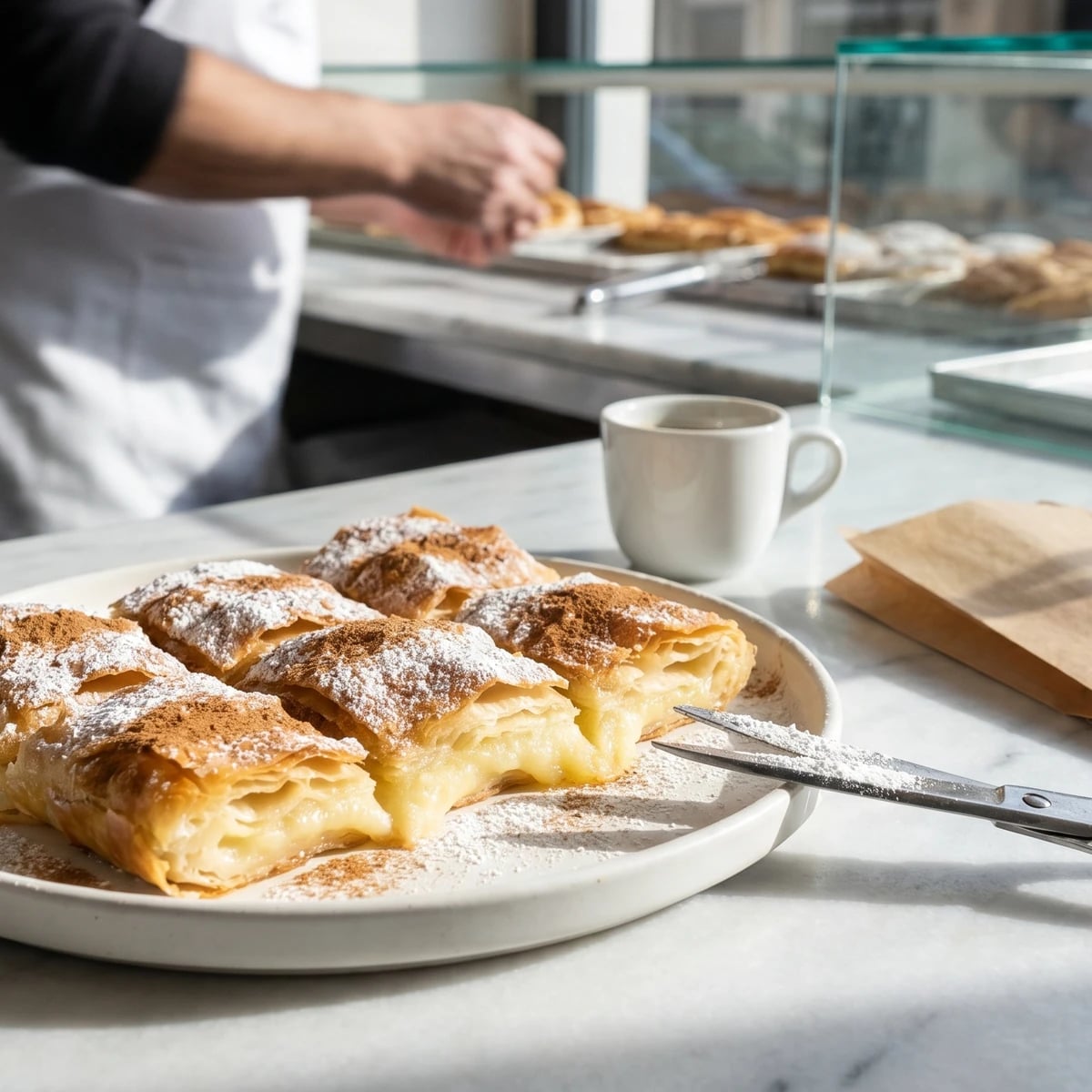
Thessaloniki's morning sweet is a square of buttered phyllo around soft semolina cream, baked crisp, cut with scissors, and buried under sugar and cinnamon while still warm.
Bougatsa me krema is Thessaloniki's morning pastry, with Serres standing very close beside it in the northern family: thin buttered phyllo folded around warm semolina cream, baked until the top crackles, then cut with scissors under a fall of sugar and cinnamon. No syrup. Galaktoboureko is the sweet that drinks syrup; bougatsa is the one you eat hot, from paper, before the day has made up its mind.
One method decides it. The cream must be cooked until it holds soft lines, then cooled until warm before it touches the phyllo. If it goes in hot, it melts the butter through the sheets and they bake heavy. If it goes in warm and settled, the outside lifts crisp while the center stays gentle and spoon-soft.
I make this as two folded packets, the way a home kitchen can manage without pretending to be a bougatsa shop. The region is the dish's surname, so I don't change the finish: sugar, cinnamon, no syrup, and a hot scissor-cut square on the plate. In Thessaloniki you learn this pastry by sound first, the snip of scissors over the tray, then by the smell of butter and vanilla in the morning.
Bougatsa belongs most strongly to Macedonia, especially Serres and Thessaloniki, where dedicated bougatsa shops shaped the city's morning table. The name is linked to Turkish poğaça and the pastry culture of Ottoman Constantinople, but the northern Greek shop form became fixed around hand-opened phyllo folded over fillings of cream, cheese, mince, or spinach. After the Asia Minor refugee arrivals of 1922, the cream version became a Thessaloniki breakfast pastry, sold hot, cut with scissors, and finished with sugar and cinnamon rather than syrup.
Quantity
1L
Quantity
170g
Quantity
1/4 teaspoon
Quantity
120g
Quantity
2
Quantity
1
Quantity
1 teaspoon
Quantity
40g
for the cream
Quantity
450g
thawed
Quantity
160g
melted, for brushing
Quantity
40g
for serving
Quantity
2 teaspoons
for serving
| Ingredient | Quantity |
|---|---|
| whole milk | 1L |
| granulated sugar | 170g |
| fine sea salt | 1/4 teaspoon |
| fine semolina (psilo simigdali, ψιλό σιμιγδάλι) | 120g |
| large eggs | 2 |
| large egg yolk | 1 |
| vanilla extract | 1 teaspoon |
| unsalted butterfor the cream | 40g |
| phyllo kroustasthawed | 450g |
| unsalted buttermelted, for brushing | 160g |
| icing sugarfor serving | 40g |
| ground cinnamonfor serving | 2 teaspoons |
Put 850ml of the milk, the sugar, and the salt in a 3L saucepan over medium heat. Stir until the sugar dissolves and the milk is hot at the edges, not boiling. Keep the remaining 150ml milk cold for the semolina mixture.
In a bowl, whisk the fine semolina with the cold 150ml milk, the eggs, and the yolk until smooth. Add two ladles of the hot milk in a thin stream, whisking all the time, then pour everything back into the saucepan. Cook over medium-low heat for 5 to 7 minutes, whisking steadily, until the cream thickens and the whisk leaves slow lines across the surface. Off the heat, whisk in the 40g butter and the vanilla.
Scrape the cream into a wide dish and press baking paper directly onto the surface. Let it cool for 25 to 30 minutes, until warm but no longer hot. This is the step that decides the bougatsa: hot cream melts the butter into the phyllo and makes it leathery; warm cream lets the sheets lift around a soft center.
Heat the oven to 190C conventional, or 180C fan. Brush a 30 x 40cm rimmed metal baking tray with melted butter. Unroll the phyllo and cover it with a barely damp towel while you work, because dry phyllo cracks before it can fold.
Lay one sheet of phyllo on the work surface with the long side facing you and brush it lightly with melted butter. Stack 6 or 7 sheets for the first packet, brushing each one, then spoon half the cream into the center and spread it into a rectangle about 22 x 16cm. Fold the left and right sides over the cream, brush the folded parts with butter, then fold the top and bottom over to make a flat parcel. Turn it seam-side down onto the tray. Repeat with the remaining phyllo and cream.
Brush the tops with the remaining melted butter and bake on the middle rack for 28 to 35 minutes, rotating the tray once, until the phyllo is deep gold and crisp at the edges. Let the bougatsa rest for 10 minutes. The cream needs that little pause, or it runs before the scissors reach it.
Cut the bougatsa into squares with kitchen scissors, the Thessaloniki way, or use a serrated knife if you must. Dust generously with icing sugar and cinnamon while warm. Serve at once, because bougatsa is not a sweet for later. It is breakfast with a clock on it.
1 serving (about 250g)
Culinary guides, cultural storytelling, and the editorial depth that makes cooking meaningful.
Discover Culinary Explorer
Chef Dimitra
Asia Minor ekmek kataifi is built in three clear layers: crisp syruped kataifi, thick semolina custard, and cold kaimaki cream under pistachios.

Chef Dimitra
Cyprus rolls thin pastry into small filled fingers, fries them crisp, and dips them in lemon-scented syrup. Seal the ends well and the almond stays where it belongs.

Chef Dimitra
Urban mainland galaktoboureko is semolina custard under buttered phyllo, baked gold and syruped with cold lemon syrup over hot pastry for the celebration table.

Chef Dimitra
Ioannina's Gianniotiko marries kataifi below and phyllo above, with walnuts between and cold syrup poured over the hot pastry until every layer knows its job.