Culinary Explorer

A cooking platform built around craft, culture, and the stories behind what we eat.
Discover Culinary Explorer
Nieve de Leche Quemada con Tuna

Nieve de Leche Quemada con Tuna

Created by

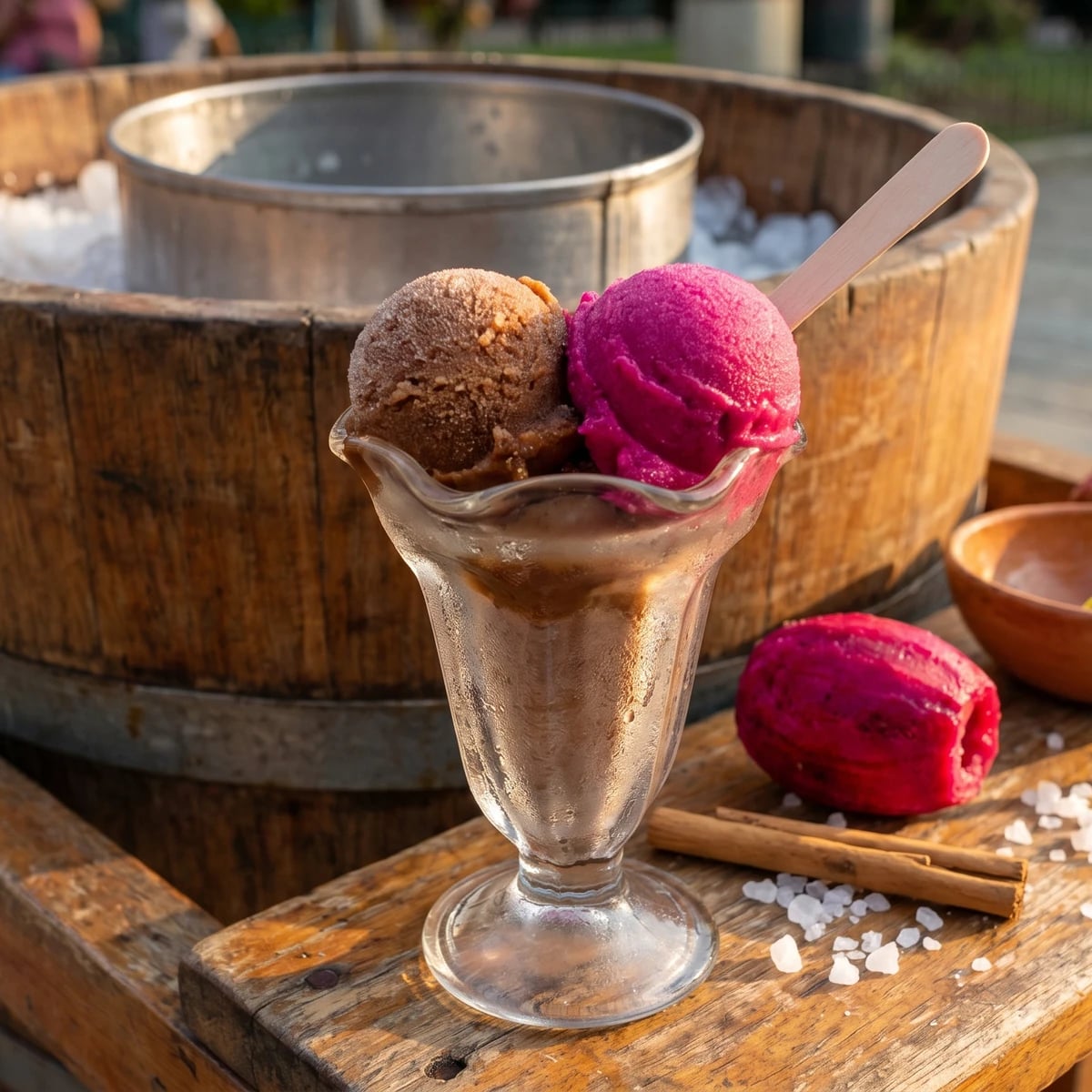
Oaxaca's iconic nieve pairing, burnt-milk sorbet hand-churned in a salt-and-ice garrafa, served beside magenta prickly pear at the Jardín Sócrates stalls in the Centro Histórico.

Desserts
Mexican
Outdoor Dining
Comfort Food
Picnic
30 min
Active Time
45 min cook1 hr 15 min total
Yield8 servings (about 1 quart of each nieve)

This is from Oaxaca. Specifically from the Jardín Sócrates, the small plaza outside the Basílica de la Soledad in the Centro Histórico, where a row of nieve stalls has been turning wooden garrafas by hand since before any of us were born. The senoras who run them learned from their mothers, who learned from theirs. This is not ice cream. This is not gelato. This is not sorbet in the French sense. A nieve is a nieve, and the technique is older than all of those words.

Leche quemada means burnt milk, and the burning is literal. You take granulated sugar past caramel, into the dark zone where it almost smokes, where the sweetness turns smoky and bitter at the edge. Then you quench it with milk. The seized sugar slowly dissolves back into the milk and stains it the color of polished wood. People who have not had it think it will taste burnt in a bad way. It does not. It tastes like the inside of a piloncillo cone if piloncillo were a beverage. The depth comes from the burn. Stop too early and you have made a different dessert.

The tuna in this pairing is not the fish. Tuna is the fruit of the nopal, the prickly pear, and the magenta variety from the Valles Centrales is the one that gives Oaxacan nieves de tuna their bougainvillea color. Both nieves get churned in a garrafa, a wooden barrel with a metal cylinder packed in rock salt and ice. You turn it by hand for half an hour with a wooden pala, scraping the frozen ring off the wall and folding it back into the center. Your arm will burn before the nieve is done. The senoras at Jardín Sócrates have forearms like stonemasons.

My mother did not make nieves. She was from Jalisco and we ate paletas. The first time I had a proper nieve was at Jardín Sócrates when I was twenty-two, the leche quemada and tuna together in a glass cup, and I understood within three bites that what I had been calling helado my whole life was a different food. I have been collecting nieve recipes from Oaxacan stalls ever since. Saber cocinar es saber vivir. Cada estado, su propia cocina.

Nieves de garrafa in Oaxaca trace to the colonial period, when ice was carried down from the Sierra Norte mountains by mule trains and stored in straw-insulated pits called neveras. The technique of churning a sweetened liquid inside a metal vessel surrounded by salted ice was introduced by Spanish friars in the 17th century, but Oaxacan nieveros developed their own flavor canon over the following centuries: leche quemada, tuna, beso oaxaqueño, queso, rosa, and the famous nieve de pétalos. The Jardín Sócrates stalls outside the Basílica de la Soledad were established in the 19th century and remain operated by descendants of the original nieveras, several families of whom received municipal recognition in the early 2000s as cultural patrimony of the city of Oaxaca. The word 'tuna' for the fruit of the nopal is not Spanish in origin but Taino, brought to Mexico from the Caribbean by Spanish settlers and applied to the cactus fruit they encountered here.

The technique, the tradition, and the story behind every dish.

Discover Culinary Explorer

Ingredients

whole milk

Quantity

6 cups

preferably from a local dairy

granulated sugar

Quantity

1 1/2 cups

divided, 1 cup for the milk and 1/2 cup for the tuna

Mexican canela (Ceylon cinnamon stick)

Quantity

1 stick, about 4 inches

lime peel

Quantity

1 strip, about 2 inches

no white pith

fine sea salt

Quantity

1 pinch

tunas rojas (magenta prickly pears)

Quantity

8 ripe

peeled

fresh lime juice

Quantity

1/2 cup (about 4 to 5 Mexican limes)

divided

cold water

Quantity

1/2 cup

crushed ice or block ice

Quantity

20 pounds

broken into chunks for the garrafa

rock salt (sal de grano)

Quantity

4 pounds

for the salt-and-ice slurry

Equipment Needed

  • Wooden garrafa with metal cylinder and pala (or 1.5-quart ice cream maker as compromise)
  • Heavy-bottomed stainless or copper saucepan for burning the sugar
  • Fine-mesh sieve for straining the milk and the tuna pulp
  • High-powered blender
  • Heavy gloves for handling tunas
  • Stout glass tulip cups for serving

Instructions

  1. 1

    Burn the sugar

    Place 1 cup of the sugar in a heavy stainless or copper pot. Set it over medium heat with no liquid, no stirring, no spoon. Watch it. The sugar will melt at the edges first, turn amber, then deepen toward mahogany. Take it past the soft caramel stage. You want it dark, almost smoking, the color of polished wood. This is leche quemada, not leche con caramelo. The bitterness at the edge of the burn is the flavor of the dish. Stop when the smoke turns from sweet to sharp.

    If you stop too early, your nieve will taste like dulce de leche. That is a different dessert from a different region. The senoras at Jardín Sócrates take the sugar dark on purpose. Do not lose your nerve at the last thirty seconds.
  2. 2

    Quench with the milk

    Pour the milk in slowly, all at once will crack the pot. The caramel will seize and harden into a black rock at the bottom. That is correct. Add the canela stick, the lime peel, and the pinch of salt. Lower the heat and stir gently with a wooden spoon. Over the next twenty minutes, the seized caramel will dissolve back into the milk and stain it the color of weak coffee with a smoky edge. Do not let it boil. A gentle simmer is enough.

  3. 3

    Steep and chill

    Once the caramel has fully dissolved into the milk, taste it. It should be sweet at the front and bitter-smoky at the back. That contrast is the whole point. Pull the canela and the lime peel. Strain the milk through a fine sieve into a metal bowl. Set the bowl over a larger bowl of ice water and stir until cold. Then refrigerate for at least two hours. Cold base churns better. Warm base makes ice crystals.

  4. 4

    Prepare the tuna

    While the milk chills, work the tuna. Wear gloves if your tunas still have spines, the small ones are nearly invisible and they hurt for days. Peel each one and drop the magenta flesh into a blender with the remaining 1/2 cup sugar, 1/4 cup of the lime juice, and the cold water. Blend just until smooth. Strain through a fine sieve to catch the seeds. They are hard as gravel and will ruin a tooth. Stir in the rest of the lime juice. Taste. The lime should sharpen the sweetness without taking over. Refrigerate until cold.

  5. 5

    Set up the garrafa

    Set the wooden barrel garrafa on a sturdy surface where the salt water can drip. Pack the space between the wooden barrel and the metal cylinder with alternating layers of crushed ice and rock salt. The salt drops the temperature of the ice well below freezing. That is what makes a nieve a nieve and not a sad slushie. If you do not have a garrafa, an ice cream maker works for the cook at home, but the texture is different. The garrafa makes the nieve dense and slightly icy in the way that defines Oaxacan nieves de leche.

    Do not skimp on the rock salt. The senoras at Jardín Sócrates use handfuls of sal de grano, not table salt. The bigger crystals work slowly and steadily as they dissolve.
  6. 6

    Churn the leche quemada

    Pour the cold burnt-milk base into the metal cylinder of the garrafa. Cover with the wooden lid. Now you turn. By hand, with the wooden pala, spin the cylinder for about twenty-five to thirty minutes. Every few minutes, stop and scrape the frozen ring off the inside wall with the pala, folding it back into the soft center. This is the work. Your arm will tire. La cocina no es decoracion, es trabajo. The nieve is done when the pala stands up by itself in the cylinder and the texture is dense and creamy with a slight grain. Transfer to a chilled container and put it in the freezer while you churn the second nieve.

  7. 7

    Churn the tuna

    Drain the salty melt from the garrafa, repack with fresh ice and salt, rinse the cylinder briefly. Pour in the cold tuna base. Churn the same way. The tuna nieve will set faster, about twenty minutes, because it has less fat and more water. Do not overchurn it or it will go grainy and lose the magenta clarity that makes this nieve famous. Stop the moment it holds the shape of the pala. The color should be the color of bougainvillea, not faded pink.

  8. 8

    Serve at the table

    Scoop side by side into stout glass tulip cups: one scoop leche quemada, one scoop tuna. The cream-and-mahogany of the burnt milk against the magenta of the tuna is the photograph that has sold Oaxaca to the world for fifty years. Eat it immediately with a small wooden pala. A nieve does not wait. As soon as it sits, the texture changes. Asi se hace y punto.

Chef Tips

  • If you cannot find tunas rojas, do not substitute strawberry. Wait for tuna season, which runs from August through November in central Mexico, or use the tuna verde or tuna blanca varieties and accept that the color will be different. The flavor is similar across varieties; the magenta clarity is what makes the rojas the photograph.
  • True Mexican canela, the soft, papery Ceylon cinnamon, is non-negotiable. The hard cassia bark sold as cinnamon in most North American supermarkets is too aggressive and will fight the burnt sugar instead of supporting it. Find a Mexican grocer.
  • If you do not own a garrafa, an ice cream maker will get you 75 percent of the way there. The texture will be smoother and less icy than a true nieve. That is a compromise, not an upgrade. Do not freeze the bases in flat trays and stir with a fork. That makes granita, which is a different dish from a different country.
  • Burning the sugar is the moment that decides the dish. Stand at the pot and watch it. Do not walk away to answer the phone. Do not stir. Just watch. When you smell the sweetness turn sharp at the back of your throat, you have thirty seconds before it goes black and bitter in the wrong way.

Advance Preparation

  • Both bases can be made one day ahead. The leche quemada actually improves overnight as the smoky notes settle and round out. The tuna base should be made no more than 24 hours ahead, as the lime starts to dull the magenta over time.
  • Once churned, nieves are best eaten the same day. They will keep in the freezer for up to three days but the texture firms up and the leche quemada loses the slight grain that defines it. If you must store them, let them soften on the counter for ten minutes before serving.
  • Rock salt and ice should be prepared just before churning. The garrafa cannot be assembled in advance.

Frequently Asked Questions

Nutrition Information

1 serving (about 400g)

Calories
320 calories
Total Fat
6 g
Saturated Fat
4 g
Trans Fat
0 g
Unsaturated Fat
2 g
Cholesterol
20 mg
Sodium
100 mg
Total Carbohydrates
60 g
Dietary Fiber
5 g
Sugars
50 g
Protein
7 g

Note: Chef personas and recipes are created with AI assistance. Cook with care: follow safe food-handling practices, check doneness with a thermometer when needed, and adapt for allergies and your kitchen.

Where cooking meets culture.

Culinary guides, cultural storytelling, and the editorial depth that makes cooking meaningful.

Discover Culinary Explorer

More from Oaxacan Desserts

Browse the full collection