
Chef Lupita
Acitrón de Cidra Conventual
Puebla's convent-style acitrón, made from cidra peel instead of endangered biznaga, built through repeated syrup soakings until the cubes turn firm, translucent, and ready for rosca or chiles en nogada.
A cooking platform built around craft, culture, and the stories behind what we eat.
Created by
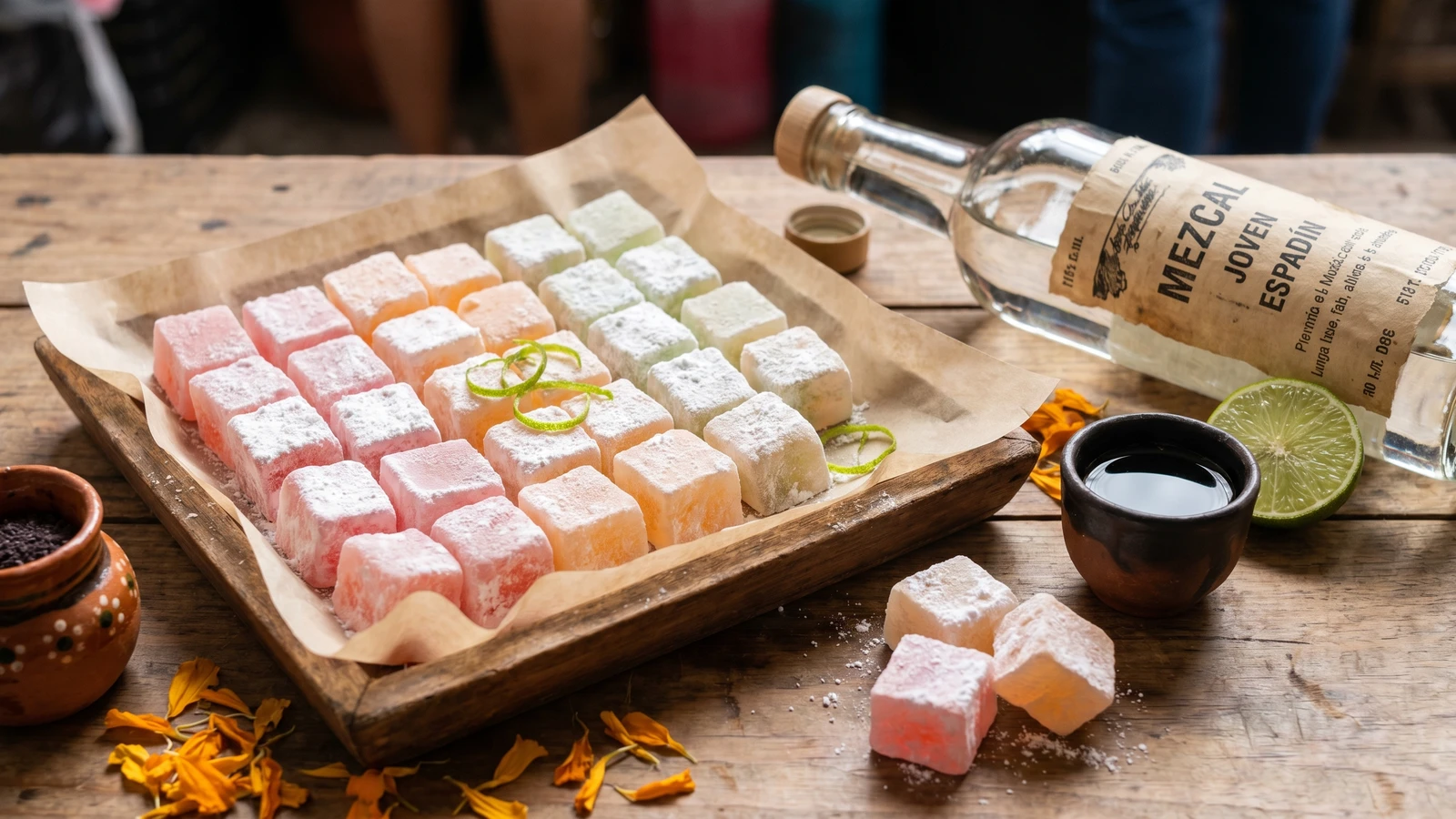
Oaxaca's drunken jellied confections, small pastel cubes spiked with mezcal espadin and dusted in powdered sugar. The dulceria tradition of the Centro Histórico in one bite.
Borrachitos are from Oaxaca. Not from a national candy factory, not from a generic Mexican confection box, from Oaxaca specifically. The dulcerias around the Zocalo and Jardin Sócrates have made them for generations, set out on wooden trays in tidy rows of pink, orange, and pale green, dusted in powdered sugar that the afternoon humidity is always trying to dissolve.
The convent tradition runs through this candy. The Dominican nuns of Oaxaca refined sugar work into an entire vocabulary of dulces: nicuatole, alfeñique, jamoncillo, cocadas, and the borrachitos that took the convent's gelled fruit candies and married them to the mezcal coming down from the agave fields of the Valles Centrales. The convent meets the distillery on one tray. That is the dish. That is why it exists.
The mezcal is not a flavoring. It is the point. A borrachito without mezcal is just a fruit gummy. Use mezcal joven from Oaxaca, espadin if you can, and add it off the heat so the alcohol stays in the candy and not in the steam over your stove. The tequila and rum are old additions from the dulceria families who learned that a drop of each rounds the mezcal's smoke. La manteca es el sabor in savory cooking. Here, el mezcal es el sabor.
My mother's notebook does not have a borrachito recipe. She was from Jalisco. I learned this one from a senora named Doña Otilia who has worked the same dulceria stall on Calle Mina for forty-one years. She showed me the cochineal she keeps in a small jar, ground from the cactus parasites that have given Oaxacan textiles and candies their pink for five centuries. She told me to use real cochineal or no color at all. Asi se hace y punto. Saber cocinar es saber vivir.
The borrachito belongs to Oaxaca's dulceria tradition, codified by the Dominican nuns of the Convento de Santa Catalina and other 16th and 17th century convents that received Spanish sugar refinement and adapted it to local fruits, agaves, and dye plants. Mezcal, distilled in the Valles Centrales since at least the 17th century when the Spanish brought distillation to existing pre-Columbian fermented agave traditions, became the convent's natural pairing with their gelled fruit candies, producing the borrachito by the 19th century as a domestic and dulceria staple. The pink color traditional to many borrachitos comes from grana cochinilla, the cochineal insect cultivated on nopal cactus that was Oaxaca's second-largest colonial export after silver and that returned to favor in the late 20th century as cooks rejected synthetic dyes in heritage confections.
Quantity
1 cup
from about 8 to 10 limones criollos
Quantity
1 cup
from about 3 oranges
Quantity
1/2 cup
Quantity
2 1/2 cups
Quantity
1/4 cup, plus more for dusting
Quantity
3 tablespoons (about 3 packets)
Quantity
1/4 cup
Quantity
1/2 cup
preferably espadin
Quantity
2 tablespoons
Quantity
1 tablespoon
Quantity
1 teaspoon
Quantity
1 teaspoon
Quantity
pinch
Quantity
a few drops
for pink color
Quantity
a few drops
for orange color
Quantity
a few drops
for green color
Quantity
as needed
for greasing the pan
Quantity
1/4 cup
for the dusting mix
| Ingredient | Quantity |
|---|---|
| fresh lime juicefrom about 8 to 10 limones criollos | 1 cup |
| fresh orange juicefrom about 3 oranges | 1 cup |
| water | 1/2 cup |
| granulated cane sugar | 2 1/2 cups |
| powdered (confectioner's) sugar | 1/4 cup, plus more for dusting |
| unflavored powdered gelatin | 3 tablespoons (about 3 packets) |
| cold water for blooming the gelatin | 1/4 cup |
| mezcal joven from Oaxacapreferably espadin | 1/2 cup |
| tequila blanco | 2 tablespoons |
| dark rum | 1 tablespoon |
| finely grated lime zest | 1 teaspoon |
| finely grated orange zest | 1 teaspoon |
| fine sea salt | pinch |
| cochineal (grana cochinilla) tincture (optional)for pink color | a few drops |
| achiote-infused water (optional)for orange color | a few drops |
| hoja santa or spinach water (optional)for green color | a few drops |
| neutral oilfor greasing the pan | as needed |
| cornstarchfor the dusting mix | 1/4 cup |
Lightly oil a square 8-inch baking pan or three small rectangular pans if you plan to make three colors. Line with parchment, leaving an overhang on two sides for lifting. Oil the parchment too. The borrachito will not release from a dry pan and a stuck candy is a wasted candy. No me vengas con atajos. The pan goes first, before you touch the stove.
Pour the 1/4 cup cold water into a small bowl. Sprinkle the gelatin evenly across the surface. Do not stir. Let it sit for 10 minutes. The granules drink the water and swell into a dense, translucent sponge. This is what gives the borrachito its clean cube and its slight resistance under the tooth. Skip the bloom and the gelatin clumps in the syrup. Asi se hace y punto.
Combine the lime juice, orange juice, water, granulated sugar, and pinch of salt in a heavy 2-quart saucepan. Set over medium heat and stir until the sugar dissolves completely. Once the syrup is clear, stop stirring. Bring to a low simmer, not a hard boil. Cook for about 8 minutes, until the syrup has reduced slightly and coats the back of a wooden spoon. The fruit and the sugar need to marry. A hard boil drives off the citrus aromatics and leaves you with sweet without depth.
Remove the saucepan from the heat. Add the bloomed gelatin to the hot syrup and whisk constantly until completely dissolved. Hold the pan up to the light and look. There should be no streaks, no flecks, no clumps. If you see any, set the pan back over the lowest heat and whisk for another minute. Gelatin that is not fully melted will leave a chewy band at the bottom of your finished borrachito.
Let the syrup cool for about 5 minutes, until it is warm but no longer steaming-hot. Whisk in the mezcal, tequila, and rum. Add the lime zest, orange zest, and the 1/4 cup powdered sugar. The alcohol must go in off the heat. If you pour mezcal into a hot pan, you boil off the very thing that makes a borrachito borracho. The point is the drunken character. La cocina no es decoracion, es trabajo. Taste the syrup. It should be bright, slightly bitter from the zest, and unmistakably alcoholic.
If you are making the traditional trio of pastel colors, divide the syrup evenly into three bowls. Add cochineal tincture to one for pink, achiote water to the second for orange, and hoja santa or spinach water to the third for green. Stir each gently. Use cochineal if you want the real Oaxacan pink. The dyers and confectioners around Tlacolula have used it for centuries. Pour each color into a small oiled pan, or pour them in stripes into the single 8-inch pan, letting each color set for 15 minutes in the refrigerator before adding the next so the layers stay distinct.
Cover the pan loosely with a clean cloth and refrigerate for at least 8 hours, or overnight. The borrachito needs the full set. A four-hour set will give you a soft, sticky candy that tears when you cut it. Eight hours gives you the clean cube with the slight bite that holds powdered sugar without weeping.
Lift the set candy out of the pan using the parchment overhang. Place on a cutting board. Whisk together about 1/2 cup powdered sugar and the cornstarch in a shallow dish. Cut the slab into 1-inch cubes with a sharp knife dipped in hot water and wiped dry between cuts. Toss each cube in the sugar-cornstarch mix until every face is coated. The cornstarch keeps them from weeping in the dish. Powdered sugar alone will dissolve into the candy within an hour. This is the dulceria trick.
Let the dusted borrachitos sit at room temperature on a wire rack for 30 minutes before serving. The exterior firms up slightly and the dusting sets. Serve on a small wooden tray lined with parchment, the way they sell them at the dulceria stalls around Jardin Sócrates in the Centro Historico of Oaxaca. Recetas probadas y garantizadas.
1 serving (about 22g)
Culinary guides, cultural storytelling, and the editorial depth that makes cooking meaningful.
Discover Culinary ExplorerChef Lupita
Puebla's convent-style acitrón, made from cidra peel instead of endangered biznaga, built through repeated syrup soakings until the cubes turn firm, translucent, and ready for rosca or chiles en nogada.

Chef Lupita
Ciudad de México's Tulyehualco alegría is popped huautli folded into piloncillo honey, pressed with peanuts, pepitas, and raisins, then cut into the rectangular bars that built a pueblo's identity.

Chef Lupita
Oaxaca's pre-Columbian amaranth bar, popped on a hot comal and bound with piloncillo, honey, and the sacred Zapotec grain that the Spanish tried, and failed, to outlaw.

Chef Lupita
Querétaro's mercado candy of popped amaranto pressed with dark piloncillo syrup, pepitas, pecans, and cacahuate, a Bajío sweet that respects the seed before it decorates the table.