
Chef Lupita
Alegrías de Amaranto
Oaxaca's pre-Columbian amaranth bar, popped on a hot comal and bound with piloncillo, honey, and the sacred Zapotec grain that the Spanish tried, and failed, to outlaw.
A cooking platform built around craft, culture, and the stories behind what we eat.
Created by
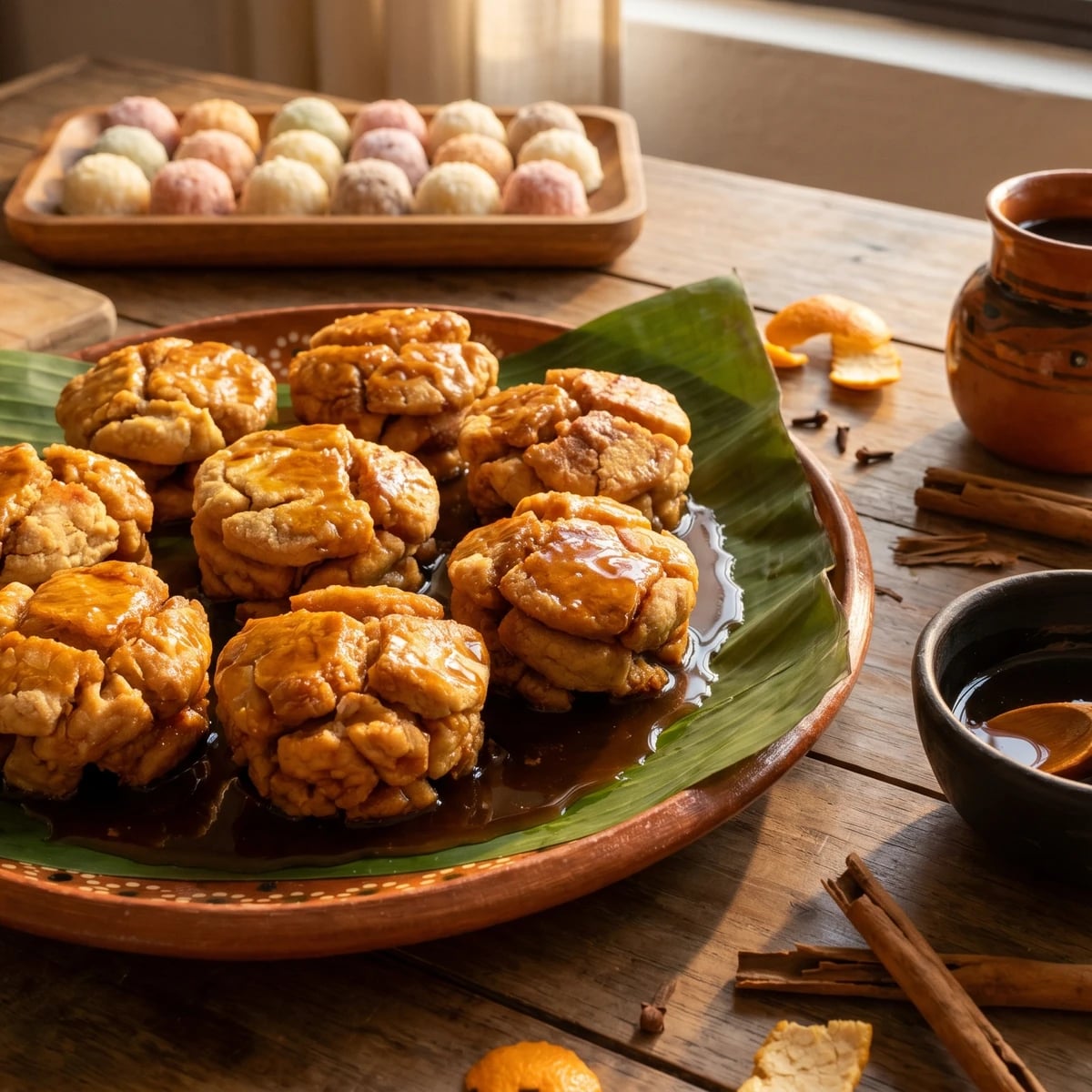
Oaxaca's after-mass sweet from the Valles Centrales: small fried wheat biscuits pressed into clusters and lacquered in a dark, spiced piloncillo syrup, sold from baskets outside the churches of the Centro Historico.
These are from Oaxaca. From the Valles Centrales specifically, where the women set up wide flat baskets outside the churches on Sunday mornings and sell nenguanitos to the families coming out of mass. You will not find them in Mexico City unless an oaxaquena has set up a stand. They are local, stubbornly so, and they belong to the dulceria tradition that runs through Oaxacan cooking from the convents of the colonial period to the home kitchens of San Agustin Yatareni today.
The biscuit itself is wheat, not corn. Oaxaca has a serious wheat tradition, brought by the Spanish and embedded in the convent kitchens, and the dulces de trigo, pan de yema, marquesote, nenguanitos, are part of that lineage. The dough is rich with manteca and a touch of anise, fried until the surface crackles, then dropped warm into a dark piloncillo syrup spiced with canela, clove, and orange peel. Three or four pressed together while the syrup is still warm. That cluster is the dish. A single nenguanito is a snack. A cluster is nenguanitos.
A senora at Jardin Socrates taught me how to glaze them properly one Sunday morning in 2011. She had been making them for thirty-two years. She told me: do not let the syrup get too thick before you dip them, and do not be shy when you press them together. The cluster has to look like it grew that way. I have made them dozens of times since and I still hear her voice when I press the warm biscuits into the spoon. Cada estado, su propia cocina. This one belongs to Oaxaca.
Oaxacan dulceria has its roots in the colonial convent kitchens of the 17th and 18th centuries, where Dominican nuns, working with Spanish wheat, sugarcane reduced into piloncillo, and indigenous techniques for handling cacao and chile, developed a body of regional sweets that survives today in the streets and markets of the Centro Historico. Nenguanitos belong to the family of small fried-and-syruped wheat dulces that includes empanaditas de leche, suspiros, and gaznates, all of which were sold by women in the atrios of Oaxaca's churches as a respectable trade for laywomen well into the 20th century. The piloncillo, made by reducing fresh cane juice in open copper kettles in towns like Pluma Hidalgo, retains the smoky mineral notes that give the syrup its characteristic depth, a flavor profile that refined white sugar cannot reproduce.
Quantity
3 cups
plus more for dusting
Quantity
1/2 cup
at room temperature
Quantity
1/4 cup
Quantity
2
Quantity
1 teaspoon
Quantity
1/2 teaspoon
Quantity
1/2 teaspoon
Quantity
1/3 cup
plus more if needed
Quantity
1 teaspoon
lightly crushed in a molcajete
Quantity
about 4 cups
Quantity
1 pound (about 2 cones)
broken into chunks
Quantity
2 cups
Quantity
2
about 4 inches each
Quantity
3
Quantity
1
about 2 inches long
Quantity
1
halved
| Ingredient | Quantity |
|---|---|
| all-purpose wheat flourplus more for dusting | 3 cups |
| manteca de cerdo (pork lard)at room temperature | 1/2 cup |
| granulated sugar | 1/4 cup |
| large eggs | 2 |
| baking powder | 1 teaspoon |
| fine sea salt | 1/2 teaspoon |
| ground canela (Mexican cinnamon) | 1/2 teaspoon |
| whole milkplus more if needed | 1/3 cup |
| anise seedlightly crushed in a molcajete | 1 teaspoon |
| vegetable oil or additional manteca for frying | about 4 cups |
| piloncillobroken into chunks | 1 pound (about 2 cones) |
| water | 2 cups |
| sticks of canela (Mexican cinnamon)about 4 inches each | 2 |
| whole cloves | 3 |
| strip of orange peelabout 2 inches long | 1 |
| small guava (optional)halved | 1 |
On a wide work surface or in a large bowl, sift together the flour, baking powder, salt, and ground canela. Make a well in the center. Add the manteca, sugar, eggs, milk, and crushed anise seed. Work the wet ingredients into the flour with your fingertips, drawing in flour from the edges of the well, until you have a soft, slightly tacky dough. La manteca es el sabor. The fat is what gives nenguanitos their tender bite, do not skimp on it.
Cover the dough with a clean cotton servilleta and let it rest at room temperature for 20 minutes. The flour needs time to hydrate and the lard needs to relax into the dough. Skip the rest and the biscuits will be tough. No me vengas con atajos.
While the dough rests, make the miel. In a heavy saucepan, combine the piloncillo, water, canela sticks, cloves, orange peel, and guava if using. Bring to a simmer over medium heat. Stir until the piloncillo dissolves completely, then lower the heat and let it reduce for about 25 minutes, until the syrup coats the back of a spoon and pulls a thin thread when you lift the spoon out. The color should be dark amber, almost the color of strong coffee.
Divide the rested dough into walnut-sized pieces, about 1 tablespoon each. Roll each piece between your palms into a smooth ball. Press each ball lightly so it is a fat little disc, about 3/4 inch thick. The senoras at Jardin Socrates make them small. A nenguanito the size of your thumb, three or four pressed together at the moment of glazing. That is the cluster. Set the shaped pieces on a flour-dusted tray as you go.
Heat the frying oil in a deep, heavy pot to 325F. Use a thermometer or test with a small piece of dough, it should sizzle steadily and float to the surface within a few seconds. Fry the nenguanitos in batches of six or seven, never crowding the pot. Cook for 4 to 5 minutes, turning once, until they are deep golden and the surface looks crackled and dry. Lift them out with a slotted spoon and drain on a wire rack set over a sheet pan. Do not drain on paper. The bottom turns soggy and they will not glaze right.
Strain the warm piloncillo syrup. Working in small batches, drop three or four fried nenguanitos into the warm syrup. Use a wooden spoon to roll them around so every surface is coated, then press them gently against each other in the syrup so they fuse into a small cluster. Lift the cluster out with the spoon and set it on a banana leaf or a wide clay plate to set. The syrup should pool slightly underneath. Recetas probadas y garantizadas.
Leave the clusters to set at room temperature for at least 20 minutes. The syrup will thicken into a glossy, almost lacquered coat as it cools. Eat them with strong cafe de olla or a glass of cold milk. They keep at room temperature, lightly covered, for two days, the third day they begin to soften and the syrup weeps. Eat them before that.
1 serving (about 60g)
Culinary guides, cultural storytelling, and the editorial depth that makes cooking meaningful.
Discover Culinary Explorer
Chef Lupita
Oaxaca's pre-Columbian amaranth bar, popped on a hot comal and bound with piloncillo, honey, and the sacred Zapotec grain that the Spanish tried, and failed, to outlaw.

Chef Lupita
Oaxaca's Day of the Dead sugar figures, Spanish-Moorish sugar paste molded into lambs, calaveras, and miniature fruits to dress the ofrenda. Edible ancestors, named in royal icing, set out for the souls who come home in November.

Chef Lupita
Oaxaca's hometown nieve, hand-churned in the wooden garrafa with pineapple, shredded carrot, toasted coconut, and chopped pecans. The proud invention of the dulceras under the laurel trees of the Zocalo.

Chef Lupita
Oaxaca's drunken jellied confections, small pastel cubes spiked with mezcal espadin and dusted in powdered sugar. The dulceria tradition of the Centro Histórico in one bite.