
Chef Fai
Southern Cucumber Relish (Ajad)
The one Thai condiment where vinegar replaces lime as the sour pillar, and the system still holds. Palm sugar for sweet, nam pla for salt, prik for heat. Ajad is the four pillars in a jar.
A cooking platform built around craft, culture, and the stories behind what we eat.

Created by
Sun-dried red chilies roasted black over charcoal, pounded with garlic, shallots, and fish sauce until your eyes water and your nose runs. That's the name. That's the point. Lanna fire from the krok.
This nam prik will make you cry. That's how it got its name. Ta daeng. Red eyes. You roast dried red chilies over charcoal until they're blackened and smoking, and the capsaicin hits the air like tear gas. Your eyes go bloodshot. Your nose runs. And then you pound the whole thing into a paste that could strip paint.
That's Lanna food talking. Northern Thai nam prik is not polite. It's not balanced in the Central Thai sense of gentle harmonies. It's aggressive, concentrated, and built on fire. The kreung tam here is elemental: roasted dried chilies, roasted garlic, roasted shallots, fish sauce, lime. Five components. Nothing to hide behind. Every single element has to be right, because there's nowhere for a weak ingredient to disappear.
Ajarn always said the kreung tam is everything. In nam prik ta daeng, that principle is distilled to its purest form. No coconut milk to soften it. No herbs to complicate it. Just roasted aromatics pounded in the krok until the oils release and the paste turns dark, slick, and dangerous. The mortar does what no blade can: it ruptures the cell walls of the dried chilies and forces the volatile oils out of the garlic and shallots. A blender would give you powder. The krok gives you paste. There's a difference you can taste.
At Fai Thai workshops, I use this dish to teach people what the mortar actually does. I have them pound the roasted chilies and smell the difference between the first strike and the fiftieth. By the time the paste is done, the whole room smells like smoke and chili oil, and everyone's eyes are red. That's when I tell them: now you understand the name. Now eat it with sticky rice and kab moo, and tell me this isn't the most honest food you've ever had.
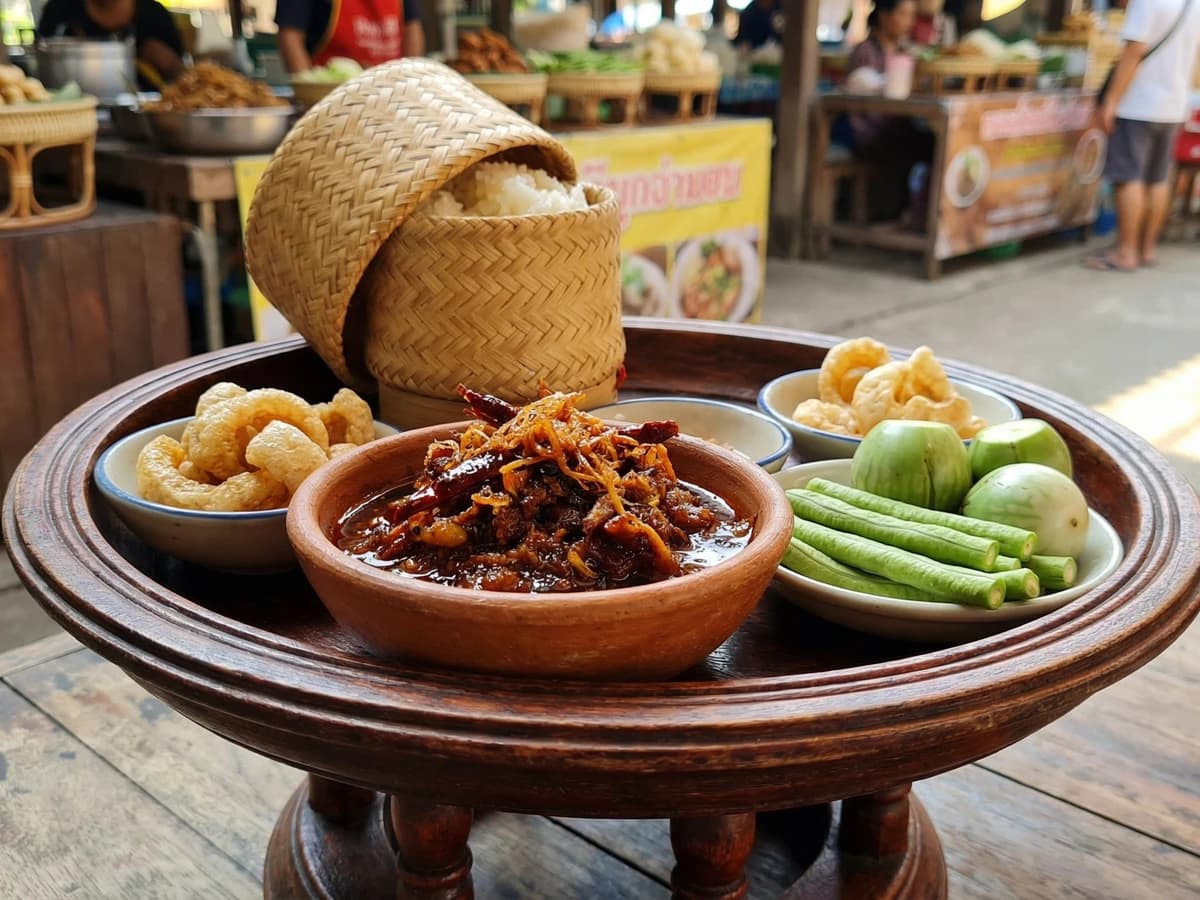
Nam prik ta daeng is a staple of the Lanna (Northern Thai) khantoke table, the traditional low round tray where small bowls of relish, curry, and vegetables surround a shared sticky rice basket. The name literally translates to 'red eye chili dip,' referencing the capsaicin fumes released during roasting that cause the cook's eyes to redden and water. Dried chili dips like this predate the arrival of the chili pepper in Southeast Asia via Portuguese traders in the 16th century; earlier versions likely used local Sichuan peppercorns (makhwaen) before prik haeng became the dominant heat source in Lanna cooking.
Quantity
15
stems removed, seeds shaken out
Quantity
8 cloves
unpeeled
Quantity
4 small
unpeeled
Quantity
2 tablespoons
Quantity
1 tablespoon (about 1 lime)
Quantity
1 teaspoon
Quantity
pinch
Quantity
for serving
Quantity
for serving
Quantity
for serving
quartered
Quantity
for serving
sliced into sticks
Quantity
for serving
cut into 3-inch pieces
Quantity
for serving
cut into wedges
Quantity
for serving
blanched
Quantity
for serving
steamed
| Ingredient | Quantity |
|---|---|
| dried red chilies (prik haeng)stems removed, seeds shaken out | 15 |
| garlicunpeeled | 8 cloves |
| shallots (hom daeng)unpeeled | 4 small |
| fish sauce (nam pla) | 2 tablespoons |
| lime juice (nam manao) | 1 tablespoon (about 1 lime) |
| palm sugar (nam tan pip) (optional) | 1 teaspoon |
| salt (optional) | pinch |
| sticky rice (khao niew) | for serving |
| kab moo (pork rinds) | for serving |
| round Thai eggplant (makhuea pro)quartered | for serving |
| cucumbersliced into sticks | for serving |
| long beans (thua fak yao)cut into 3-inch pieces | for serving |
| cabbagecut into wedges | for serving |
| morning glory (pak bung)blanched | for serving |
| sweet leaf (pak wan)steamed | for serving |
Set your dried red chilies in a dry wok or directly on a charcoal grill over medium-low heat. This is not fast work. You're toasting, not burning. Turn them constantly with tongs. The chilies will darken from deep red to a mottled brown-black, puff slightly, and release an acrid, smoky capsaicin vapor that will hit your eyes and throat. That's the moment the name makes sense. Your eyes will water. Your nose will run. Keep going. You want them blackened in spots, brittle, and deeply fragrant. About 3 to 5 minutes. If they turn to ash, you went too far. Pull them off and set aside.
Place the unpeeled garlic cloves and shallots directly on the charcoal or in the same dry wok over medium heat. Roast them, turning occasionally, until the skins are charred black and the flesh inside is soft and sweet. The garlic takes about 5 to 7 minutes. The shallots take 8 to 10 because they're larger. Squeeze one: if it gives easily under pressure and smells caramelized, it's done. Peel off the charred skins. The flesh should be golden to brown, jammy, and intensely aromatic.
Start with the roasted chilies in the granite mortar. Pound them first, alone. They need to break down into coarse flakes before anything else goes in. The dried chilies resist at first, then shatter, then gradually become a rough, oily, dark red mass. You'll feel the texture change under the pestle. Once the chilies are a coarse paste (not powder, not whole pieces, somewhere in between), add the roasted garlic and shallots. Pound again. The soft garlic and shallots will merge into the chili paste, binding everything together. The mortar is doing what no machine can: rupturing cell walls at different rates, releasing garlic oils into chili oils, creating a paste where every component is integrated but still has texture. Keep pounding until the paste is cohesive, slightly oily, and dark reddish-brown. About 5 minutes of steady work.
Add the fish sauce to the mortar. Pound it in. The paste will loosen slightly and darken. Squeeze in the lime juice. Pound again to incorporate. Taste. This is the moment that matters. The dominant note should be smoky heat from the roasted chilies, backed by the deep sweetness of charred garlic and shallots, with the fish sauce providing the salt foundation and the lime cutting through the richness with a sharp edge. If the heat is overwhelming and there's no depth behind it, add the palm sugar, just a teaspoon, pounded in. If the salt isn't enough, a pinch more fish sauce. If it's flat, more lime. Pound, taste, adjust. That's the method.
Transfer the nam prik to a small bowl. Arrange it on a khantoke tray (or any shared platter) surrounded by a basket of sticky rice, a pile of kab moo (pork rinds), and the vegetable accompaniments: raw long beans, quartered round Thai eggplant, cucumber sticks, cabbage wedges, blanched morning glory, and steamed pak wan. Tear off a piece of sticky rice with your fingers, press it flat, scoop a small amount of nam prik onto it, add a piece of vegetable or kab moo. That's a bite. The sticky rice is the vehicle. The nam prik is the soul. The vegetables are the cooling counterpoint. Every element has a job.
1 serving (about 45g)
Culinary guides, cultural storytelling, and the editorial depth that makes cooking meaningful.
Discover Culinary ExplorerChef Fai
The one Thai condiment where vinegar replaces lime as the sour pillar, and the system still holds. Palm sugar for sweet, nam pla for salt, prik for heat. Ajad is the four pillars in a jar.

Chef Fai
Every grilled dish in Isan answers to this dip. Roasted dried chilies, nam pla, manao, khao khua, and shallots: the four pillars in a condiment that's structural, not optional.
Chef Fai
Roasted dried chilies and galangal pounded to a rough paste, folded with shredded pork skin and palm sugar until it becomes something sweet, smoky, and chewy that belongs on every khantoke tray in Chiang Mai.
Chef Fai
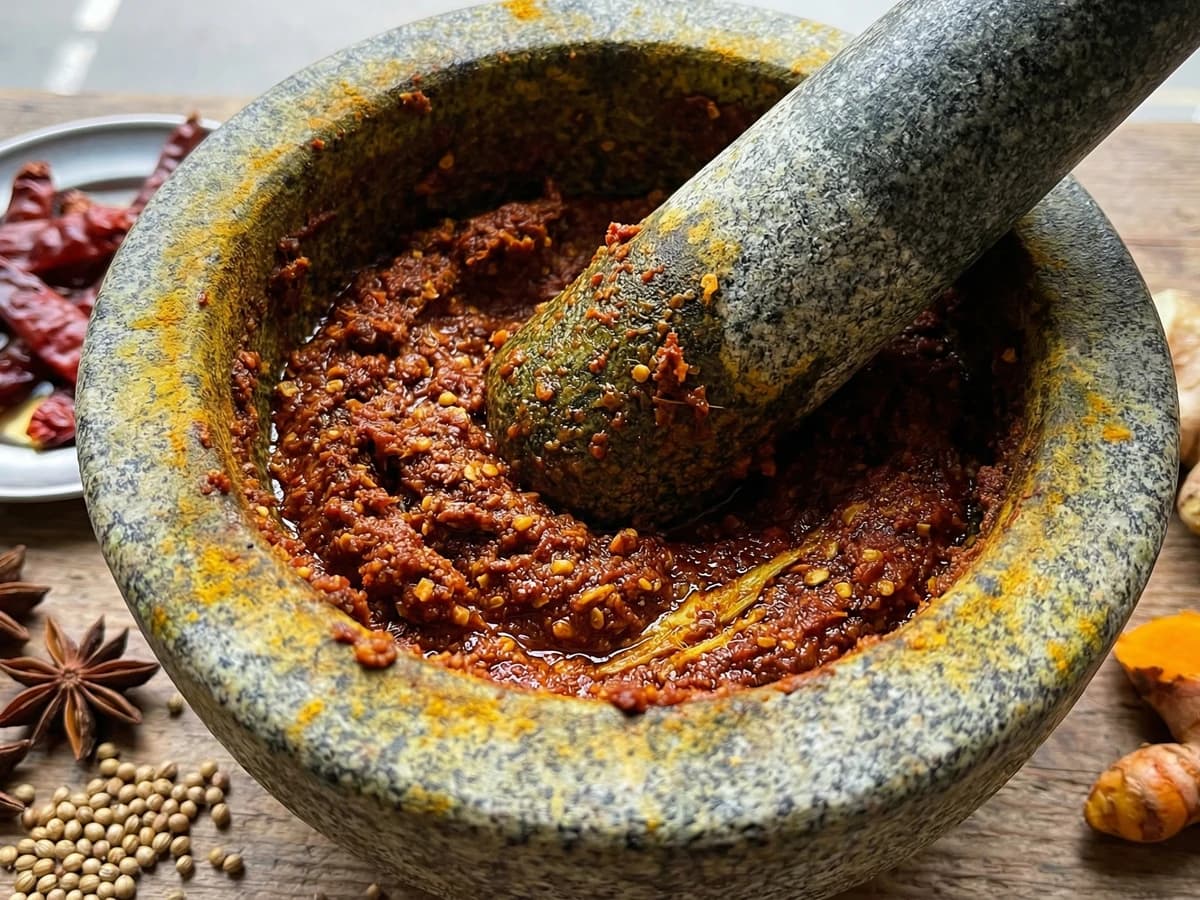
The kreung tam that proves the system adapts. Ginger instead of galangal, cumin and star anise alongside lemongrass. Lanna's mortar holds the whole Burma-to-Chiang Mai trade route in a single paste.