
Chef Fai
Southern Cucumber Relish (Ajad)
The one Thai condiment where vinegar replaces lime as the sour pillar, and the system still holds. Palm sugar for sweet, nam pla for salt, prik for heat. Ajad is the four pillars in a jar.
A cooking platform built around craft, culture, and the stories behind what we eat.

Created by
The kreung tam stripped to its driest bones: roasted chilies and garlic pounded until they shatter like glass. Lanna farmers carried this to the rice fields because the mortar can preserve as well as it transforms.
Every nam prik starts in the mortar. This one ends there too. No liquid. No coconut milk. No broth to loosen it. Nam prik haew is the kreung tam taken to its logical extreme: pound dried ingredients until there's nothing left but concentrated flavor and a texture that snaps like thin glass between your teeth.
Ajarn always said the mortar transforms. He was talking about the physics of it, how the pestle crushes cell walls and releases volatile oils in ways a blade never can. Nam prik haew proves this more than any other dish I know. You start with dried chilies that are leathery and tough. You start with garlic cloves roasted until they're papery husks. You pound them together and something happens. The chili flakes catch the garlic oils. The salt draws out whatever moisture remains and then locks it down. The tua nao (fermented soybean disc), that funky, brilliant Lanna replacement for kapi, crumbles into the mix and gives it a deep, almost cheesy umami. What comes out of the krok is a dry, brittle, rust-colored paste with a sheen on the broken edges that looks like, well, glass.
This is Lanna preservation science. No refrigerator. No vacuum seal. Just the knowledge that if you remove all the water and pound everything into a dense, dry mass, it won't spoil. Northern Thai farmers packed nam prik haew in bamboo tubes and carried it to the fields. They'd break off a chunk, press it onto a ball of sticky rice, eat it with whatever raw vegetables grew at the edge of the paddy. That was lunch. Portable, shelf-stable, complete.
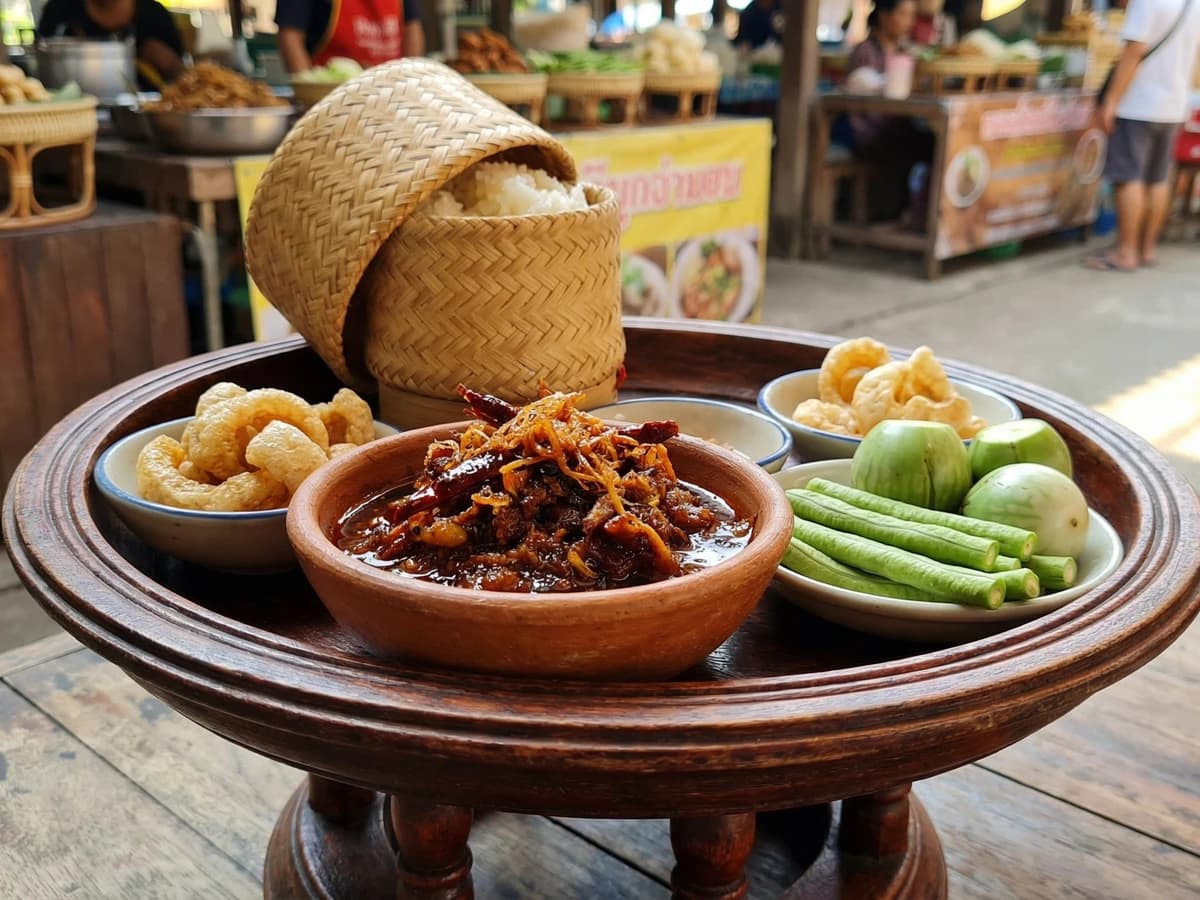
The four pillars are here, compressed. Salt from the fish sauce, dried into the paste. Heat from the chilies, which is the dominant voice. The sour and sweet are absent because they require moisture, and moisture is what this dish refuses. When you eat it, the accompaniments supply what the paste doesn't: the sticky rice gives body, the raw vegetables give freshness, the kab moo (pork rinds) give fat. The khantoke tray is designed this way. Every element completes the others. That's the system at work.
Nam prik haew belongs to the Lanna (Northern Thai) tradition of dry-pounded relishes developed before refrigeration, when farmers and traders needed portable, shelf-stable food for days in the rice fields or on mountain trade routes. The word 'haew' in Northern dialect describes the dry, glass-brittle quality of the finished paste, distinguishing it from wet nam prik preparations. Lanna's use of tua nao (fermented soybean discs) instead of kapi (shrimp paste) in many relishes reflects the region's inland geography, far from the coast and its fermented seafood traditions, and points to cultural exchange with highland communities across mainland Southeast Asia.
Quantity
30
stems removed, seeds shaken out
Quantity
1 full head (about 15 cloves)
unpeeled
Quantity
4
unpeeled
Quantity
1 small disc (about 2 tablespoons crumbled)
Quantity
1 tablespoon
Quantity
1 teaspoon
| Ingredient | Quantity |
|---|---|
| large dried red chilies (prik haeng)stems removed, seeds shaken out | 30 |
| garlicunpeeled | 1 full head (about 15 cloves) |
| shallots (hom daeng)unpeeled | 4 |
| tua nao (fermented soybean disc) | 1 small disc (about 2 tablespoons crumbled) |
| fish sauce (nam pla) | 1 tablespoon |
| coarse salt | 1 teaspoon |
Set a dry wok or heavy pan over medium heat. No oil. Add the dried chilies in a single layer and toast them, pressing down with a spatula and turning frequently. You want them darkened two shades, deeply fragrant, and completely brittle. They should snap cleanly when you bend one. If they bend without breaking, they're not done. This takes 5 to 8 minutes. The smell will be sharp, smoky, and it will make you cough. Open a window. That burn in your throat means the capsaicin is volatilizing. Good. Set the chilies aside to cool completely. They must be bone-dry and cool before you pound them.
In the same dry wok, roast the unpeeled garlic cloves and shallots over medium heat. Turn them every couple of minutes. The skins will blacken and char. That's fine, the skins are armor. You're cooking the flesh inside until it's soft, golden, and starting to dry out. Garlic takes about 10 minutes. Shallots take 12 to 15 because they're larger. When a clove gives easily under gentle pressure and smells sweet and nutty, it's done. Peel them while warm. The skins slip right off. Let the peeled flesh cool on a plate, spreading them out so moisture evaporates.
Break the tua nao disc into rough pieces and dry-toast them in the same wok for 2 minutes, just until fragrant and slightly darkened. Tua nao smells funky. Earthy, fermented, almost like aged cheese. That's exactly right. This is Lanna's answer to kapi (shrimp paste). Different fermentation, different organism, different depth entirely. The soybean gives you umami without the sea. Cool the pieces completely.
Add the salt to your granite mortar. Add the cooled toasted chilies in batches. Pound them down to coarse flakes first, then keep going. The rhythm is steady, vertical strikes, rotating the mortar with your free hand. The chilies will resist, then suddenly collapse into a rough powder with shiny, flaky edges. That's the beginning of the glass texture. Add the tua nao pieces and pound them in. Then the garlic and shallots, a few cloves at a time. The garlic still has some moisture, and this is the only moisture in the entire paste. Pound it in. Let the dry chili absorb it. Keep pounding until the mass comes together into a dense, dry, crumbly paste. Drizzle in the fish sauce, a little at a time, pounding after each addition. The paste should not be wet. It should be barely cohesive, like damp sand that holds its shape when pressed but crumbles when you break it. If it looks glossy or oily on the surface, you've gone too wet. The finished texture should shatter at the edges when you press a spoon into it.
Break off a small piece and press it onto a ball of sticky rice. Eat it with a raw long bean or a piece of cucumber. The paste should hit you with concentrated chili heat first, then the deep fermented funk of tua nao, then the roasted sweetness of garlic and shallot underneath. The salt from the fish sauce should tie it together without announcing itself. If the heat overwhelms everything else, you need more garlic and tua nao. If it tastes flat, more salt. Adjust in the mortar. Pack the finished paste into a clean jar, press it down firmly to remove air pockets, and seal. Serve at room temperature alongside sticky rice (khao niew), kab moo (pork rinds), raw long beans (thua fak yao), sliced cucumber, round Thai eggplant (makheua pro), and steamed pak wan (sweet leaf).
1 serving (about 42g)
Culinary guides, cultural storytelling, and the editorial depth that makes cooking meaningful.
Discover Culinary ExplorerChef Fai
The one Thai condiment where vinegar replaces lime as the sour pillar, and the system still holds. Palm sugar for sweet, nam pla for salt, prik for heat. Ajad is the four pillars in a jar.

Chef Fai
Every grilled dish in Isan answers to this dip. Roasted dried chilies, nam pla, manao, khao khua, and shallots: the four pillars in a condiment that's structural, not optional.
Chef Fai
Roasted dried chilies and galangal pounded to a rough paste, folded with shredded pork skin and palm sugar until it becomes something sweet, smoky, and chewy that belongs on every khantoke tray in Chiang Mai.
Chef Fai
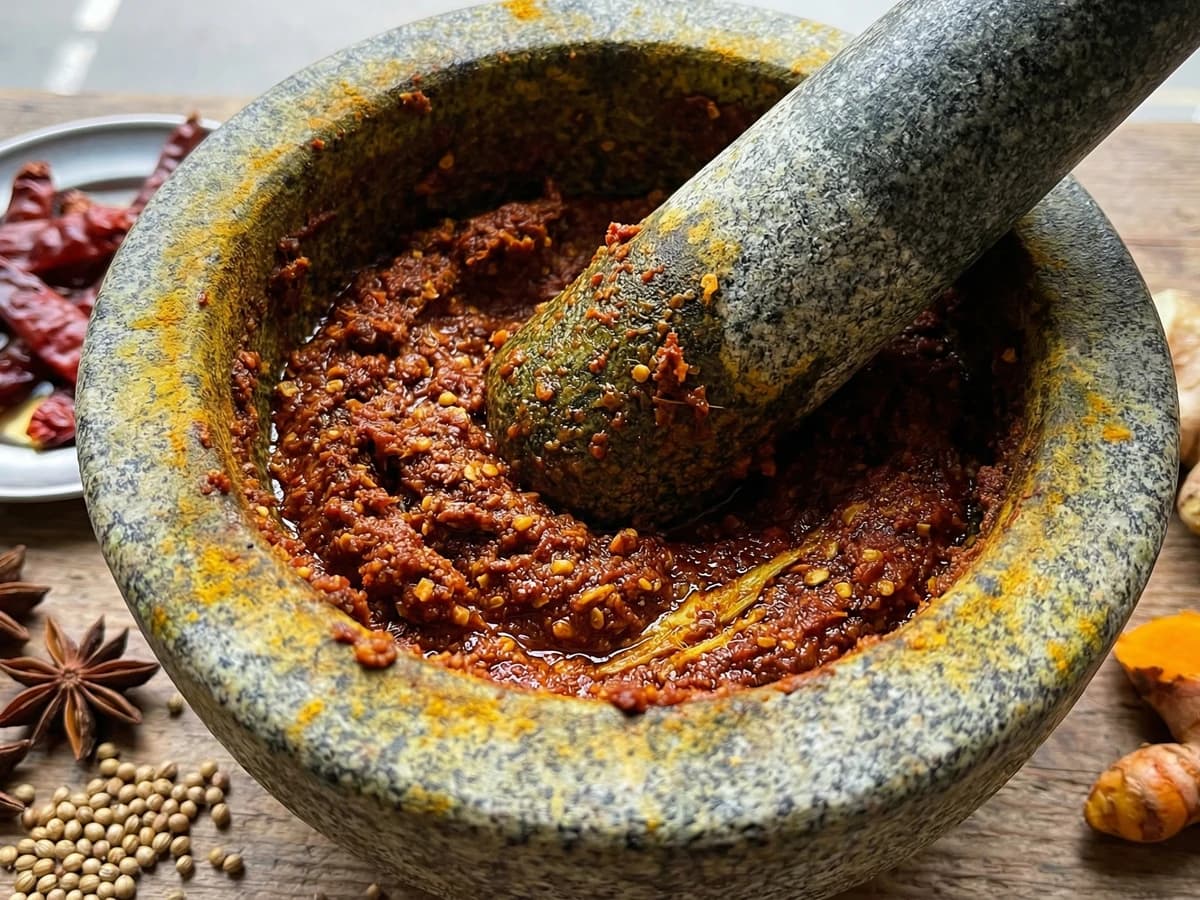
The kreung tam that proves the system adapts. Ginger instead of galangal, cumin and star anise alongside lemongrass. Lanna's mortar holds the whole Burma-to-Chiang Mai trade route in a single paste.