
Chef Fai
Southern Cucumber Relish (Ajad)
The one Thai condiment where vinegar replaces lime as the sour pillar, and the system still holds. Palm sugar for sweet, nam pla for salt, prik for heat. Ajad is the four pillars in a jar.
A cooking platform built around craft, culture, and the stories behind what we eat.

Created by
Roasted pla too torn apart and pounded into a kreung tam of charred chilies, garlic, and shallots. Fish sauce for salt, lime for sour, palm sugar for sweet, prik haeng for heat. Every Thai mother's answer to the question: what's for dinner?
Nam prik is the oldest idea in Thai food. Before curries, before stir-fries, before anything you'd recognize on a restaurant menu, there was nam prik: a pounded relish eaten with rice and whatever vegetables were at hand. That's the system stripped to its skeleton. Kreung tam plus protein plus rice. Everything else is decoration.
Ajarn always said that if you want to understand Thai cuisine, don't start with pad thai or green curry. Start with nam prik. It's the kreung tam in its purest form. Aromatics pounded in the mortar, seasoned with the four pillars, eaten with your hands from a shared tray. Nam prik pla too takes that foundation and adds pla too, Thailand's most eaten fish, roasted until the skin blisters and the flesh flakes apart, then torn and pounded directly into the paste. The fish isn't a topping. It's part of the kreung tam. That's the principle.
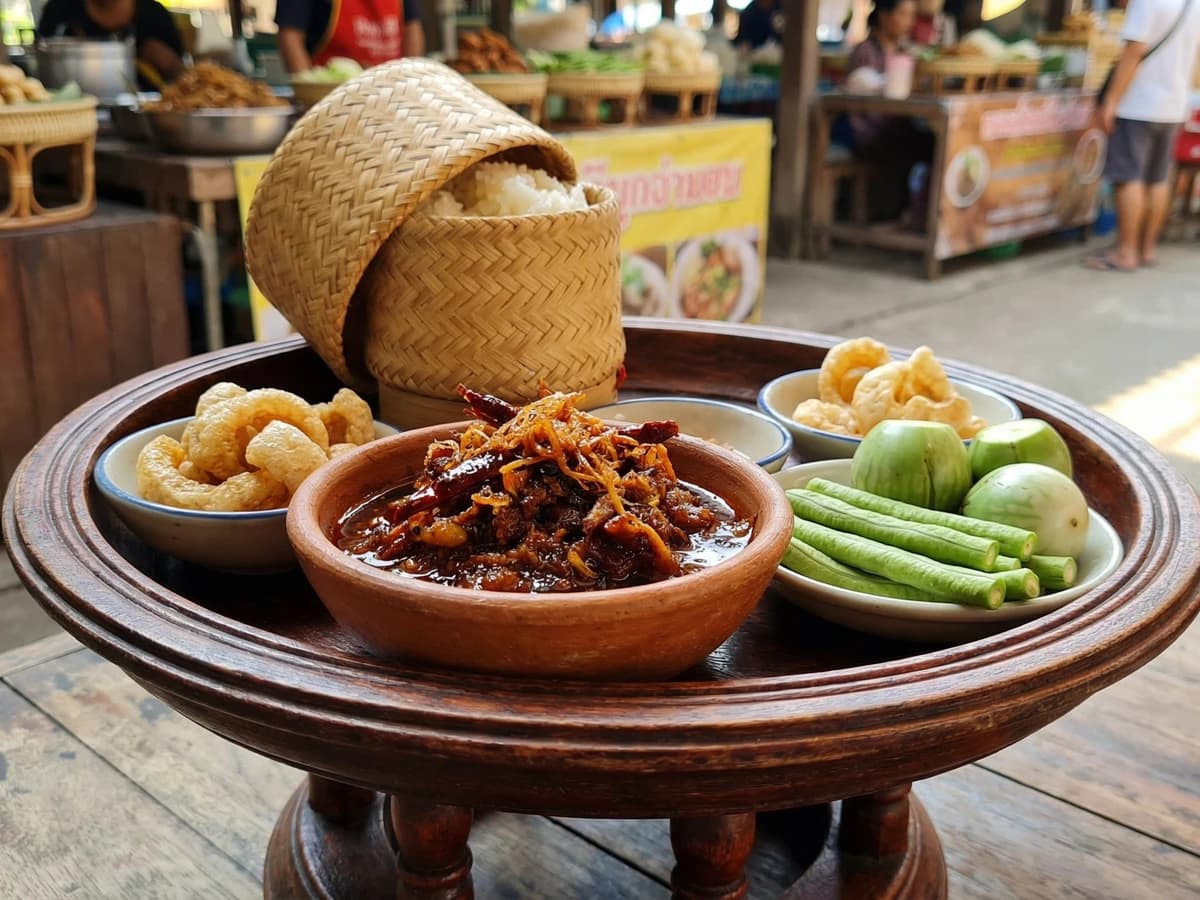
In the North, this lives on the khantoke. A low round tray on the floor, small bowls of nam prik circling a central basket of sticky rice, kab moo (pork rinds) piled next to raw vegetables and blanched greens. You pinch off sticky rice, press it flat, scoop the nam prik, add a slice of cucumber or a bite of round eggplant. That's a mouthful. The combination is the design. Eating nam prik from a plate with a fork is like reading a poem one word at a time.
The aromatics here are charred. Dried red chilies (prik haeng), garlic cloves, and shallots go over charcoal or an open flame until blackened on the outside and soft inside. That char is where the depth comes from. Raw garlic gives sharpness. Charred garlic gives sweetness and smoke. The mortar brings everything together: fish, char, kapi (shrimp paste), lime, nam pla. Pound, taste, adjust. The method doesn't change. The principle doesn't change. Fish sauce for salt. Palm sugar for sweet. Lime for sour. That's the law.
Nam prik predates every other category of Thai cooking and is considered the original Thai dish: a pounded relish of chilies, garlic, and fermented protein eaten with rice. Pla too (short mackerel, Rastrelliger brachysoma) is the most consumed fish in Thailand, historically the cheapest protein available at any market. Nam prik pla too became the default weeknight meal across all regions precisely because of this accessibility. In Northern Thailand, nam prik pla too is served on the khantoke (ขันโตก), the traditional Lanna low tray, alongside sticky rice rather than the jasmine rice of Central Thailand, reflecting Lanna's deep cultural alignment with Lao and Shan sticky-rice traditions.
Quantity
2 whole, about 150g each
Quantity
2 tablespoons
for frying the fish
Quantity
7
deseeded
Quantity
5 cloves
unpeeled
Quantity
4 small
unpeeled
Quantity
1 teaspoon
Quantity
2 tablespoons
Quantity
3 tablespoons (about 2-3 limes)
Quantity
1 teaspoon
Quantity
for serving
Quantity
for serving
quartered
Quantity
for serving
sliced into spears
Quantity
for serving
cut into 3-inch pieces
Quantity
for serving
cut into wedges
Quantity
for serving
blanched
Quantity
for serving
steamed
Quantity
for serving
| Ingredient | Quantity |
|---|---|
| short mackerel (pla too) | 2 whole, about 150g each |
| vegetable oilfor frying the fish | 2 tablespoons |
| dried red chilies (prik haeng)deseeded | 7 |
| garlicunpeeled | 5 cloves |
| shallots (hom daeng)unpeeled | 4 small |
| shrimp paste (kapi) | 1 teaspoon |
| fish sauce (nam pla) | 2 tablespoons |
| lime juice (nam manao) | 3 tablespoons (about 2-3 limes) |
| palm sugar (nam tan pip) | 1 teaspoon |
| sticky rice (khao niew) | for serving |
| round Thai eggplant (makhuea phuang)quartered | for serving |
| cucumbersliced into spears | for serving |
| long beans (thua fak yao)cut into 3-inch pieces | for serving |
| cabbagecut into wedges | for serving |
| morning glory (pak bung)blanched | for serving |
| sweet leaf (pak wan)steamed | for serving |
| pork rinds (kab moo) | for serving |
Heat the oil in a small pan over medium-high heat. Fry the pla too whole until the skin is golden and blistered on both sides, about 4-5 minutes per side. The skin should be crisp, the flesh cooked through and easy to flake. Set aside to cool enough to handle. You can grill the fish over charcoal instead of frying, which gives you a smokier result. Either way, the fish needs to be fully cooked with firm, flaky flesh.
Dry-roast the dried red chilies in a hot wok or directly over a gas flame, turning constantly, until they darken and smell smoky. About 2 minutes. Set aside. Place the unpeeled garlic cloves and shallots directly on the charcoal grill or over a gas flame. Char them until the skins are blackened and the inside is soft and sweet. The garlic takes about 5 minutes, the shallots about 8. Squeeze them out of their charred skins. They should be golden, soft, almost jammy.
Start with the roasted chilies in the granite mortar (krok hin). Pound them to rough flakes. Add the charred garlic and shallots. Pound to a coarse, chunky paste. You want texture, not baby food. Add the kapi (shrimp paste) and pound it in until everything is incorporated. The aroma should hit you now: smoky, funky, sharp. That's the kreung tam doing its work.
Pull the mackerel flesh off the bones in large flakes. Discard the head, bones, and guts. Add the flaked fish to the mortar. Pound it into the paste, but gently. You're integrating, not pulverizing. The fish should break into the kreung tam while keeping some visible texture. Some chunks, some threads, some fully incorporated. That variation is the point.
Add the fish sauce, lime juice, and palm sugar to the mortar. Stir with the pestle to combine. Now taste. The balance should be: sour first (the lime leads), then salty (the fish sauce and kapi together), then a low sweetness (the palm sugar and the charred shallots), then heat building from the prik haeng. Adjust. More lime if it's flat. More nam pla if it needs backbone. The palm sugar is there to round the edges, not to make it sweet. A tiny amount. If you can taste the sugar as sugar, you've added too much.
Transfer the nam prik to a small bowl and set it on the khantoke tray. Arrange the sticky rice basket in the center. Surround with the raw vegetables: quartered round Thai eggplant, cucumber spears, long bean pieces, cabbage wedges. Add the blanched morning glory and steamed pak wan (sweet leaf). Pile the kab moo (pork rinds) on one side. You eat this with your hands. Pinch sticky rice, flatten it, scoop the nam prik, grab a vegetable. That's a bite. The combination of nam prik, rice, and raw vegetable in one mouthful is the entire design. Don't separate them.
1 serving (about 75g)
Culinary guides, cultural storytelling, and the editorial depth that makes cooking meaningful.
Discover Culinary ExplorerChef Fai
The one Thai condiment where vinegar replaces lime as the sour pillar, and the system still holds. Palm sugar for sweet, nam pla for salt, prik for heat. Ajad is the four pillars in a jar.

Chef Fai
Every grilled dish in Isan answers to this dip. Roasted dried chilies, nam pla, manao, khao khua, and shallots: the four pillars in a condiment that's structural, not optional.
Chef Fai
Roasted dried chilies and galangal pounded to a rough paste, folded with shredded pork skin and palm sugar until it becomes something sweet, smoky, and chewy that belongs on every khantoke tray in Chiang Mai.
Chef Fai
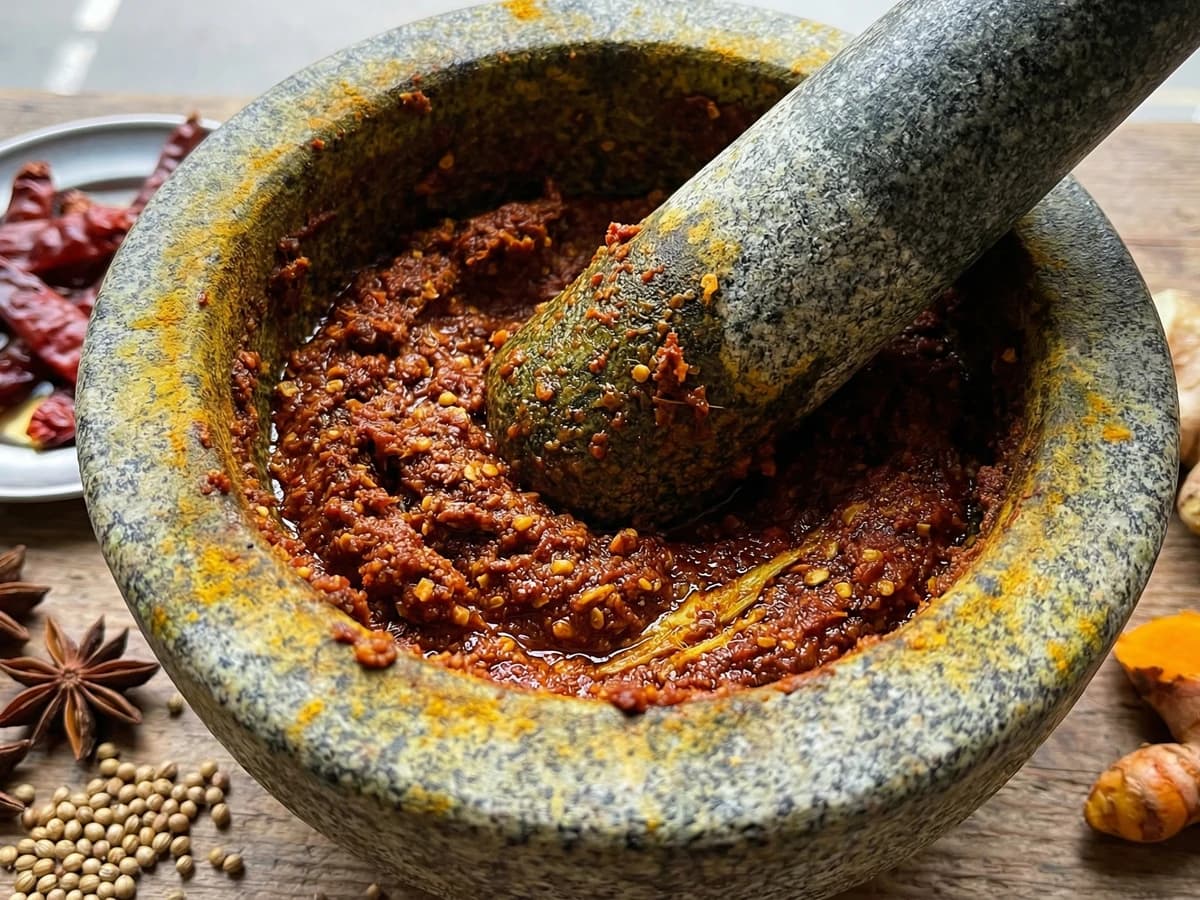
The kreung tam that proves the system adapts. Ginger instead of galangal, cumin and star anise alongside lemongrass. Lanna's mortar holds the whole Burma-to-Chiang Mai trade route in a single paste.