
Chef Fai
Southern Cucumber Relish (Ajad)
The one Thai condiment where vinegar replaces lime as the sour pillar, and the system still holds. Palm sugar for sweet, nam pla for salt, prik for heat. Ajad is the four pillars in a jar.
A cooking platform built around craft, culture, and the stories behind what we eat.

Created by
Five ingredients. Charcoal. A mortar. The kreung tam stripped to its bones: fire transforms, the krok unifies, and galangal steps from background note to the center of the plate.
Strip Thai food down to its bones and this is what you find. Fire. A mortar. Salt. That's Nam Prik Kha. It's the kreung tam principle at its most elemental: roast your ingredients until the fire changes them at a cellular level, then pound them into something greater than the sum of their parts. Principles, not recipes.
Galangal is a hard, woody, almost medicinal rhizome when raw. Most people know it as a background note in tom kha or green curry, a slice floating in broth. In Lanna cuisine, it steps forward. You slice it thin, throw it directly onto hot charcoal or an open gas flame, and roast it until the edges blacken and the interior turns soft, smoky, and warm. The fire does what no blade can: it breaks down the sharp camphor compounds and concentrates the earthy oils underneath. Raw galangal bites. Roasted galangal hums. That transformation is the whole point of this dish.
The dried chilies go into the fire too. So do the garlic and shallots, still in their skins, charring on the outside while they steam and sweeten within. Then everything goes into the krok. Pound it coarse with fish sauce and a pinch of salt. Five ingredients. One technique. The kreung tam is everything.
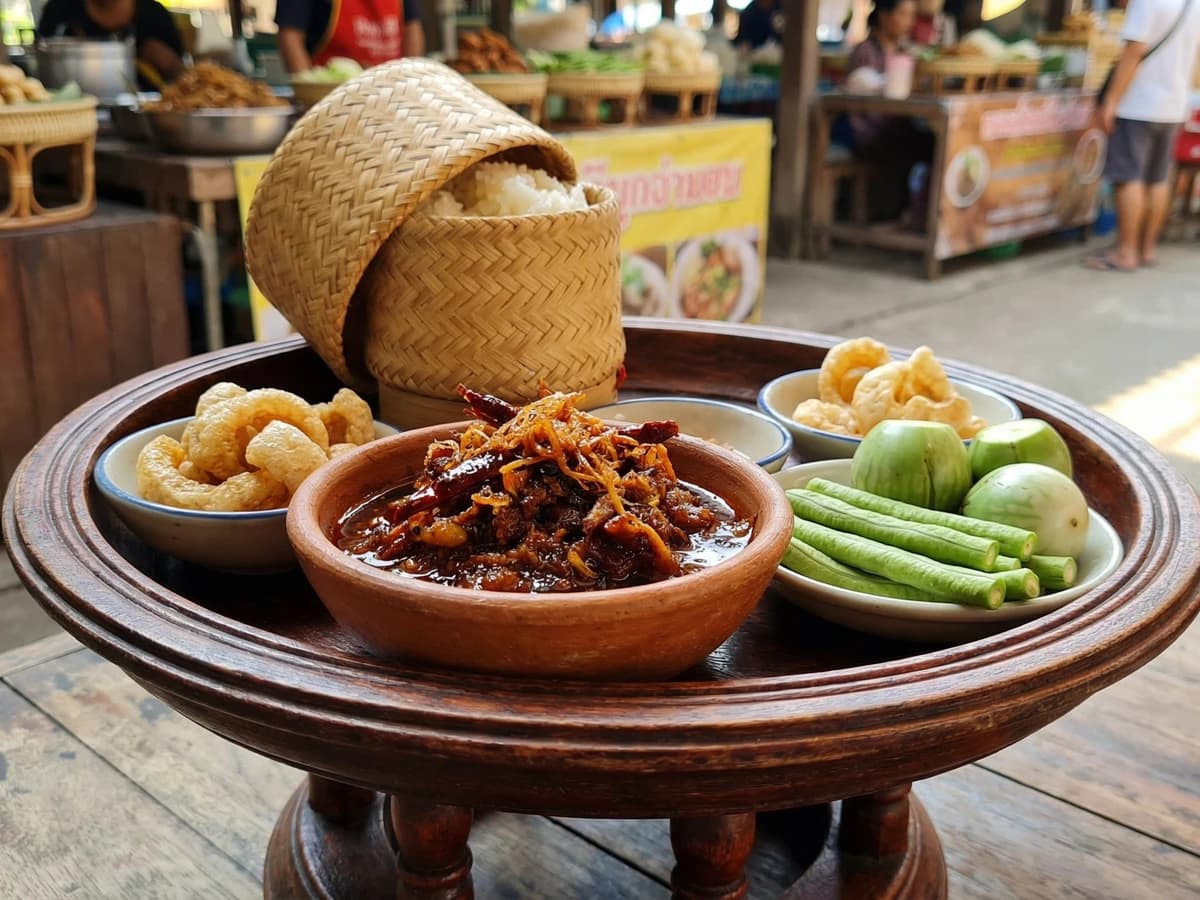
Ajarn always said the kreung tam tells you when it's ready. When the aroma fills the room, you're there. With Nam Prik Kha, that aroma is unmistakable: smoky, herbal, ancient. This is mountain food. Lanna food. The kind of nam prik that sits in a small bowl on the khantoke tray next to a basket of sticky rice, a mound of steamed mushrooms, some raw long beans, and a pile of kab moo (pork rinds). Nothing fancy. Nothing wasted. Simple food that only exists because someone took the time to roast, pound, and taste.
Nam Prik Kha (น้ำพริกข่า) belongs to the Lanna culinary tradition of Northern Thailand, where galangal (kha) grows abundantly in the cooler mountainous terrain and appears as a primary ingredient rather than a supporting aromatic. Unlike Central Thai nam priks that typically rely on shrimp paste (kapi) as the fermented backbone, many Lanna nam priks achieve their depth through dry-roasting over charcoal, concentrating flavor through fire rather than fermentation. The dish is traditionally served as part of a khantoke (ขันโตก), the raised wooden tray used in Northern Thai communal dining since the Lanna Kingdom period, alongside sticky rice and an assortment of seasonal vegetables foraged from the surrounding hills.
Quantity
80g
sliced into thin rounds, about 2mm thick
Quantity
8
stems snapped off, seeds left in
Quantity
1 head (about 8 cloves)
unpeeled
Quantity
4
unpeeled
Quantity
2 tablespoons
Quantity
1/2 teaspoon
Quantity
for serving
Quantity
200g
steamed
Quantity
for serving
Quantity
for serving
| Ingredient | Quantity |
|---|---|
| young galangal (kha on)sliced into thin rounds, about 2mm thick | 80g |
| dried red chilies (prik haeng)stems snapped off, seeds left in | 8 |
| garlicunpeeled | 1 head (about 8 cloves) |
| shallots (hom daeng)unpeeled | 4 |
| fish sauce (nam pla) | 2 tablespoons |
| coarse salt (klua) | 1/2 teaspoon |
| sticky rice (khao niew) | for serving |
| mixed mushrooms (het)steamed | 200g |
| pork rinds (kab moo) | for serving |
| raw vegetables: long beans, round Thai eggplant (makhuea pro), cucumber | for serving |
Set a charcoal grill, wire rack over charcoal embers, or a gas flame to medium heat. Place the dried red chilies (prik haeng) directly on the grate or in a dry pan over the flame. Roast them, turning frequently with tongs, until they darken two or three shades, puff slightly, and become brittle. About 2 to 3 minutes. You want charred spots, not ash. The smell should be smoky and sharp, not acrid. If they go black all the way through, they're burnt. Start over. Pull them off the heat and set aside.
Place the galangal slices directly on the charcoal grate or over the gas flame. Roast until the edges char and blacken, the slices curl slightly, and the interior turns from stark white to a pale golden tan. Flip once. About 3 to 4 minutes per side. The galangal should be dry, leathery at the edges, and fragrant. Raw galangal smells like camphor and pine. Roasted galangal smells earthy, warm, almost woody. That shift is everything. If you can still smell sharp camphor, keep roasting.
Place the whole unpeeled garlic cloves and shallots on the grate. Roast, turning occasionally, until the skins are deeply charred on all sides and the interior is soft when pressed with tongs. The garlic takes about 8 minutes. The shallots take 10 to 12 because they're larger. Press one with tongs: if it gives easily and feels jammy inside, it's done. The charred skin peels off in papery sheets. The roasted flesh inside should be golden and sweet-smelling. Set aside and let them cool enough to handle. Peel.
Start with the salt and roasted dried chilies in the granite mortar (krok hin). Pound to a coarse flake. Not powder. You want rough texture with visible chili fragments. Add the roasted galangal slices. These are tough even after roasting, so pound with force. Firm, steady strikes. The galangal breaks down into fibrous shreds first, then into a rough, dry paste. This takes work. Your arm will know. Add the peeled roasted garlic and shallots. They're soft, so they'll meld quickly. Pound everything together until you have a coarse, dry, unified paste. You should see chili flecks, galangal fiber, and roasted garlic all incorporated but not homogeneous. Texture matters. This is a rustic nam prik, not a smooth sauce.
Add the fish sauce to the mortar. Pound it in, just a few strokes, to distribute evenly through the paste. Taste. The balance should be: salty first from the fish sauce and salt, then a slow herbal heat from the galangal and chilies, then a deep smokiness underneath everything. If it tastes flat, add more fish sauce, half a teaspoon at a time. If the salt is right but the smoke flavor feels muted, your roasting wasn't aggressive enough. This is a dry nam prik. It should hold its shape on a spoon, not run. If it's too wet, you've added too much fish sauce. Adjust. Pound, taste, adjust. That's the method.
Transfer the nam prik to a small bowl. Arrange it on the khantoke tray (or a large plate if that's what you have) alongside a basket of sticky rice (khao niew), steamed mushrooms, pork rinds (kab moo), and raw vegetables: long beans cut into 3-inch pieces, sliced cucumber, quartered round Thai eggplant. The sticky rice is the vehicle. Tear off a small piece, pinch some nam prik onto it with a bit of mushroom or a shard of kab moo. That's a bite. The combination is the design. Don't eat the nam prik alone. It's not meant to stand by itself. It's meant to be part of the khantoke.
1 serving (about 90g)
Culinary guides, cultural storytelling, and the editorial depth that makes cooking meaningful.
Discover Culinary ExplorerChef Fai
The one Thai condiment where vinegar replaces lime as the sour pillar, and the system still holds. Palm sugar for sweet, nam pla for salt, prik for heat. Ajad is the four pillars in a jar.

Chef Fai
Every grilled dish in Isan answers to this dip. Roasted dried chilies, nam pla, manao, khao khua, and shallots: the four pillars in a condiment that's structural, not optional.
Chef Fai
Roasted dried chilies and galangal pounded to a rough paste, folded with shredded pork skin and palm sugar until it becomes something sweet, smoky, and chewy that belongs on every khantoke tray in Chiang Mai.
Chef Fai
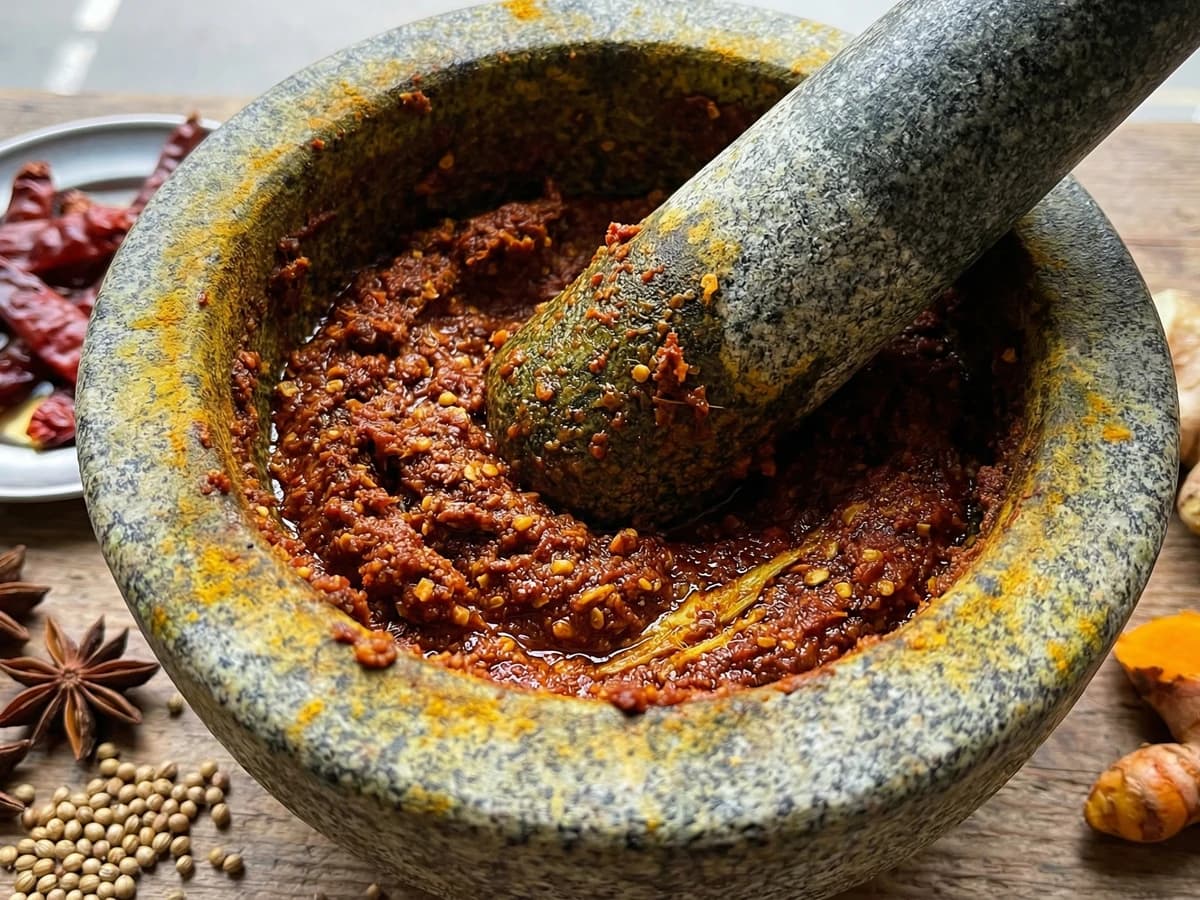
The kreung tam that proves the system adapts. Ginger instead of galangal, cumin and star anise alongside lemongrass. Lanna's mortar holds the whole Burma-to-Chiang Mai trade route in a single paste.