
Chef Fai
Dry Egg Noodles (Ba Mee Haeng)
The four pillars live at the bottom of the bowl before the noodles ever touch it: nam pla for salt, sugar for sweet, vinegar for sour, chili for heat. Every noodle cart in Bangkok runs on this principle.
A cooking platform built around craft, culture, and the stories behind what we eat.
Created by
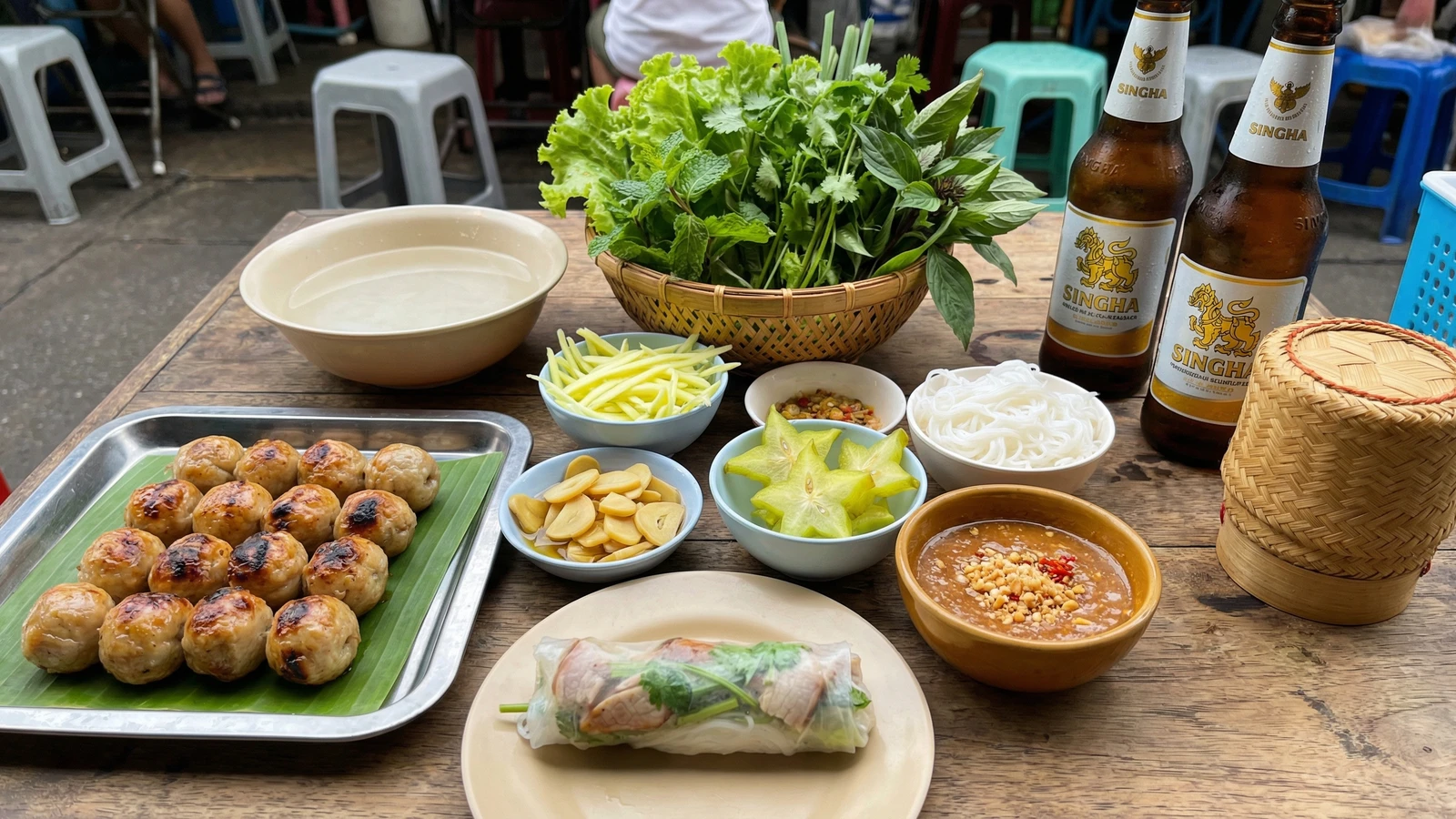
Korat's favorite crossover: bouncy grilled pork balls, rice paper, a mountain of herbs, and a peanut dipping sauce that hits all four pillars. This is Isan hospitality on a table, not a plate.
Naem nuang is not one dish. It's a system laid out on a table. Grilled pork balls, rice paper, herbs, pickled garlic, green mango, dipping sauce. Every person at the table builds their own wrap. Every wrap is different. That's the design.
The pork balls follow a principle Ajarn drilled into me about protein manipulation: you pound the pork until the myosin proteins bind. That's what gives naem nuang its signature bounce, that QQ texture that snaps when you bite down. It's not a meatball. It's a pounded, worked, restructured protein that holds its shape on the grill and resists crumbling in a rice paper wrap. If your pork balls are soft and crumbly, you didn't pound hard enough or long enough. The mortar matters again. Even here.
The dipping sauce is where the four pillars show up. Fish sauce for salt. Palm sugar for sweet (and it's generous here, this sauce leans sweet). Lime for sour. Chili for heat. Ground roasted peanuts for body. Fermented soybean paste (tao jiew) or hoisin for depth. The sauce ties everything together. Without it, you're eating plain grilled pork in lettuce. With it, you're eating naem nuang.
I learned this dish not from Ajarn but from a vendor in Korat who'd been grilling naem nuang for thirty years at the same spot near Thao Suranaree monument. She told me her grandmother learned it from Vietnamese settlers. Three generations of the same technique, the same charcoal, the same bounce in the pork. That's how food traditions survive: not in books, but in hands.
Naem nuang arrived in Thailand's Isan region through Vietnamese immigrants who settled in Nakhon Ratchasima (Korat) and Udon Thani during the mid-20th century political upheavals in Indochina. The dish descends directly from Vietnamese nem nướng (grilled pork sausage), but Isan cooks adapted the dipping sauce to follow Thai flavor principles, replacing Vietnamese nuoc cham with a sweeter, peanut-enriched nam jim that leans on fish sauce and palm sugar. Korat claims naem nuang as its signature dish, and the city's Tha Suranari area remains the epicenter, where multi-generational vendors serve the full table spread to locals and road-trippers alike.
Quantity
500g
cut into chunks
Quantity
100g
cut into small cubes
Quantity
1 tablespoon
Quantity
1 teaspoon
Quantity
8 cloves
divided: 4 for pork, 4 for sauce
Quantity
1 teaspoon
Quantity
1/2 teaspoon
Quantity
100g
Quantity
3 tablespoons
Quantity
2 tablespoons
Quantity
1 tablespoon
Quantity
3 tablespoons
ground
Quantity
2
minced, for sauce
Quantity
4 cloves
minced, for sauce
Quantity
1/2 cup
Quantity
1 pack
Quantity
1 head
leaves separated
Quantity
1 bunch
Quantity
1 bunch
Quantity
1 bunch
Quantity
1
julienned
Quantity
1
sliced crosswise
Quantity
1
sliced thin
Quantity
1 head
sliced
Quantity
for table
whole
Quantity
1 small bundle
blanched and drained
Quantity
for serving
| Ingredient | Quantity |
|---|---|
| pork shouldercut into chunks | 500g |
| pork back fatcut into small cubes | 100g |
| fish sauce (nam pla) | 1 tablespoon |
| white pepper | 1 teaspoon |
| garlicdivided: 4 for pork, 4 for sauce | 8 cloves |
| granulated sugar | 1 teaspoon |
| baking powder | 1/2 teaspoon |
| fermented soybean paste (tao jiew) or hoisin sauce | 100g |
| palm sugar (nam tan pip) | 3 tablespoons |
| fish sauce (nam pla) | 2 tablespoons |
| lime juice (nam manao) | 1 tablespoon |
| roasted peanutsground | 3 tablespoons |
| bird's eye chilies (prik khi nu)minced, for sauce | 2 |
| garlicminced, for sauce | 4 cloves |
| water | 1/2 cup |
| round rice paper wrappers (phaen paeng) | 1 pack |
| green leaf lettuceleaves separated | 1 head |
| fresh mint (saranae) | 1 bunch |
| fresh cilantro (phak chi) | 1 bunch |
| Thai sweet basil (horapha) | 1 bunch |
| green mango (mamuang)julienned | 1 |
| star fruit (mafueng) (optional)sliced crosswise | 1 |
| green banana (kluay dip)sliced thin | 1 |
| pickled garlic (kratiem dong)sliced | 1 head |
| bird's eye chilies (prik khi nu)whole | for table |
| rice vermicelli (sen mee)blanched and drained | 1 small bundle |
| sticky rice (khao niew) | for serving |
This is where the dish is made or ruined. Take your pork shoulder chunks and pound them in a mortar, or chop them aggressively with a cleaver on a heavy board, until the meat becomes a sticky, tacky paste. You're not grinding it. You're destroying the protein structure so the myosin binds. The meat should pull away from your hand in strings and feel almost gluey. That's correct. Add the garlic (pounded), fish sauce, white pepper, sugar, and baking powder. Mix with your hand for another 3-4 minutes, slapping the mixture against the inside of the bowl. When you can pull a piece and it stretches slightly before snapping, the protein is bound. Fold in the cubed pork fat. These stay as pieces. They'll render slightly on the grill and give you pockets of richness in every bite.
Wet your hands. Pull off pieces of the pork mixture about the size of a golf ball and flatten them slightly into thick discs, roughly 2 inches across and half an inch thick. Don't roll them into perfect spheres. The flat shape gives you more surface area on the grill, which means more char, more flavor. Set them on a lightly oiled plate. You should get about 20-24 pieces.
Charcoal only. I'm not negotiating on this. Gas gives you heat but not smoke, and naem nuang needs that faint charcoal smokiness baked into the pork. Light your coals and let them burn down until they're white-ashed and glowing. Medium-high heat. You should be able to hold your hand 4 inches above the grate for about 3 seconds before pulling away. That's your window.
Oil the grate lightly. Lay the pork discs down and don't touch them for 3-4 minutes. Resist the urge to flip. The surface needs to develop a golden-brown crust with visible char marks. When the edges start to look opaque and the bottom releases cleanly from the grate, flip once. Another 3 minutes. The pork should be cooked through but still bouncy when you press the center. Overcooked naem nuang is dry and loses its snap. Pull them off and rest for a minute.
In a small saucepan over medium heat, combine the fermented soybean paste (tao jiew) or hoisin with the water. Stir until smooth. Add the palm sugar and let it dissolve completely. Add the minced garlic and cook for one minute until fragrant. Remove from heat. Stir in the fish sauce, lime juice, ground peanuts, and minced chilies. Taste it. The sauce should be: sweet first, salty second, with a sour edge and a slow chili burn at the back. The ground peanuts should give it body, almost like a thin satay sauce. If it's too thick, splash in more water. If it's too sweet, more fish sauce. If it's flat, more lime.
Naem nuang is a table dish, not a plated dish. Set out everything in separate bowls and plates: the grilled pork on one platter, the rice paper stack (dry, not soaked), the herbs in a big pile (lettuce, mint, cilantro, horapha), the julienned green mango, sliced star fruit, sliced green banana, pickled garlic, whole chilies, and the blanched rice vermicelli in a bowl. The dipping sauce goes in a shared bowl in the center. This is communal eating. Everyone builds their own wraps.
Here's how you build a wrap. Take a rice paper wrapper and briefly dip it in warm water, just a quick pass, 2 seconds. Lay it flat. It'll soften as you work. Place a lettuce leaf on the wrapper. Add a piece of grilled pork, a few strands of vermicelli, some green mango, a slice of pickled garlic, a couple of mint leaves, some cilantro. Spoon a generous amount of dipping sauce over everything. Roll it up tight like a spring roll: fold the bottom up over the filling, fold in the sides, and roll forward. The rice paper sticks to itself. Bite. The crunch of green mango, the snap of the pork, the brightness of the herbs, the sweet-salty sauce pulling it all together. That's naem nuang.
1 serving (about 450g)
Culinary guides, cultural storytelling, and the editorial depth that makes cooking meaningful.
Discover Culinary ExplorerChef Fai
The four pillars live at the bottom of the bowl before the noodles ever touch it: nam pla for salt, sugar for sweet, vinegar for sour, chili for heat. Every noodle cart in Bangkok runs on this principle.

Chef Fai
The kreung tam fried in cracked coconut cream until the oil bleeds red. That's the technique. Concentrated, semi-dry, spooned thick over crispy fish. This is what happens when the four pillars meet restraint.

Chef Fai
Isan foraging in a bowl: wild taro stems stripped of their sting, simmered in padaek broth with a pounded chili paste and yanang leaf extract. The land feeds you if you know the rules.

Chef Fai
Lanna's kreung tam breaks from Central Thai rules: ginger over galangal, cumin and coriander from Burmese spice routes, tamarind for sour instead of lime. The North has its own system, and this curry is its crown.