
Chef Joost
Acar Ketimun (Indo-Dutch Cucumber Pickle)
Acar means pickle, ketimun means cucumber, and this little bowl of sweet vinegar, chilli, and crunch is the cool note that lets an Indo-Dutch rijsttafel keep its balance.
A cooking platform built around craft, culture, and the stories behind what we eat.
Created by
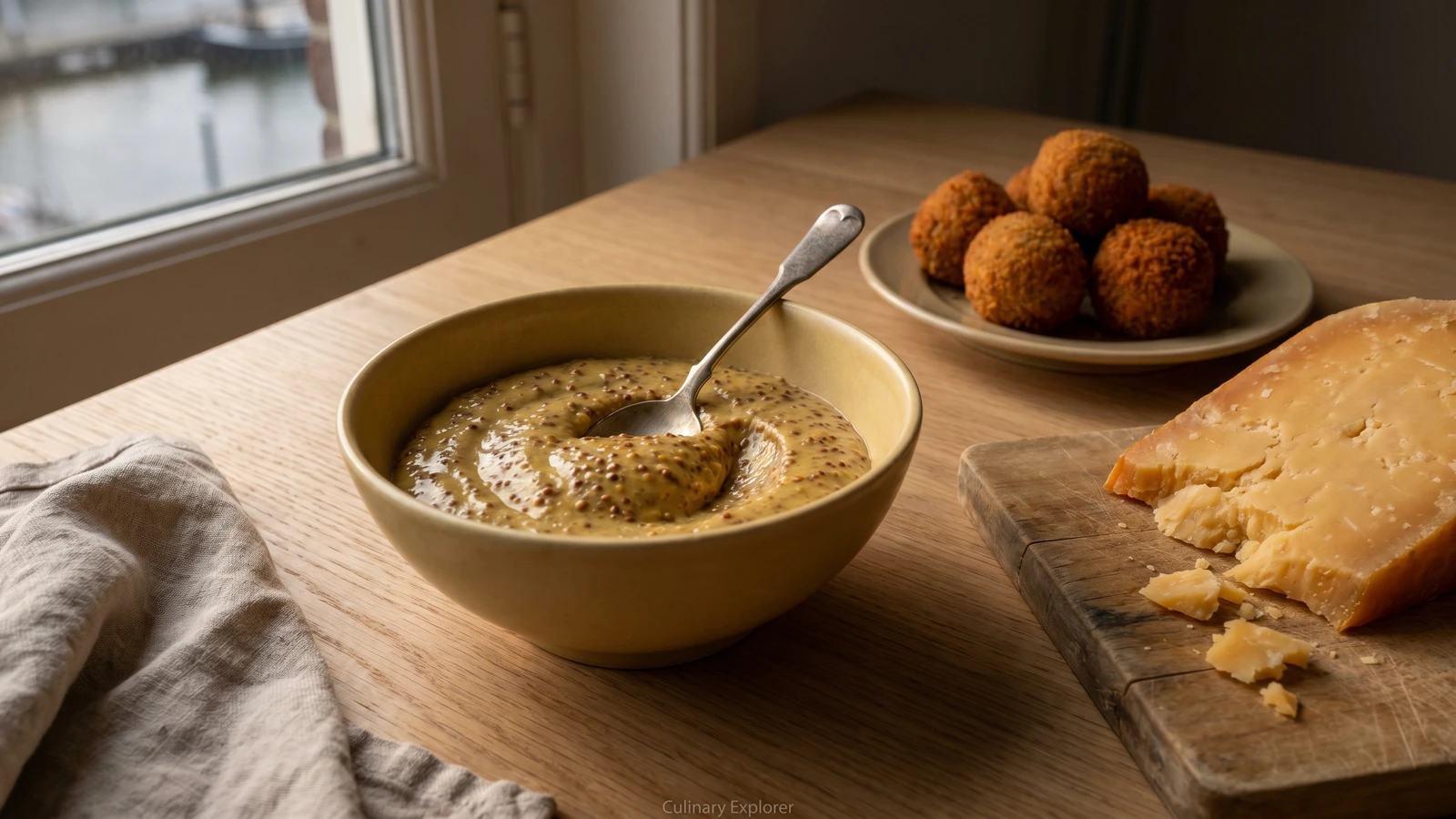
The pale Dutch mustard that looks modest and bites like a harbour wind, ground from yellow and brown seed, vinegar, and patience, waiting beside bitterballen and old Gouda.
Mosterd is the little jar on the Dutch table that everyone pretends not to worship. In my grandmother's second notebook it did not even get a recipe, only a margin note beside bitterballen: goede mosterd, good mustard, not too sweet. That was all the authority it needed. The cook had her work, the mustard had its work, and between them a whole borrel, the Dutch drinks-and-snacks hour, made sense.
The name already tells you this sauce has travelled. Mosterd came into Dutch through French mostarde, from Latin mustum ardens, burning must, because the Romans mixed crushed mustard seed with young grape juice. We replaced the must with vinegar, for obvious reasons (the Dutch table has more pickles than vineyards), but the idea stayed: crack the seed, wake its heat with cold liquid, then hold it in acid so the bite doesn't run away.
But let me tell you a secret. Dutch mustard is not one national yellow smear. Doesburg makes its own stern Gelderland version, Groningen likes it coarse and dark, and the Zaanstreek has long known the sound of mills grinding seed. This recipe is the pale table mosterd I make for bitterballen and old Gouda: brown seed for bite, yellow seed for body, vinegar for the clean snap, no sweetness pretending to be charm.
Hou het altijd simpel, always keep it simple. Give the seeds a short cold-water waking, add vinegar and salt, let them soften overnight, then grind only as smooth as your table likes. Fresh mustard is loud on day one and wiser by day three. That is not decline. That is manners.
The Dutch word mosterd belongs to the European mustard family that descends through Old French mostarde from Latin mustum ardens, 'burning must', a Roman mixture of crushed mustard seed and grape must. In the Low Countries mustard moved from medicine chest and elite sauces into everyday table use by the late medieval and early modern periods, helped by mills that ground grain and spices in towns from the Zaanstreek to Groningen. Doesburg in Gelderland preserves one of the best-known regional traditions, with mustard making traced locally to the fifteenth century and mustard soup still served as the city's edible calling card.
Quantity
70g
Quantity
30g
Quantity
80ml, plus 1 to 3 tablespoons more if needed
Quantity
120ml
Quantity
8g
Quantity
1 teaspoon
Quantity
1/4 teaspoon
for colour only
| Ingredient | Quantity |
|---|---|
| yellow mustard seeds | 70g |
| brown mustard seeds | 30g |
| cold water | 80ml, plus 1 to 3 tablespoons more if needed |
| white wine vinegar or Dutch natuurazijn | 120ml |
| fine sea salt | 8g |
| light basterdsuiker or light brown sugar | 1 teaspoon |
| ground turmeric (optional)for colour only | 1/4 teaspoon |
Put the yellow and brown mustard seeds in a spice grinder or mortar and crack them briefly, stopping while plenty of seeds are still only broken, not powdered. You want a mustard with teeth. Powder gives speed, cracked seed gives character.
Scrape the cracked seeds into a glass bowl and stir in the cold water. Leave it for 10 minutes. This is where the heat begins: cold water lets the seed's sharpness bloom before vinegar fixes it in place.
Stir in the vinegar, salt, sugar, and turmeric if using. Cover the bowl and let it stand at room temperature for 12 to 24 hours, until the seeds have swollen and softened. The bowl will smell fierce. Good. Mustard should announce itself before it behaves.
Transfer the soaked mixture to a blender or use a stick blender in a tall jug. Grind until it becomes a thick pale mustard, adding a tablespoon or two of cold water if the blades sulk. Stop when the texture suits your table: nearly smooth for bitterballen, a little coarse for cheese.
Spoon the mustard into a clean jar, close it, and refrigerate it for at least 24 hours before serving. It will be sharp at first and rounder after two or three days. Serve it cold, in a small bowl, beside hot bitterballen, old Gouda, rookworst, or anything honest enough to ask for a sting.
1 serving (about 5g)
Culinary guides, cultural storytelling, and the editorial depth that makes cooking meaningful.
Discover Culinary ExplorerChef Joost
Acar means pickle, ketimun means cucumber, and this little bowl of sweet vinegar, chilli, and crunch is the cool note that lets an Indo-Dutch rijsttafel keep its balance.

Chef Joost
Appelcompote is the apple left with its dignity: soft enough to spoon beside pork or potatoes, still chunky enough to remind you autumn did the real work.

Chef Joost
The little bowl beside the plate is never decoration: appelmoes is the Dutch treaty between sweet and savoury, spooned beside sausage, potatoes, pancakes, and childhood itself.

Chef Joost
Appelstroop is the orchard made patient: apples, pears, and beet syrup boiled down until morning bread, farmhouse cheese, and zuurvlees taste of Limburg in autumn.