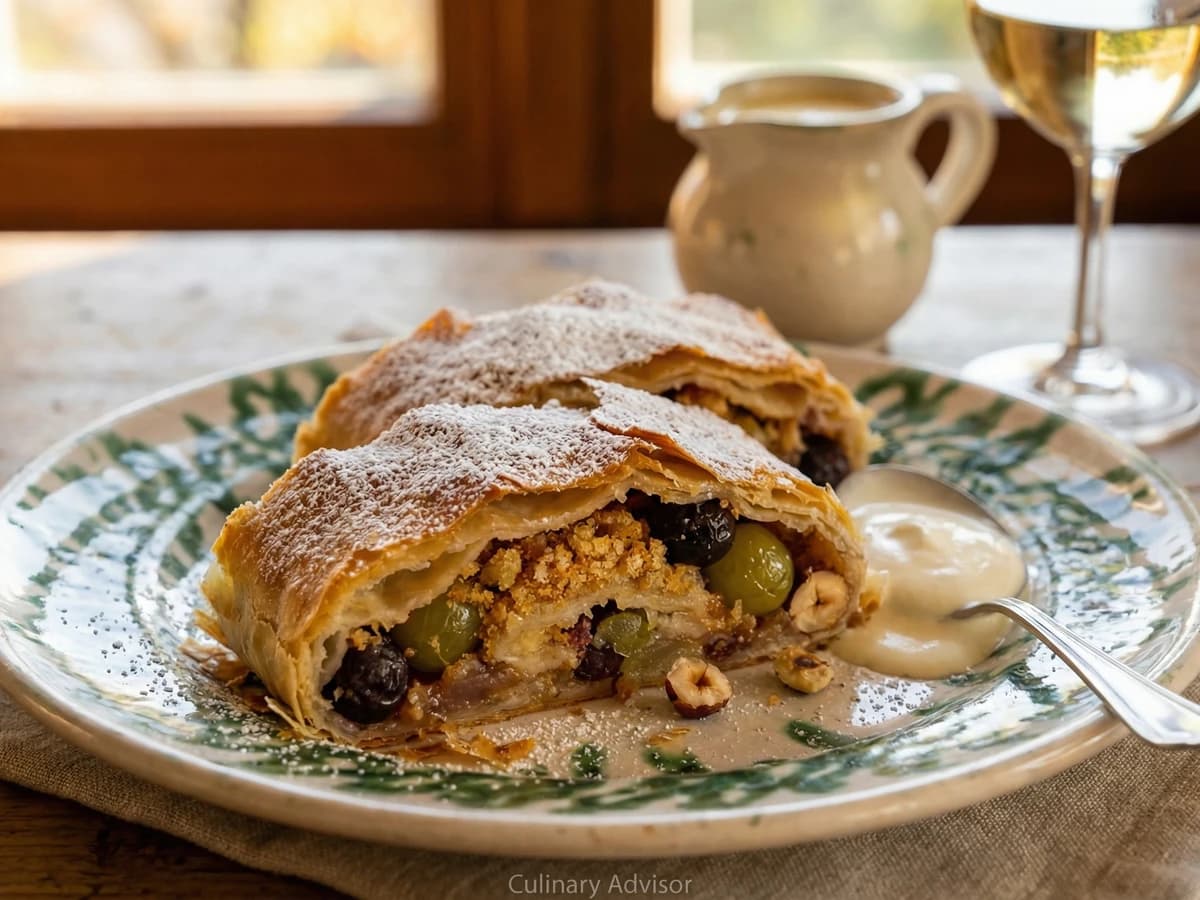
Crumbly poppy seed shortcrust from the Waldviertel, sandwiched with dark, spiced Powidl and dusted in powdered sugar. Two of Austria's oldest regional ingredients, together in one bite.
Pastries & Cookies
Austrian
Christmas
Holiday
Make Ahead
35 min
Active Time
25 min cook•2 hr total
YieldAbout 30 sandwich cookies
In my grandmother Eva's kitchen in Kent, the Christmas baking started in November. Gretel would arrive with a bag of ground poppy seeds, already measured out, because she didn't trust the ones from the local shops. Too old, she'd say. Poppy seeds go stale faster than people think. She'd open the bag and the kitchen would fill with that particular smell, nutty and faintly sweet, like nothing else in the baking cupboard.
Mohnkekse were always part of the Weihnachtsbäckerei, the Christmas cookie collection that every Austrian household puts together in the weeks before Advent. These aren't decorated sugar cookies. They're short, crumbly, almost sandy little rounds made dark with ground poppy seeds, baked until just set, then sandwiched with Powidl, a thick plum butter so concentrated it's nearly black. The combination is quiet and grown-up. Poppy and plum. One from the Waldviertel, one from Bohemia. Both carrying centuries of Austrian kitchen history in a cookie you can eat in two bites.
The dough is a simple Murbteig, a shortcrust that relies on cold butter and a light hand. You don't knead it. You bring it together, let it rest in the cold, and roll it thin. The ground poppy seeds make it fragile, which is the point. These cookies should crumble when you bite through them, the butteriness giving way to the dense, spiced sweetness of the Powidl inside. Gretel always said the filling should be visible at the edges, a dark ring peeking out between two pale, sugar-dusted rounds. That's how you know someone filled them generously.
The Waldviertel, the forested quarter of Lower Austria along the Czech border, has been growing culinary poppy seeds (Waldviertler Graumohn) for centuries, and the region holds a protected geographical designation for its crop. Powidl arrived in Austrian kitchens from Bohemia, where slow-cooked plum butter was a pantry staple preserved without sugar, thickened by hours of stirring over low heat until it turned nearly black. When the Habsburg empire drew Bohemian, Hungarian, and Austrian kitchen traditions into the same orbit, Powidl became as Austrian as it was Czech, showing up in Buchteln, Knodel, and Christmas baking across the eastern provinces.
The technique, the tradition, and the story behind every dish.
•Small round cutter or thimble for window cuts (optional)
•Fine-mesh sieve for dusting
•Two baking trays with parchment paper
•Wire cooling rack
•Spice grinder or coffee grinder for poppy seeds (if grinding your own)
Instructions
1
Prepare the poppy seed dough
Put the flour, ground poppy seeds, powdered sugar, Vanillezucker, lemon zest, and salt into a large bowl. Whisk them together briefly so the poppy seeds are evenly distributed. Add the cold cubed butter and work it into the dry ingredients with your fingertips, rubbing and pressing until the mixture looks like coarse, dark breadcrumbs. You want flat little flakes of butter coated in flour and poppy, not a smooth paste. Cold hands help. If the butter starts going soft, put the whole bowl in the fridge for ten minutes.
Grind your own poppy seeds if you can. A spice grinder or clean coffee grinder does the job in thirty seconds. Pre-ground poppy seeds lose their oils and go bitter quickly. If your ground Mohn smells like nothing when you open the bag, it's too old for this.
2
Bring the dough together
Drop in the two egg yolks and work everything together with your hands until the dough just holds in a ball. Don't knead it. Murbteig is not bread dough. You want to bring it together with as little handling as possible so the butter stays cold and the cookies stay short. If it crumbles and won't hold, press it firmly against the side of the bowl. It will come together. If it's truly too dry, add a teaspoon of cold milk, no more. Flatten the dough into a thick disc, wrap it tightly in cling film, and put it in the fridge for at least one hour.
The resting time is not optional. Cold dough rolls cleanly and holds its shape. Warm dough sticks to everything and your cookies will spread in the oven. If you're in a hurry, thirty minutes in the freezer instead of one hour in the fridge.
3
Roll and cut the cookies
Preheat your oven to 170°C (340°F), conventional, not fan. Line two baking trays with parchment paper. Take the dough from the fridge and let it sit for five minutes, just enough to lose the hardest chill. Roll it out on a lightly floured surface to about three to four millimeters thick. This dough is fragile because of the poppy seeds, so work gently. If it cracks at the edges, press it back together with your fingers. Cut rounds with a 4 to 5 centimeter cutter. You need an even number because these are sandwich cookies. Gather the scraps, press them together, chill again briefly, and roll once more. You should get about sixty rounds.
If you want to be traditional, cut a small hole in the center of half the rounds using a thimble or a very small cutter. The hole lets the dark Powidl peek through the top cookie like a little window. It looks beautiful on a Keksteller.
4
Bake until just set
Place the rounds on the prepared trays with a centimeter of space between them. These don't spread much. Bake for ten to twelve minutes, rotating the tray halfway through. The cookies are done when the edges are just barely firm and the tops look dry and matte. They will not brown much because of the poppy seeds. Don't wait for golden color or you'll overbake them. They firm up as they cool. Slide the parchment off the tray and let the cookies cool completely on a wire rack. They're fragile when warm.
5
Prepare the Powidl filling
While the cookies cool, stir the Powidl in a small bowl until it's smooth and spreadable. If you're using rum, fold it in now. Good Powidl should be thick and dark, almost like a stiff jam. If yours is too firm to spread without breaking the cookies, warm it for twenty seconds in the microwave or over a water bath, just enough to loosen it. You want it soft, not runny.
Real Powidl is made from Zwetschken (damson plums) cooked down for hours without added sugar. The best ones come from Czech or Austrian producers. If you can't find Powidl, a very thick, dark plum jam will do in a pinch, but it won't have the same concentrated, slightly tart depth. It's worth searching for the real thing.
6
Fill and dust
Turn half the cookies flat side up. Spread about a teaspoon of Powidl on each one, going almost to the edge. Gretel always said be generous with the filling. A stingy Keks is a sad Keks. Press the matching halves on top gently, flat side down. If you cut windows in the tops, make sure the Powidl shows through. Dust the finished cookies with powdered sugar through a fine sieve. Let them sit for a few hours or overnight in a cool place before serving. The Powidl needs time to soften the cookies slightly from the inside, and the flavors marry into something better than either one alone.
Chef Tips
•Buy your poppy seeds from a shop with good turnover, or better yet, order Waldviertler Graumohn online from an Austrian supplier. Poppy seeds are full of oil and they go rancid on the shelf faster than most people realize. Fresh ground Mohn smells sweet and nutty. Old Mohn smells like cardboard. You'll taste the difference immediately.
•These cookies improve with time. Store them in a tin between layers of parchment paper and they'll be better on day three than day one. The Powidl softens the shortcrust just enough to make each bite melt. By day five they're perfect. This is why Austrian Christmas baking starts in November.
•If your dough keeps cracking when you roll it, it's too cold. Let it sit on the counter for five minutes. If it's sticking, it's too warm. Slide it onto a baking sheet and put it back in the fridge. Murbteig is always a conversation between you and the butter.
•For a proper Keksteller (cookie platter), arrange these alongside Vanillekipferl and Linzer Augen. Three different textures, three different flavors, and every one of them is good Austrian home cooking.
Advance Preparation
•The dough can be made two days ahead and refrigerated, or frozen for up to one month. Thaw overnight in the fridge before rolling.
•Unfilled baked cookies store well in an airtight tin for up to a week. Fill them two to three days before serving so the Powidl has time to soften the shortcrust.
•Filled cookies keep beautifully for up to two weeks in a cool place, layered between parchment in a tin. They are better after day three. This is a make-ahead recipe by design.
Frequently Asked Questions
Nutrition Information
1 serving (about 26g)
Calories
115 calories
Total Fat
6 g
Saturated Fat
3 g
Trans Fat
0 g
Unsaturated Fat
3 g
Cholesterol
23 mg
Sodium
15 mg
Total Carbohydrates
14 g
Dietary Fiber
1 g
Sugars
6 g
Protein
2 g
Where cooking meets culture.
Culinary guides, cultural storytelling, and the editorial depth that makes cooking meaningful.