
Chef Jeong-sun
Aehobak-guk (애호박국, Korean Zucchini Soup)
A clean summer soup of Korean zucchini and salted shrimp, built on quick anchovy-kelp broth and finished before the half-moons lose their shape on a weeknight table.
A cooking platform built around craft, culture, and the stories behind what we eat.
Created by
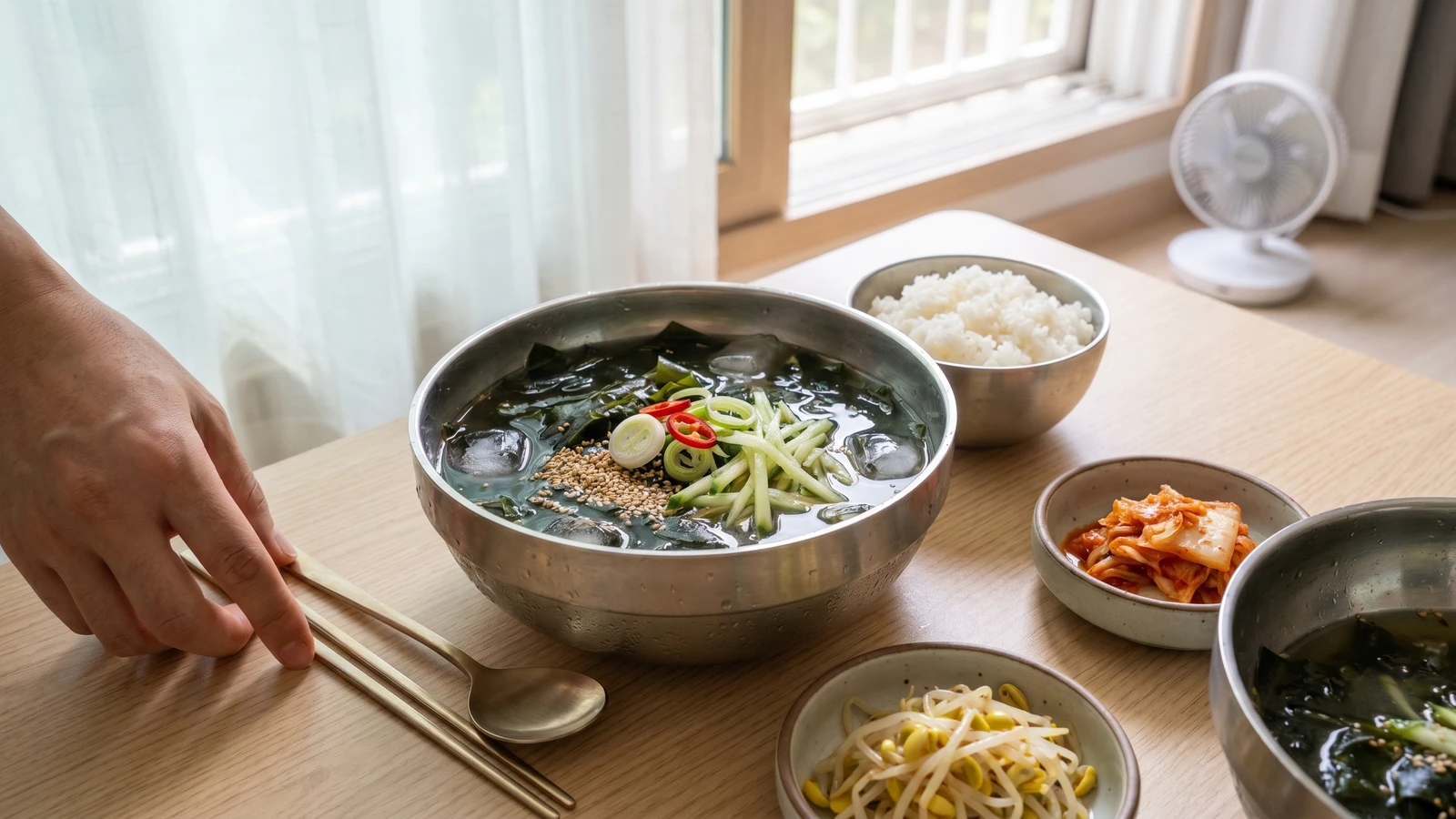
A summer bowl of softened miyeok and crisp cucumber in a clean, vinegared broth, the cold cousin of birthday soup and one of the quickest comforts on a Korean table.
Miyeok-naengguk belongs to the heat of summer, when the rice is still warm but nobody wants a heavy soup beside it. At my mother's table it came out in a stainless bowl, cold enough to bead water on the outside, with cucumber cut thin and seaweed softened just enough to be tender. It was not a grand dish. That is why it needs to be written down.
The dish lives or dies by restraint. Dried miyeok (sea mustard) swells like it has been waiting all year, so measure it before soaking or you'll make a basin when you meant to make soup. The broth should be tart, lightly salty, and faintly sweet, not sour enough to pinch your eyes. The cucumber must stay crisp, which means salt it briefly and rinse it, then keep everything truly cold.
Notebook 19 says 12 grams of dried miyeok for four bowls. That looks too little in the hand. Trust the scale. 손맛 is real, the hand-taste our mothers trusted, and I still measure it so it can be handed on. Tonight this asks only for soaking, slicing, tasting, and patience in the refrigerator.
Naengguk, or cold soup, appears across Korean home cooking as a summer answer to heat, made with cucumber, seaweed, eggplant, or young greens in a chilled vinegared broth. Miyeok itself has long been tied to Korean household cooking through miyeok-guk, the warm seaweed soup eaten after childbirth and on birthdays, but miyeok-naengguk is its lighter seasonal relative rather than a ceremonial dish. Modern home versions often use chilled water for speed, while older and more careful kitchens build flavor with a light anchovy-kelp broth.
Quantity
12g, about 1/2 cup loosely packed
Quantity
1/2 English cucumber or 1 small Korean cucumber, about 150g
julienned
Quantity
1/2 teaspoon
for salting cucumber
Quantity
3 cups
Quantity
3 tablespoons
Quantity
1 tablespoon
Quantity
1 teaspoon
Quantity
1/2 teaspoon, plus more as needed
Quantity
1 small clove
finely grated
Quantity
1 teaspoon
Quantity
1 teaspoon
Quantity
1
thinly sliced
Quantity
1 cup
for serving
Quantity
1/2
thinly sliced
| Ingredient | Quantity |
|---|---|
| dried cut miyeok (sea mustard) | 12g, about 1/2 cup loosely packed |
| English cucumber or Korean cucumberjulienned | 1/2 English cucumber or 1 small Korean cucumber, about 150g |
| fine sea saltfor salting cucumber | 1/2 teaspoon |
| cold anchovy-kelp broth or cold water | 3 cups |
| rice vinegar | 3 tablespoons |
| soup soy sauce (guk-ganjang) or regular soy sauce | 1 tablespoon |
| sugar | 1 teaspoon |
| fine sea salt | 1/2 teaspoon, plus more as needed |
| garlicfinely grated | 1 small clove |
| toasted sesame seeds | 1 teaspoon |
| toasted sesame oil | 1 teaspoon |
| scallionthinly sliced | 1 |
| ice cubesfor serving | 1 cup |
| fresh red chili (optional)thinly sliced | 1/2 |
Put the dried miyeok in a bowl and cover it with plenty of cold water. Soak 10 minutes, until it opens and turns soft but still has a little spring. Drain it well, rinse once under cold water, and squeeze gently. Do not leave it soaking while you wander off; over-soaked miyeok loses its clean bite.
Toss the julienned cucumber with 1/2 teaspoon fine sea salt and let it stand 8 minutes. Rinse quickly under cold water and squeeze out the excess moisture. This keeps the cucumber crisp and stops it from watering down the broth later.
In a large bowl, stir together the cold anchovy-kelp broth or water, rice vinegar, soup soy sauce, sugar, 1/2 teaspoon salt, and grated garlic until the sugar and salt dissolve. Taste it cold. It should be a little sharper and saltier than you think, because the ice and seaweed will soften the seasoning.
Add the squeezed miyeok and cucumber to the broth. Stir in the sesame seeds, sesame oil, scallion, and red chili if using. Chill at least 30 minutes. This short rest lets the seaweed take in the seasoning without turning limp.
Taste once more just before serving. If it tastes flat, add 1 teaspoon vinegar or a pinch of salt, not both at once. Ladle into chilled bowls with a few ice cubes in each. Serve beside warm rice and one or two banchan (side dishes), while the cucumber still snaps.
1 serving (about 295g)
Culinary guides, cultural storytelling, and the editorial depth that makes cooking meaningful.
Discover Culinary ExplorerChef Jeong-sun
A clean summer soup of Korean zucchini and salted shrimp, built on quick anchovy-kelp broth and finished before the half-moons lose their shape on a weeknight table.
Chef Jeong-sun
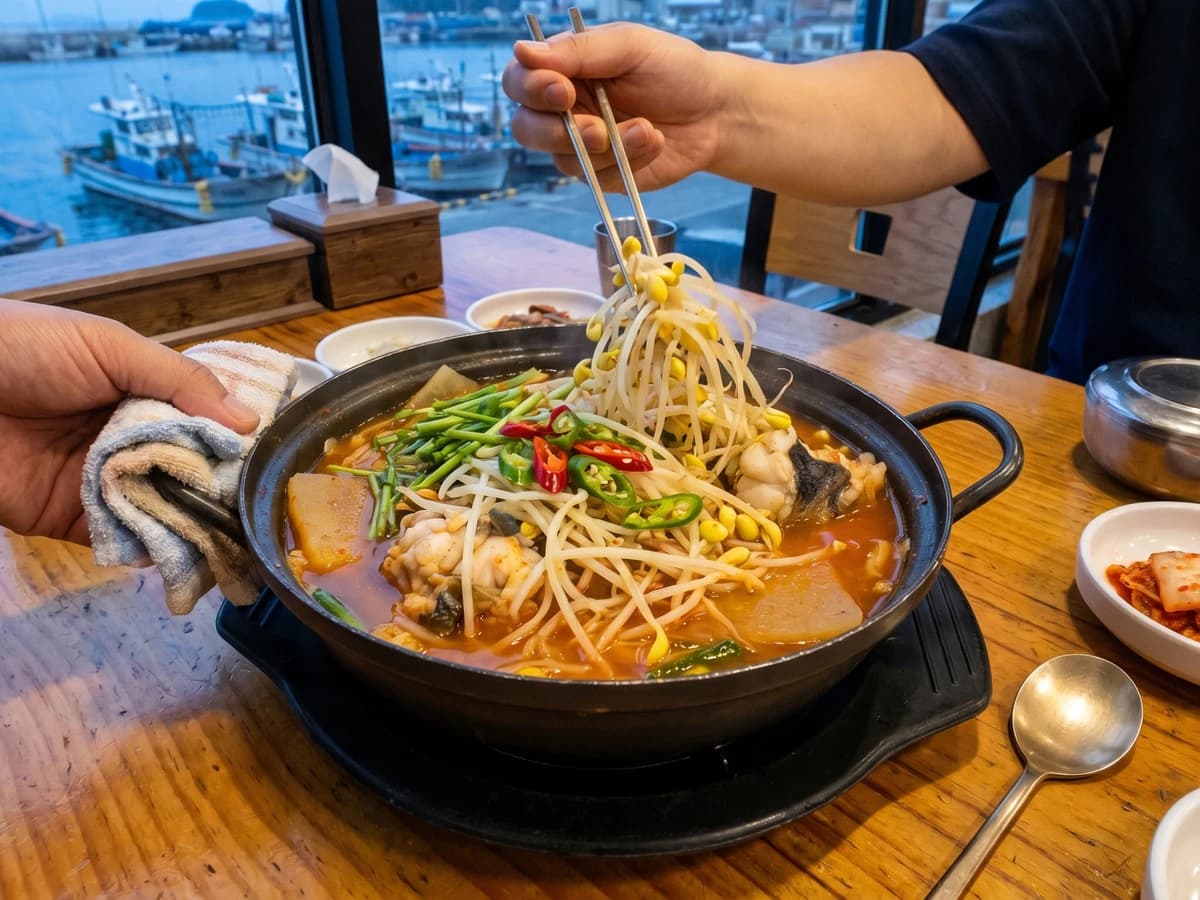
A Masan coast monkfish stew with firm white meat, gelatin at the bones, soybean sprouts for crunch, and a red broth seasoned to carry the fish, not bury it.

Chef Jeong-sun
A weeknight fish roe stew with radish and crown daisy in a clean spicy broth, where the whole success depends on adding the roe late enough that it sets tender, not chalky.

Chef Jeong-sun
Late-summer mallow leaves rubbed with salt until the bitter green water runs off, then simmered in a clean doenjang broth with dried shrimp, the quiet soup a Korean weeknight deserves.