Culinary Explorer

A cooking platform built around craft, culture, and the stories behind what we eat.
Discover Culinary Explorer
Mincemeat

Mincemeat

Created by Chef Thomas

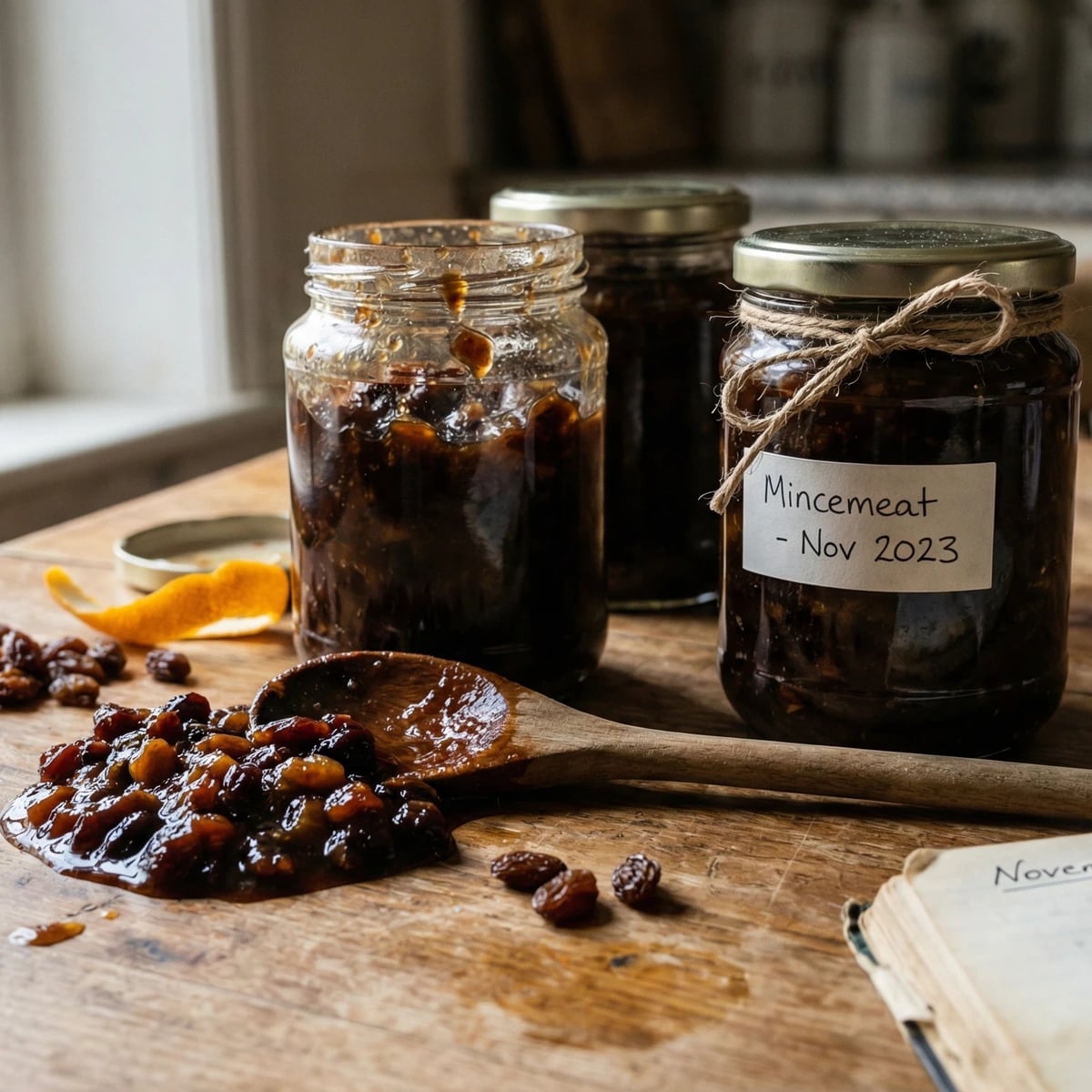
A November mincemeat for the Christmas weeks ahead, dried fruit and suet and spices stirred together with a generous measure of brandy, then left in the cupboard to do its quiet, patient work.

Sauces & Condiments
British
Make Ahead
Christmas
30 min
Active Time
0 min cookPT30M plus two weeks maturing total
YieldAbout 1.5kg (enough for roughly 36 mince pies)

Make this in November. Not December, when the lists have grown long and the patience has thinned. November, when the afternoons start going dark by four and the kitchen feels like the right place to be doing something with your hands.

Mincemeat is one of those small domestic acts that rewards you weeks later, when the mince pies are warm and someone reaches for a second one without thinking. There's nothing to it, really. You stir together a bowl of dried fruit, sugar, suet, spices, and brandy, and then you walk away. The cupboard does the rest. The fruit drinks the brandy, the sugar dissolves into the juices, the spices settle into the corners, and a month later you have something dark and glossy and faintly boozy that smells of Christmas the moment you lift the lid.

I wrote it down in the notebook the first year I made my own: "Better than the jar. Won't go back." That's still true. Shop-bought mincemeat is fine. Homemade mincemeat is the difference between fine and properly good, and the difference costs you about half an hour in November and the patience to wait. Patience pays.

A recipe is a conversation, not a contract. Use the dried fruit you like. Swap the brandy for rum or whisky if that's what's in the cupboard. Add a knob of stem ginger if you've got some. The proportions are forgiving and the result will still be unmistakably mincemeat. We're only making dinner. Or in this case, the small thing that makes dinner in six weeks' time feel like Christmas.

The technique, the tradition, and the story behind every dish.

Discover Culinary Explorer

Ingredients

raisins

Quantity

200g

sultanas

Quantity

200g

currants

Quantity

200g

mixed peel

Quantity

100g

finely chopped

dried cranberries or sour cherries

Quantity

100g

Bramley apple

Quantity

1 large

peeled, cored and grated

shredded suet

Quantity

200g

beef or vegetarian

dark muscovado sugar

Quantity

200g

unwaxed lemon

Quantity

1

zest and juice

unwaxed orange

Quantity

1

zest and juice

blanched almonds

Quantity

50g

roughly chopped

ground cinnamon

Quantity

1 teaspoon

ground mixed spice

Quantity

1 teaspoon

freshly grated nutmeg

Quantity

1/2 teaspoon

ground cloves

Quantity

1/4 teaspoon

fine sea salt

Quantity

pinch

brandy

Quantity

150ml, plus extra for topping up

Equipment Needed

  • Very large mixing bowl
  • Box grater
  • Wooden spoon
  • Sterilised jam jars with tight-fitting lids (about 3 x 500ml)
  • Funnel (optional, but helpful)

Instructions

  1. 1

    Combine the fruit

    Tip the raisins, sultanas, currants, mixed peel, and dried cranberries into a large mixing bowl. Use the biggest bowl you have. This recipe makes more mess than you think it will. Add the grated apple straight onto the fruit, juice and all. The apple needs to go in raw and be coated quickly so it doesn't brown.

    Grate the apple on the coarse side of the box grater, skin and core left behind. You want long shreds that will dissolve into the mixture as it sits, not a wet pulp.
  2. 2

    Add suet, sugar, and citrus

    Scatter the suet over the fruit, then the muscovado sugar. Add the lemon and orange zest and their juice. The kitchen will start to smell of Christmas at this point, sticky, dark, citrus-bright. It's a good smell. Stir everything through with a wooden spoon, working from the bottom of the bowl upwards so nothing is left dry.

  3. 3

    Spice and almonds

    Add the chopped almonds, the cinnamon, mixed spice, nutmeg, cloves, and a pinch of salt. Stir again, properly this time. You're looking for an even distribution of everything: no pockets of dry sugar, no clumps of suet. The mixture should look glossy and uniformly dark.

    Grate the nutmeg fresh. The pre-ground stuff loses its lift within weeks of opening, and nutmeg is one of the spices that actually announces itself in mincemeat.
  4. 4

    Rest, then add brandy

    Cover the bowl with a clean cloth and leave it in a cool place for twelve hours, or overnight. The fruit will swell and the sugar will begin to dissolve into the juices. The next day, pour in the brandy and stir it through. You should be able to smell it from across the room. If you can't, add a little more.

  5. 5

    Jar and store

    Spoon the mincemeat into clean, sterilised jars, pressing down firmly with the back of a spoon to remove any air pockets. Leave a small gap at the top of each jar. Seal, label with the date, and store somewhere cool and dark. A cupboard is fine. Wait at least two weeks before using. A month is better. The flavours need time to find each other.

    To sterilise jars: wash them in hot soapy water, rinse, and put them in a 140C oven for fifteen minutes. The lids go in a pan of simmering water for five. Both should be hot when the mincemeat goes in.

Chef Tips

  • Use the best dried fruit you can find. Plump, soft, recently dried. The cheap stuff has often been sitting on a shelf for too long and tastes of nothing but its own packaging. Mincemeat is mostly fruit, so the fruit has to carry it.
  • Vegetarian suet works perfectly well here, and nobody at the table will know the difference. If you can't find suet at all, very cold butter grated on the coarse side of a box grater is a workable substitute, though the texture will be slightly different.
  • Top up the jars with a little extra brandy every few weeks if you remember. A teaspoon, no more. It keeps the mincemeat lively and pushes the flavour a little deeper as Christmas approaches.
  • Mincemeat keeps for a year in a cool dark cupboard, sometimes longer. The high sugar and alcohol content do the preserving work. If you open a jar and it smells right, it is right. Trust your nose.

Advance Preparation

  • Mincemeat needs at least two weeks in the jar before it is ready to use. A month is better. Six weeks is better still. Make it in November and it will be at its best by Christmas.
  • Stored in sterilised jars in a cool, dark cupboard, mincemeat will keep for up to a year. Once a jar is opened, refrigerate and use within a month.
  • If the top of the mincemeat dries out a little in the jar, simply spoon over a little more brandy and stir through before using.

Frequently Asked Questions

Nutrition Information

1 serving (about 42g)

Calories
155 calories
Total Fat
6 g
Saturated Fat
3 g
Trans Fat
0 g
Unsaturated Fat
3 g
Cholesterol
4 mg
Sodium
10 mg
Total Carbohydrates
24 g
Dietary Fiber
1 g
Sugars
21 g
Protein
1 g

Note: Chef personas and recipes are created with AI assistance. Cook with care: follow safe food-handling practices, check doneness with a thermometer when needed, and adapt for allergies and your kitchen.

Where cooking meets culture.

Culinary guides, cultural storytelling, and the editorial depth that makes cooking meaningful.

Discover Culinary Explorer

More from British Preserves, Pickles & Chutneys

Browse the full collection