
Chef Dimitra
Aegean Island Chtapodi me Kritharaki (Χταπόδι με Κριθαράκι)
Aegean island octopus, tomato, red wine, and toasted kritharaki share one pot, so the pasta drinks the briny sauce and stays glossy instead of turning heavy.
A cooking platform built around craft, culture, and the stories behind what we eat.
Created by
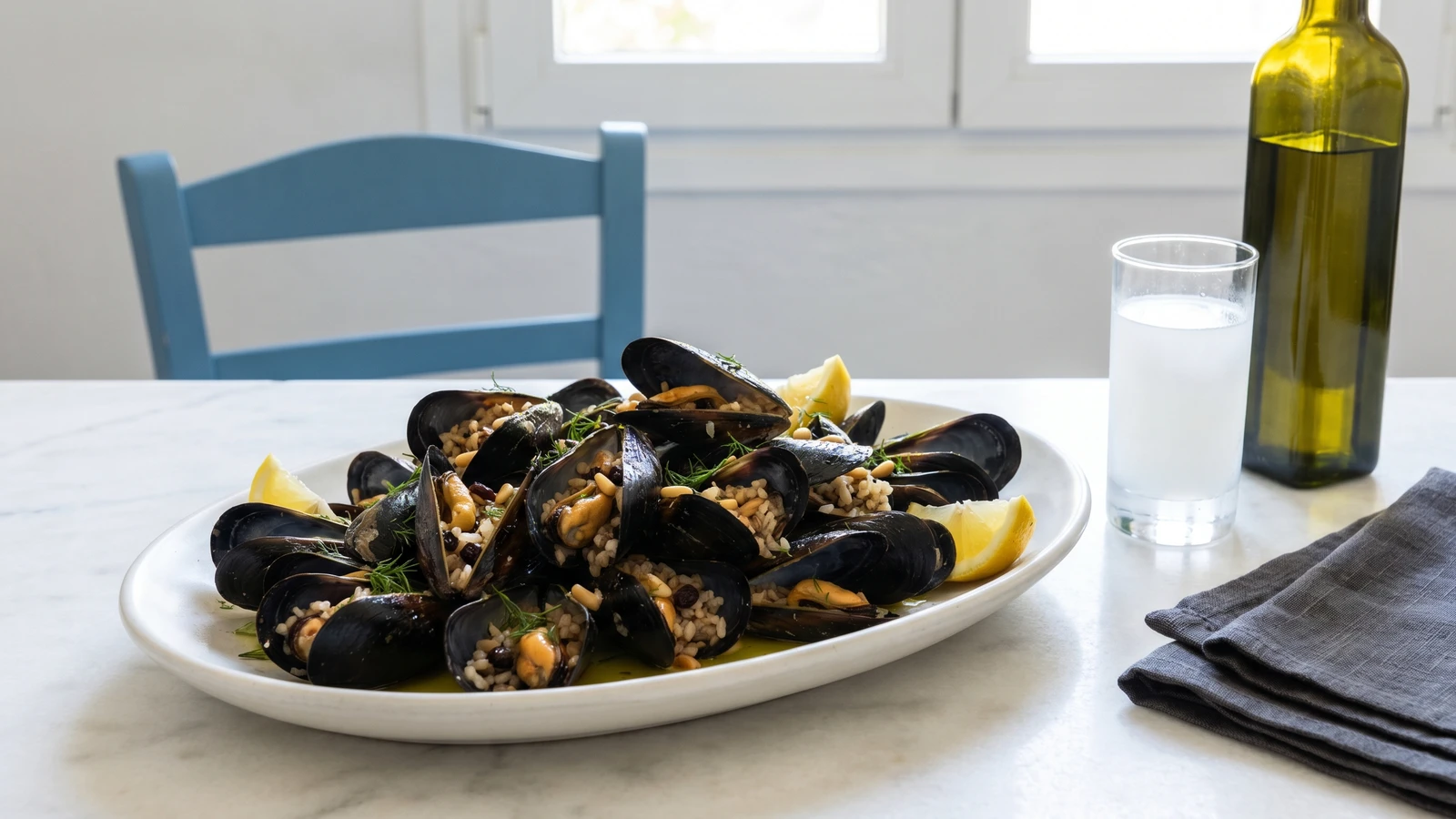
Politiki stuffed mussels are the City's hand-held seafood: glossy shells filled with half-cooked spiced rice, pine nuts, currants, and herbs, then rested for lemon at the table.
Midia Gemista Politika are Constantinople's stuffed mussels, the City's street food brought into the Greek kitchen with its sweet spices intact. The region is the dish's surname. Here the mussel shell becomes the little cooking pot, filled with rice, pine nuts, currants, allspice, cinnamon, herbs, and the briny liquor the mussels give you themselves.
What makes the dish itself is the half-cooked rice and the loose hand with the stuffing. Cook the rice fully and it turns soft before the mussel is ready. Leave it raw and it stays stubborn in the shell. Bring it halfway, close the mussel gently, hold the shells under a plate, and the grains finish plump and separate, carrying the perfume of the sea and the spice together.
Serve them warm or at room temperature, with lemon squeezed inside each shell. They look like meze, but a full platter with bread, salad, and a glass of ouzo makes a proper dinner. I don't invent it. I find it, I test it, I write it down, because a dish from the City should still taste like the City when it lands on a home table in Thessaloniki.
Midia gemista Politika belong to Constantinople's Rum and Ottoman street-food world, where mussels from the Bosphorus and the Sea of Marmara were packed with spiced rice as midye dolma. After the 1922 Asia Minor catastrophe and later departures from the City, Greek families carried this Politiki method to Thessaloniki, Piraeus, and island ports. The seasoning marks the old urban kitchen: allspice and cinnamon with seafood, a combination rarer in many mainland Greek homes.
Quantity
1.5kg
scrubbed and debearded
Quantity
180g
rinsed and drained
Quantity
90ml
divided
Quantity
250g
finely chopped
Quantity
30g
Quantity
35g
soaked in warm water for 10 minutes and drained
Quantity
500ml
divided
Quantity
1/2 tsp
use more only if the mussel liquor tastes mild
Quantity
1 tsp
Quantity
1/2 tsp
Quantity
1/2 tsp
Quantity
1/4 tsp
Quantity
20g
finely chopped
Quantity
15g
finely chopped
Quantity
8g
finely chopped
Quantity
30ml
Quantity
1
cut into wedges
| Ingredient | Quantity |
|---|---|
| large live mussels (midia)scrubbed and debearded | 1.5kg |
| short-grain or medium-grain ricerinsed and drained | 180g |
| extra virgin Koroneiki olive oildivided | 90ml |
| yellow onionsfinely chopped | 250g |
| pine nuts | 30g |
| dried currantssoaked in warm water for 10 minutes and drained | 35g |
| strained mussel liquor topped up with waterdivided | 500ml |
| fine sea saltuse more only if the mussel liquor tastes mild | 1/2 tsp |
| ground allspice (bahari) | 1 tsp |
| ground cinnamon | 1/2 tsp |
| freshly ground black pepper | 1/2 tsp |
| sugar | 1/4 tsp |
| flat-leaf parsleyfinely chopped | 20g |
| dillfinely chopped | 15g |
| mint leavesfinely chopped | 8g |
| fresh lemon juice | 30ml |
| lemoncut into wedges | 1 |
Rinse the mussels under cold running water, scrub the shells, and pull away the beards with a firm tug toward the hinge. Throw away cracked mussels and any open mussel that doesn't close after a tap. Keep them cold while you work. Live shellfish are not something to bargain with.
Set a fine sieve over a bowl. Working one mussel at a time, slide a short blunt oyster knife into the seam and cut just enough to open the shell like a book, leaving the hinge attached. Let the liquor fall into the sieve. The meat stays in the shell. If a mussel smells wrong or is dry inside, discard it.
Measure the strained mussel liquor and top it up with water to make 500ml. Warm 60ml of the olive oil in a wide pan over medium heat. Add the onions and salt, and cook for 8 to 10 minutes until soft and pale, not browned. Stir in the pine nuts for 2 minutes, then add the rice, currants, allspice, cinnamon, black pepper, and sugar. Pour in 220ml of the mussel liquor mixture and cook for 8 to 9 minutes, stirring now and then, until the liquid is absorbed. The rice should be swollen at the edges but still firm in the center. Fold in the parsley, dill, and mint, then let the filling cool for 10 minutes.
Spoon a small amount of filling into each mussel, usually 1 to 2 teaspoons depending on the shell. Close the shell gently. Don't pack it tight. This is the dish's hinge: the rice finishes cooking inside the shell, so it needs a little liquid and a little room to swell. Fill hard and the shell gapes, or the rice turns heavy instead of separate.
Arrange the stuffed mussels in tight layers in a wide heavy pot, with the hinged sides outward where you can. Pour the remaining 280ml mussel liquor mixture, the remaining 30ml olive oil, and the lemon juice around the edge of the pot. Set a heatproof plate directly on top to keep the shells closed, cover with the lid, and bring to a gentle simmer. Cook on low for 22 to 25 minutes. Do not stir.
Turn off the heat and leave the pot covered for 20 minutes. Lift away the plate carefully. Serve the mussels warm or at room temperature with lemon wedges. At the table, open the shell, squeeze in lemon, and use one half of the shell to scoop the rice and mussel. The City knew what it was doing.
1 serving (about 325g)
Culinary guides, cultural storytelling, and the editorial depth that makes cooking meaningful.
Discover Culinary ExplorerChef Dimitra
Aegean island octopus, tomato, red wine, and toasted kritharaki share one pot, so the pasta drinks the briny sauce and stays glossy instead of turning heavy.

Chef Dimitra
Aegean coast psari plaki is the quiet whole-fish bake: onions and tomato softened first, fish laid on top, and olive oil doing its slow work until the bones release cleanly.

Chef Dimitra
Astakomakaronada is the Aegean islands' celebration pasta: spiny lobster, tomato, olive oil, and long noodles cooked in the shell broth, never drowned in cream or cheese.

Chef Dimitra
Aegean Easter goat on the spit, lean and full-flavored, turned slowly over charcoal and basted with lemon, oregano, garlic, and good olive oil.