
Chef Lupita
Acambaritas de Acámbaro
Guanajuato's daily bread from Acámbaro, a small glazed roll built on pata, enriched with manteca de cerdo, and baked until the top shines lightly for merienda.
A cooking platform built around craft, culture, and the stories behind what we eat.
Created by
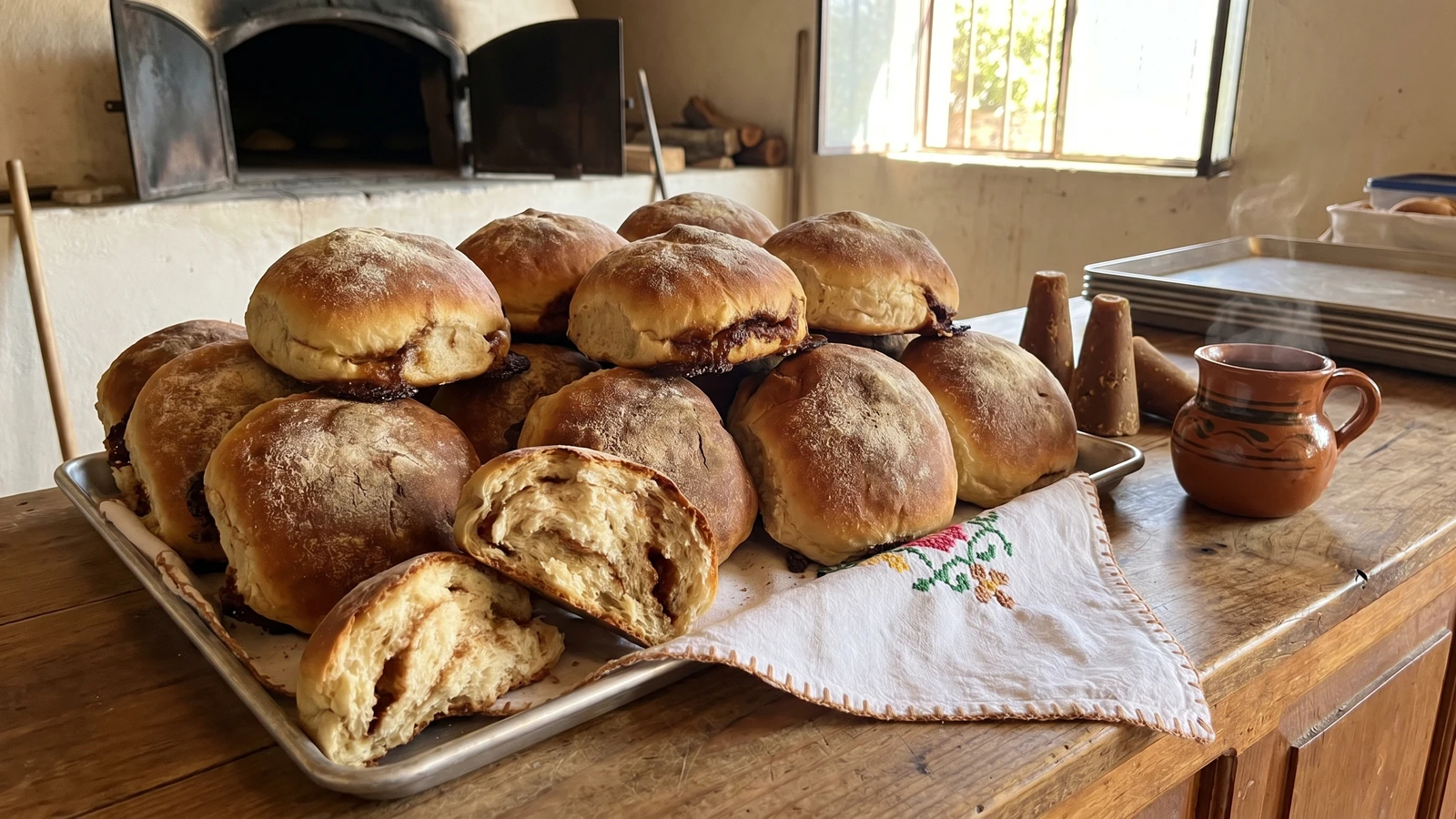
Queretaro's Sierra Gorda mestiza is a layered pan de pueblo from Jalpan de Serra, built with wheat dough, manteca de cerdo, piloncillo, and the dark edges of a wood-fired oven.
Queretaro, Sierra Gorda. Jalpan de Serra sits in the mountains, far from the flat idea people have of the Bajio, and this bread belongs to that serrania: practical, filling, made to sit on the table with cafe de olla and feed whoever walks in.
The mestiza is called that because two preparations meet in one piece: a tender wheat dough and a darker piloncillo-cinnamon paste spread through the folds with manteca de cerdo. It is not a concha, not a sweet roll from a city bakery. It is pan de pueblo, layered by hand, baked hard enough that the edges caramelize and the inside stays soft.
At Panaderia Dona Rufi in Jalpan, this style has been tied to the wood oven for generations. You can bake it in a home oven, claro, but understand what you're imitating: the horno de boveda gives the bread an uneven top, a deeper crust, and a smell of browned flour and piloncillo that no plastic-wrapped supermarket bread will ever have. La cocina no es decoracion, es trabajo.
Use manteca de cerdo. No me vengas con atajos. Butter makes a softer, sweeter bread, but it is not this bread. Cada estado, su propia cocina.
Jalpan de Serra became the civic and market center of Queretaro's Sierra Gorda after the Franciscan mission system expanded there in the 18th century, bringing wheat bread into a region already shaped by maize, piloncillo, and mountain trade routes. The mestiza belongs to the secular panaderia register of the serrania, where local bakers adapted wheat dough to wood-fired ovens and sweetened it with piloncillo rather than refined sugar alone. Panaderias such as Dona Rufi in Jalpan helped keep the form visible as a daily bread, not a festival relic.
Quantity
4 cups
plus more for dusting
Quantity
1 cup
Quantity
2 1/4 teaspoons
Quantity
1/3 cup
Quantity
2
room temperature
Quantity
1/2 cup
softened, divided
Quantity
1 1/2 teaspoons
Quantity
1 cup
grated
Quantity
1 tablespoon
Quantity
1/4 teaspoon
Quantity
2 tablespoons
for the piloncillo paste
Quantity
1 tablespoon
only if needed for the paste
Quantity
1 egg plus 1 tablespoon milk
for brushing
| Ingredient | Quantity |
|---|---|
| bread flourplus more for dusting | 4 cups |
| warm whole milk | 1 cup |
| active dry yeast | 2 1/4 teaspoons |
| granulated sugar | 1/3 cup |
| large eggsroom temperature | 2 |
| manteca de cerdosoftened, divided | 1/2 cup |
| fine sea salt | 1 1/2 teaspoons |
| piloncillograted | 1 cup |
| ground Mexican cinnamon | 1 tablespoon |
| ground anise seed | 1/4 teaspoon |
| all-purpose flourfor the piloncillo paste | 2 tablespoons |
| warm water (optional)only if needed for the paste | 1 tablespoon |
| egg beaten with milkfor brushing | 1 egg plus 1 tablespoon milk |
Stir the warm milk, yeast, and 1 tablespoon of the sugar in a large bowl. Let it stand 8 to 10 minutes, until the surface looks foamy and alive. If nothing happens, your yeast is dead. Start again. Bread does not forgive bad leavening.
Add the bread flour, remaining sugar, eggs, 1/4 cup of the softened manteca de cerdo, and salt. Mix until a rough dough forms, then knead 8 to 10 minutes by hand, or 6 minutes in a stand mixer on low. The dough should be smooth, elastic, and slightly tacky, not wet. Manteca gives the crumb tenderness without making it taste like cake. La manteca es el sabor.
Shape the dough into a ball and place it in a lightly greased bowl. Cover with a clean kitchen towel and let it rise in a warm place until doubled, about 1 hour 15 minutes. In the Sierra Gorda, the panaderia reads the dough by touch, not by the clock. Press it gently. If the mark fills back slowly, it is ready.
In a small bowl, combine the grated piloncillo, Mexican cinnamon, ground anise, all-purpose flour, and the remaining 1/4 cup softened manteca de cerdo. Work it together with your fingers until it forms a spreadable paste. Add the warm water only if the piloncillo is very dry. The paste should smear, not pour.
Turn the risen dough onto a lightly floured table and pat it into a rectangle about 14 by 18 inches. Spread the piloncillo paste over the surface, leaving a small border. Fold the dough in thirds like a letter, then roll it gently to flatten the layers. Do not press so hard that the filling leaks out. You are building layers, not punishing the dough.
Cut the folded dough into 10 rectangles. Tuck the corners slightly underneath each piece and press the tops once with the heel of your hand so they sit low and broad. The pieces should look handmade, with uneven ridges and small streaks of piloncillo showing. Machine-perfect bread has no memory.
Set the mestizas on a parchment-lined baking sheet with space between them. Cover and let rise 35 to 45 minutes, until puffy but not doubled. Brush lightly with the egg and milk. Too much wash seals the top and fights the oven spring. A light hand is enough.
Bake at 375F for 24 to 28 minutes, rotating the tray once, until the tops are deep golden and the piloncillo at the edges has darkened to caramel. In a wood oven, the color comes faster and less evenly. In a home oven, wait for the edges. Pale mestiza is unfinished mestiza. Asi se hace y punto.
Let the mestizas cool at least 20 minutes before tearing one open. The piloncillo needs time to settle into the crumb. Serve with cafe de olla in a clay jarrito, or keep them wrapped in a clean servilleta for the next day's breakfast. Saber cocinar es saber vivir.
1 serving (about 115g)
Culinary guides, cultural storytelling, and the editorial depth that makes cooking meaningful.
Discover Culinary ExplorerChef Lupita
Guanajuato's daily bread from Acámbaro, a small glazed roll built on pata, enriched with manteca de cerdo, and baked until the top shines lightly for merienda.

Chef Lupita
Michoacan's Tinguindin aguacatas are flat, leaf-scored sweet breads made with harina de trigo, piloncillo, anise, and manteca de cerdo, shaped by hand for the wood oven.

Chef Lupita
From Ajijic on Lake Chapala, Pan Tachihual is a lightly sweet wedding loaf built with harina de trigo, harina de maiz, piloncillo, manteca, anise, and the old Guadalajara pata.

Chef Lupita
Comitán's pan de yema shaped into little pigs, birds, and rabbits, a Chiapas bakery bread rich with egg yolks, manteca de cerdo, and anís, baked golden on hoja de plátano.