Culinary Explorer

A cooking platform built around craft, culture, and the stories behind what we eat.
Discover Culinary Explorer
Memelas Oaxaqueñas con Huevo y Asiento

Memelas Oaxaqueñas con Huevo y Asiento

Created by

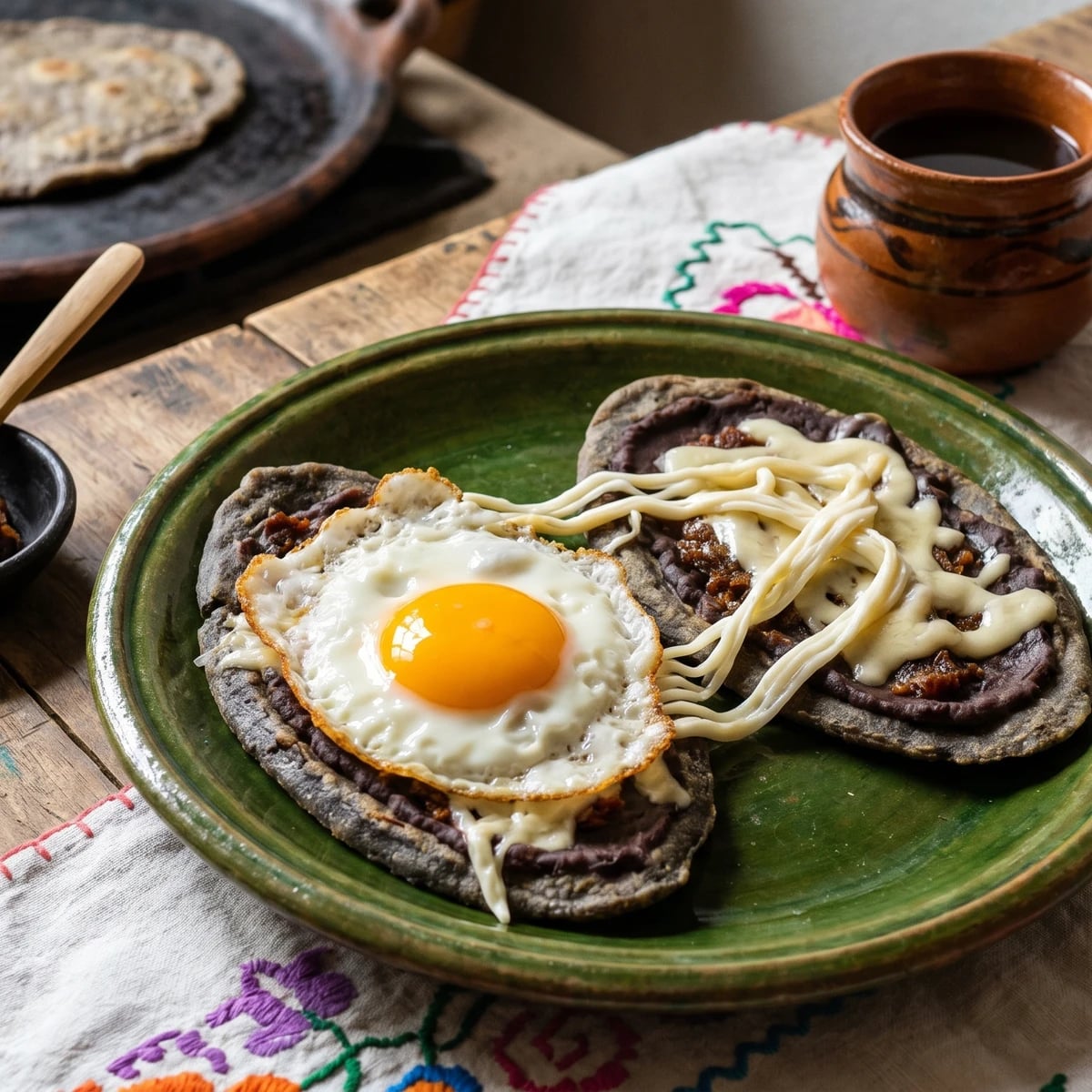
Oaxaca's morning griddle cakes, thick masa pinched by hand into a shallow rim on the comal, spread with the dark sediment of rendered lard and refried black beans, then topped with pulled quesillo and a fried egg cooked in manteca.

Breakfast & Brunch
Mexican
Weeknight
Comfort Food
Budget Friendly
25 min
Active Time
30 min cook55 min total
Yield4 servings (8 memelas)

This is Oaxaca on a comal at seven in the morning. Memelas are the breakfast that feeds the state before the day starts, sold by women at market stalls and street corners from the Central de Abastos to the smallest village in the Sierra Norte. They are not tortillas. They are thicker, wider, pinched at the edges into a shallow rim that holds the toppings in place. That rim is formed by hand while the masa is still on the hot comal. It takes practice. It takes fingers that do not flinch.

The ingredient that makes this Oaxacan and nothing else is asiento. Not manteca. Not rendered fat. Asiento is the dark, toasty sediment that sinks to the bottom of the pot when pork lard is rendered slowly over low heat. It is brown, grainy, intensely porky, and it tastes like the bottom of a well-seasoned cast iron pan concentrated into a spoonful. In Oaxaca, you buy it by the scoop at the market from the same vendor who sells the manteca. Outside Oaxaca, most people have never heard of it. That tells you something about how much of this cuisine the world has not bothered to learn.

The black beans are cooked with hoja de aguacate, the dried avocado leaf that gives Oaxacan beans their signature anise-like warmth. The salsa is made from chile pasilla oaxaqueño, a smoky dried chile grown in the Mixe region that has no real substitute. The quesillo is pulled into long strings and draped over the hot memela so it softens but does not fully melt. And the egg is fried in manteca until the edges lace and the yolk stays liquid.

I watched a woman in the Mercado 20 de Noviembre make forty memelas in an hour without looking down at her hands. She pinched the rims with her thumbs while talking to her neighbor about the price of avocado leaves. Her comal was black from decades of use. The memelas came off it with a crust on the bottom and the asiento already melting into the masa. That is what you are learning to make. Saber cocinar es saber vivir.

The memela belongs to a family of thick masa antojitos, including tlacoyos, huaraches, and sopes, that predate the Spanish conquest and descend from the simple practice of cooking nixtamalized corn dough on clay comales, a technique documented in Mesoamerican archaeology as far back as 1500 BCE. The word 'memela' likely derives from a Nahuatl root, and the form varies across southern Mexico: in Puebla and Tlaxcala, memelas are thinner and folded; in Oaxaca, they are thick, open-faced, and defined by the use of asiento, a byproduct of lard rendering that became a regional staple because Oaxacan markets historically sold manteca and its sediment as separate products with distinct culinary purposes. The specific combination of asiento, black beans cooked with hoja de aguacate, and chile pasilla oaxaqueño marks the memela as a dish that could only have developed in the Valles Centrales of Oaxaca, where all three ingredients converge in the same market stalls.

The technique, the tradition, and the story behind every dish.

Discover Culinary Explorer

Ingredients

fresh masa for tortillas

Quantity

1 pound (or 2 cups masa harina + 1 1/4 cups warm water)

fine salt (for masa)

Quantity

1/2 teaspoon

cooked black beans

Quantity

2 cups

with 1/2 cup of their cooking broth

manteca de cerdo (for beans)

Quantity

2 tablespoons

dried avocado leaf (hoja de aguacate)

Quantity

1

chile pasilla oaxaqueño

Quantity

4

garlic clove

Quantity

1

unpeeled

water (for salsa)

Quantity

1/4 cup

fine salt (for salsa)

Quantity

to taste

asiento

Quantity

1/2 cup (about 1 tablespoon per memela)

large eggs

Quantity

4

manteca de cerdo (for frying eggs)

Quantity

2 tablespoons

quesillo (Oaxacan string cheese)

Quantity

8 ounces

pulled into thin strips

Equipment Needed

  • Large clay comal or well-seasoned cast iron griddle
  • Heavy skillet for frying eggs and refried beans
  • Blender for salsa
  • Bean masher or wooden spoon
  • Damp cloth for covering masa

Instructions

  1. 1

    Toast the pasilla oaxaqueño

    Heat a dry comal or heavy skillet over medium heat. Place the chiles pasilla oaxaqueño on the comal and toast for about 20 seconds per side, pressing them flat with a spatula. They are already smoked, so you are not adding smoke here. You are waking up the oils. The skin will puff slightly and the kitchen will fill with a dark, tobacco-like aroma. Pull them the moment they smell alive. Burned pasilla oaxaqueño turns acrid and there is no recovering from it. Place the toasted chiles in a small bowl, cover with hot tap water, and soak for 10 minutes to soften.

    Chile pasilla oaxaqueño is smoked over wood in the Mixe region of Oaxaca. It is not the same as a regular pasilla or a chipotle. If you cannot find it, a chipotle meco is the closest compromise, but you will lose the specific floral smokiness that makes this salsa Oaxacan.
  2. 2

    Roast garlic and blend the salsa

    While the chiles soak, place the unpeeled garlic clove on the same comal. Let it char on all sides, turning it with tongs, about 5 minutes total. The skin will blacken and the flesh inside will turn soft and sweet. Peel it. Drain the soaked chiles, tear off the stems, and shake out some of the seeds if you want less heat. Place the chiles, roasted garlic, water, and a pinch of salt in a blender. Blend until you have a coarse, textured salsa. Not smooth. This is a rustic salsa with body. Taste for salt. Set aside.

  3. 3

    Make the bean paste

    Melt two tablespoons of manteca de cerdo in a heavy skillet over medium heat. Crumble the dried avocado leaf into the fat and let it fry for 30 seconds until fragrant. It will release a warm, anise-like scent. Add the cooked black beans with their broth. Mash them in the skillet with a bean masher or the back of a wooden spoon, working the fat into the beans until you have a thick, spreadable paste that holds its shape on a spoon. This takes about five minutes of mashing and stirring. If the paste is too thick, add a splash of broth. If it is too loose, cook it down. Season with salt. Set aside and keep warm.

    Oaxacan black beans are always cooked with hoja de aguacate, not epazote. The avocado leaf gives the beans a subtle anise note that is unmistakably Oaxacan. If you cooked the beans from scratch with avocado leaf already in the pot, skip adding another leaf to the refry.
  4. 4

    Make the memela dough

    If using fresh masa, place it in a bowl, add the salt, and knead briefly until smooth and pliable. It should feel like soft clay that does not crack at the edges when you press it. If using masa harina, combine it with the warm water and salt and knead for two minutes until the dough comes together. Cover with a damp cloth and let it rest for five minutes. Divide the dough into eight equal balls, each about the size of a large golf ball.

    Fresh masa from a tortilleria is always better. Masa harina is a compromise you can live with, but the texture will be slightly grainier and the corn flavor less pronounced. If you have a Mexican market nearby, buy fresh masa the morning you plan to cook.
  5. 5

    Form and cook the memelas

    Heat your comal over medium-high heat until a drop of water sizzles and evaporates on contact. Take one ball of masa and pat it between your palms into a thick disk about four to five inches across and a quarter-inch thick. Thicker than a tortilla. Do not use a tortilla press: memelas are hand-formed. Place the disk on the hot comal and cook until the bottom sets and develops light brown spots, about two minutes. Flip it. Now, while the memela is still on the comal, use your thumbs to pinch up the edges all the way around, forming a shallow rim about half an inch high. The heat makes this harder. Your fingers will learn. That rim holds the toppings.

    The pinching is done on the hot comal because the masa needs to be partially cooked to hold its shape. If you try to pinch the rim before cooking, the dough is too soft and the rim collapses. This is the step that separates a memela from a thick tortilla.
  6. 6

    Spread asiento and top the memelas

    While the memela is still on the comal, spread about one tablespoon of asiento across the surface inside the rim. The asiento will soften and melt into the hot masa, turning it dark and glossy. Spoon a generous layer of the black bean paste over the asiento. Lay strips of quesillo across the beans. Let the memela sit on the comal for another minute until the bottom develops a proper crust and the quesillo begins to soften and go slightly translucent. Transfer to a plate and repeat with the remaining masa balls. You can run two or three memelas on the comal at once if it is large enough.

    Asiento should be at room temperature so it spreads easily. If it is straight from the refrigerator, it will be too stiff. Let it sit out for twenty minutes before you start cooking.
  7. 7

    Fry the eggs

    In a small skillet, melt the remaining two tablespoons of manteca de cerdo over medium-high heat. When the fat shimmers, crack in the eggs one or two at a time. The manteca should be hot enough that the edges of the whites lace and crisp within the first thirty seconds. Tilt the skillet and spoon the hot fat over the whites to set the tops, but leave the yolks liquid. A Mexican market egg fried in manteca has crispy brown edges, a set white, and a yolk that runs when you cut into it. That yolk is your sauce. Season with a pinch of salt.

    La manteca es el sabor. An egg fried in manteca de cerdo tastes different from an egg fried in vegetable oil. The edges crisp faster, the flavor is rounder, and it belongs on this dish. Do not substitute butter. Butter is not Oaxacan.
  8. 8

    Assemble and serve

    Place two memelas on each plate. Set a fried egg on top of one memela per serving, letting the yolk sit right in the center where it will break and run down into the beans. Spoon the salsa de pasilla oaxaqueño alongside or drizzle it over the memelas. Serve immediately. The memela should be eaten while the bottom is still crisp, the asiento is still warm in the masa, and the yolk is still liquid. This is not a dish that waits. Asi se hace y punto.

Chef Tips

  • Asiento is sold at Mexican markets in Oaxaca by the same vendors who sell manteca. Outside Mexico, look for it at well-stocked Mexican grocery stores, sometimes labeled 'asiento de chicharron' or 'asiento de manteca.' If you cannot find it, you can make your own by rendering pork back fat or pork belly fat very slowly over low heat for an hour or more, then collecting the dark, grainy sediment that settles at the bottom of the pot. Strain the clear manteca off the top. What remains is your asiento. It keeps in the refrigerator for weeks.
  • Quesillo is Oaxacan string cheese. It comes in a ball or a skein and you pull it apart into long strings by hand before using it. Do not slice it with a knife. The pulled strings melt differently from sliced cheese: they soften and become stretchy without turning into a puddle. If you cannot find quesillo, fresh mozzarella pulled into strips is the closest option, but the flavor will be milder and the texture less stringy.
  • The comal matters. A clay comal gives the memela a flavor that cast iron does not, a toasty, mineral quality from the clay itself. If you have a clay comal and know how to season it, use it. If you do not, a well-seasoned cast iron comal or griddle will do the job. Do not use a nonstick pan. The memela needs direct contact with hot, heavy material to develop its crust.
  • Make the beans and the salsa the night before. The morning assembly, forming the memelas, cooking them on the comal, frying the eggs, takes about twenty minutes once everything else is ready. That is how Oaxacan women do it: the components are prepared in advance, and the comal work happens fresh each morning.

Advance Preparation

  • Black beans can be cooked from dried up to three days ahead. Store them in their broth in the refrigerator. Refry them the morning of, or the night before and reheat.
  • Salsa de pasilla oaxaqueño can be made one day ahead and refrigerated. The smokiness deepens overnight.
  • Asiento keeps refrigerated for several weeks. Let it come to room temperature before spreading on the memelas.
  • The masa must be made fresh. Do not make memela dough ahead of time. Masa dries out within the hour and the texture suffers.

Frequently Asked Questions

Nutrition Information

1 serving (about 330g)

Calories
895 calories
Total Fat
54 g
Saturated Fat
22 g
Trans Fat
0 g
Unsaturated Fat
31 g
Cholesterol
255 mg
Sodium
760 mg
Total Carbohydrates
70 g
Dietary Fiber
13 g
Sugars
2 g
Protein
33 g

Note: Chef personas and recipes are created with AI assistance. Cook with care: follow safe food-handling practices, check doneness with a thermometer when needed, and adapt for allergies and your kitchen.

Where cooking meets culture.

Culinary guides, cultural storytelling, and the editorial depth that makes cooking meaningful.

Discover Culinary Explorer

More from Oaxacan Breakfast & Almuerzo

Browse the full collection