
Chef Lupita
Ante de Coco Conventual
Campeche's colonial coconut ante, layered with syrup-soaked bizcocho, slow-thickened coconut milk, almendra pelada, yemas de huevo, and cinnamon, the tropical convent cousin of Sor Juana's old ante tradition.
A cooking platform built around craft, culture, and the stories behind what we eat.
Created by
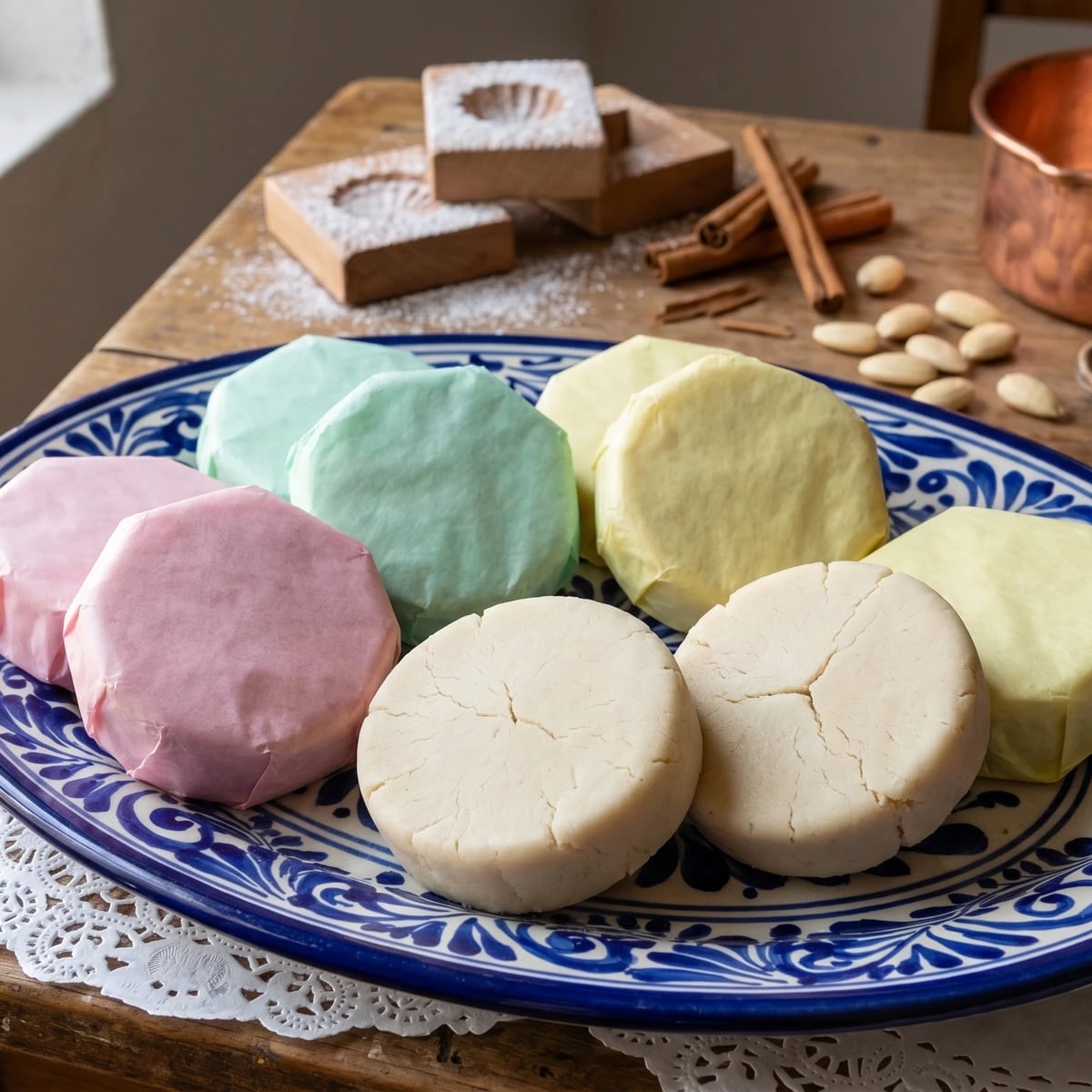
Puebla's conventual mazapan de almendra, inherited through the dulceria of Santa Clara: peeled almonds, clean almibar, patient grinding, and rounds wrapped like something passed through a convent grille.
Puebla de los Angeles, in the old convent streets near Santa Clara, is where this mazapan de almendra belongs. Not the peanut mazapan that crumbles in your hand, though that one has its place. This is the older conventual sweet: almendra pelada, sugar worked into almibar, a little cinnamon, and the discipline of grinding until the paste is fine enough to hold its shape without becoming greasy.
The technique came through women who lived by order and repetition. Las Clarisas, las Madres Concepcionistas, las nuns who turned sugar into income for their houses, knew that a sweet this small exposes every lazy decision. If the almonds are stale, you taste it. If the syrup is thin, the paste slumps. If you grind too long, the oil comes out and the mazapan looks tired. No me vengas con atajos.
I first learned this version from a Puebla dulcera who kept her molds in a wooden drawer lined with tissue paper, pink, mint green, pale yellow, exactly like the dulcerias around Calle 6 Oriente. She told me: the almond has to taste like almond, not perfume. A few drops of agua de azahar are enough if you use it at all. Cada estado, su propia cocina, and Puebla's sweet kitchen is conventual, ordered, and precise.
Almond marzipan reached New Spain through Spanish convent kitchens, especially from Toledo's mazapan tradition, which itself carried the influence of medieval Arabic confectionery built on almonds and sugar. In Puebla, 17th- and 18th-century convents including Santa Clara and Santa Rosa became formal centers of dulceria, selling sweets through the torno to support religious houses. The peanut mazapan now common across Mexico is a later popular adaptation; Puebla's almond mazapan preserves the older criollo-conventual lineage tied to imported almonds, refined sugar, and manuscript technique.
Quantity
250 grams
completely dry
Quantity
250 grams
Quantity
75 milliliters
Quantity
1 small piece
Quantity
1 teaspoon
Quantity
1 pinch
Quantity
1 tablespoon
for dusting the molds
| Ingredient | Quantity |
|---|---|
| almendra peladacompletely dry | 250 grams |
| granulated sugar | 250 grams |
| water | 75 milliliters |
| canela mexicana | 1 small piece |
| agua de azahar (optional) | 1 teaspoon |
| fine sea salt | 1 pinch |
| powdered sugarfor dusting the molds | 1 tablespoon |
Spread the almendra pelada on a tray and let it sit uncovered for at least 2 hours, or warm it in a low oven at 200F for 8 minutes and cool completely. The almonds must be dry before grinding. Moist almonds make a paste that turns heavy before the almibar can do its work.
Grind the almonds in short pulses in a food processor until they look like fine meal. Stop before they become almond butter. If you have a metate, use it and take your time. The convents had labor, not machines, but the principle is the same: fine, dry, even almond. Sift out any large pieces and grind them again.
Combine the sugar, water, and canela mexicana in a small copper cazo or heavy saucepan. Cook over medium heat without stirring once the sugar dissolves. Swirl the pan if needed. Cook until the syrup reaches 238F, soft-ball stage, thick and clear but not caramel colored. Remove the cinnamon. Do not use corn syrup. This sweet is sugar and almond, not factory gloss.
Lower the heat. Stir the ground almendra pelada into the almibar with the pinch of salt. Add the agua de azahar only if using it, and use a light hand. Cook, stirring constantly with a wooden spoon, 4 to 6 minutes, until the paste pulls away from the sides and leaves the bottom of the pan clean for a second. The almond should smell warm and clean, not toasted hard.
Scrape the paste onto a marble slab or a clean wooden board dusted very lightly with powdered sugar. When it is cool enough to touch but still warm, knead it with the heel of your hand until smooth and pliable. If oil appears on the surface, you overworked the almond or ground it too long. Keep going gently, but learn the lesson for next time.
Dust small wooden molds or a tortilla press lined with parchment with the barest film of powdered sugar. Pinch off 25-gram portions, roll into balls, and press into rounds about 1/2 inch thick. The edges should be clean, not cracked. If the paste cracks, knead in a few drops of warm water. A few drops, not a spoonful. Así se hace y punto.
Let the mazapanes sit uncovered at cool room temperature for 4 to 6 hours, until the surface feels dry but the center still gives slightly under your thumb. Wrap each round in pastel tissue paper or waxed paper. Store in a tin. They are ready the same day, better the next, and proper for Christmas trays with other dulces conventuales.
1 serving (about 30g)
Culinary guides, cultural storytelling, and the editorial depth that makes cooking meaningful.
Discover Culinary Explorer
Chef Lupita
Campeche's colonial coconut ante, layered with syrup-soaked bizcocho, slow-thickened coconut milk, almendra pelada, yemas de huevo, and cinnamon, the tropical convent cousin of Sor Juana's old ante tradition.

Chef Lupita
Ciudad de Mexico's conventual ante, tied to Sor Juana's San Jeronimo kitchen, layers syrup-soaked sponge cake with ripe mamey, almendra pelada, raisins, and cinnamon-scented almibar.

Chef Lupita
Puebla's convent kiss pairs two small almond meringues around a slow-reduced milk and yema cream, a delicate dulce from the kitchens of Puebla de los Ángeles.

Chef Lupita
Guanajuato's cajeta quemada is goat milk and sugar worked for hours in a copper cazo, the dark caramel inheritance of Celaya's dairies, convent kitchens, and patient hands.