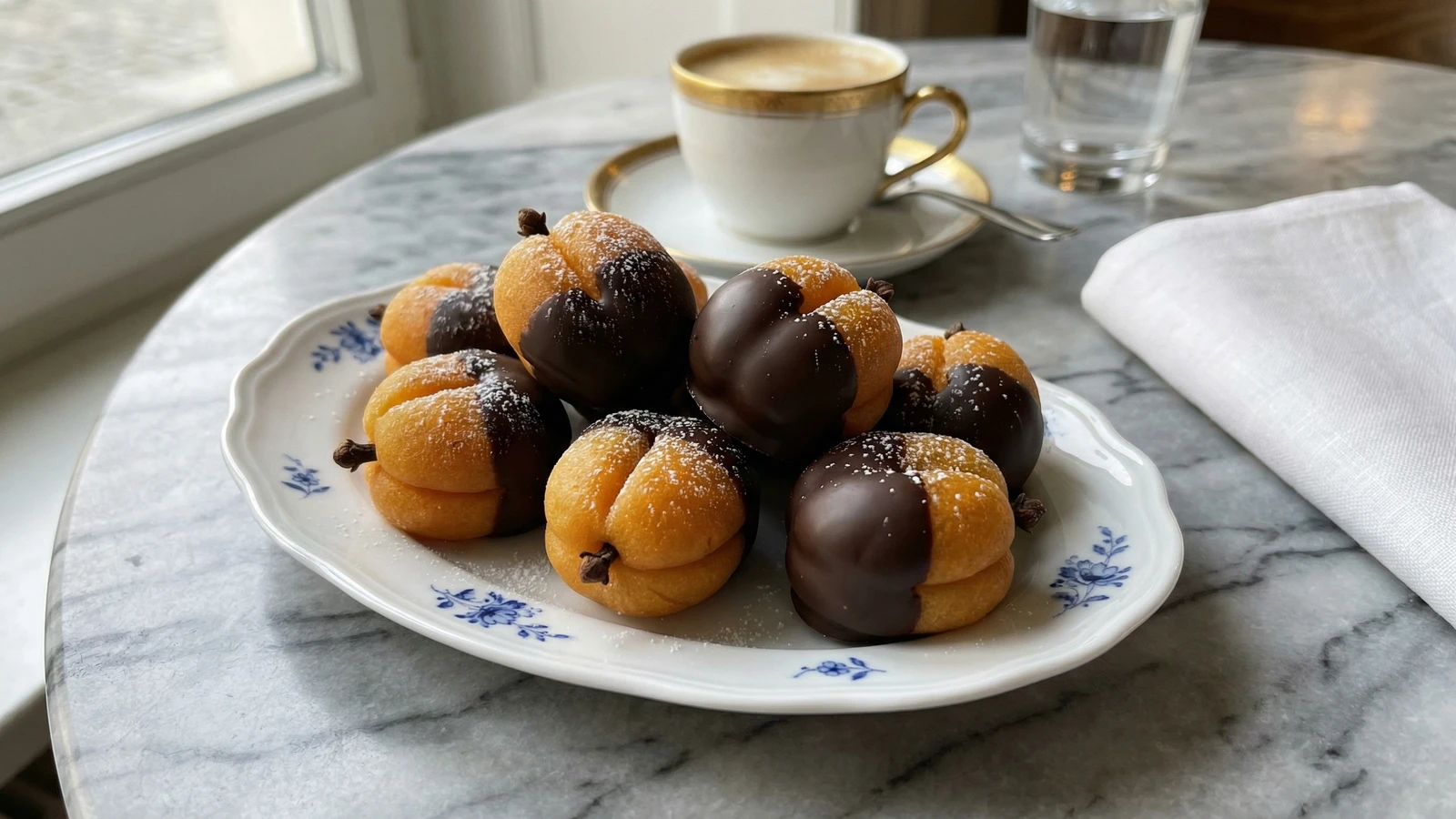
Intensely fragrant apricot confections from the Wachau valley, shaped by hand into tiny golden fruits and half-dipped in bittersweet chocolate. The taste of an Austrian summer in a single bite.
Desserts
Austrian
Special Occasion
Make Ahead
1 hr
Active Time
10 min cook•2 hr total
Yield40-50 confections
In my grandmother Eva's kitchen in Kent, there was a small ceramic dish that lived on the sideboard through December. It held Marillenkonfekt, little apricot confections no bigger than a walnut, some half-dipped in dark chocolate, all dusted lightly with sugar. Gretel made them every year in the weeks before Christmas. She'd sit at the table with a bowl of apricot paste, rolling and shaping each one between her palms, pressing a whole clove into the top for a stem. The kitchen smelled like apricots and almonds for days.
Marillenkonfekt belongs to the Austrian tradition of Konfekt, the small, precious confections that appear at Christkindlmärkte and in Konditorei windows alongside marzipan and nougat. But where marzipan is almond-forward, Konfekt made from Marillen puts the fruit at the center. The Wachau valley along the Danube produces the most aromatic apricots in Europe, and drying them concentrates that flavor into something almost overwhelming. When you grind those dried Marillen with almonds and a splash of Marillenschnaps, the paste holds every bit of that summer fragrance.
The shaping is the meditative part. You pinch off small pieces, roll them round, press a slight crease down one side to mimic the fruit's natural seam, and tuck a clove into the top. Then you dip half of each one into tempered dark chocolate and set them on parchment to firm up. The whole process is quiet, repetitive, and deeply satisfying. Gretel always said that making Konfekt was the closest cooking ever came to prayer.
The Wachau valley, a 30-kilometer stretch along the Danube between Melk and Krems, has been cultivating apricots since at least the 16th century. The microclimate of warm days and cool nights produces Marillen with an intensity of flavor unmatched elsewhere in Europe, and the region holds a protected geographical indication for Wachauer Marille. Marillenkonfekt emerged from the broader Central European Konfekt tradition, where noble households and monasteries produced small confections from fruit pastes, marzipan, and nuts as gifts and festival foods. The combination of dried apricots with almonds and chocolate became a signature Austrian confection, sold in Konditorei displays alongside Mozartkugeln and Punschkrapfen.
The technique, the tradition, and the story behind every dish.
dried apricots (Marillen)preferably Wachau or unsulphured Turkish
300g
blanched almondsfinely ground
100g
powdered sugar
80g, plus extra for dusting
apricot jam (Marillenmarmelade)sieved
2 tablespoons
Marillenschnaps or apricot brandy
1 tablespoon
lemon juice
1 teaspoon
whole clovesfor stems
40-50
dark chocolate (70% cocoa)for dipping
150g
neutral oil or cocoa butter (optional)for thinning chocolate
1 teaspoon
Equipment Needed
•Food processor
•Heatproof bowl for tempering
•Small saucepan for water bath
•Butter knife for shaping crease
•Parchment-lined baking sheet
•Chocolate or instant-read thermometer (helpful but not essential)
Instructions
1
Grind the apricot paste
Put the dried apricots through a food processor and pulse until they form a sticky, fine paste. This takes longer than you'd think. You'll go through a phase where the apricots look like coarse rubble, then they'll clump into a ball, and finally they'll break down into a smooth, dense mass. Scrape the sides of the bowl between pulses. If your apricots are very dry, add a teaspoon of warm water to help them along, but only if they truly won't come together. You want paste, not puree.
Unsulphured apricots are darker and stickier, which actually works in your favor here. The bright orange sulphured ones look prettier in the bag but often have less concentrated flavor. For Konfekt, flavor wins.
2
Build the Konfekt mixture
Transfer the apricot paste to a bowl. Add the ground almonds, powdered sugar, sieved apricot jam, Marillenschnaps, and lemon juice. Work everything together with your hands until the mixture is completely uniform. It should feel like soft marzipan: pliable, smooth, and slightly tacky but not wet. The almonds give it structure. The jam and Schnaps intensify the apricot flavor in two different directions, one sweet and concentrated, the other bright and aromatic. The lemon juice is there to keep all that sweetness honest.
If you can't find Marillenschnaps, use a good apricot brandy or even a splash of Cointreau. What you're after is a fruity spirit that lifts the apricot without burying it. Don't substitute vanilla extract. It takes the flavor somewhere this dish doesn't belong.
3
Shape the confections
Dust your hands lightly with powdered sugar. Pinch off a small piece of paste, about the size of a large hazelnut, and roll it into a smooth ball between your palms. Press a shallow crease down one side with the back of a butter knife to mimic the natural seam of an apricot. Gently press a whole clove, bud-end up, into the top of each one for a stem. Set the finished confections on a sheet of parchment as you go. Take your time with this step. It's the kind of work that goes better with a cup of coffee and no one rushing you.
Re-dust your hands every five or six confections. If the paste starts sticking, a light touch of powdered sugar on your palms fixes it immediately. Don't use flour. It dulls the flavor and turns the surface chalky.
4
Temper the chocolate
Chop the dark chocolate finely and melt two-thirds of it in a heatproof bowl set over barely simmering water. The water should not touch the bottom of the bowl. Stir gently until it reaches about 50 degrees Celsius, then remove from the heat and stir in the remaining third of the chopped chocolate. Keep stirring until everything is melted, smooth, and has cooled to around 31 degrees. If you don't have a thermometer, dab a small amount on your lower lip. It should feel just barely cool, not warm. Add a teaspoon of neutral oil or cocoa butter if the chocolate feels too thick for dipping.
Tempering is what gives the chocolate its snap and shine. If you skip it, the chocolate will set dull and soft. It's not difficult once you've done it twice. The key is patience: don't rush the cooling and keep stirring.
5
Dip in chocolate
Hold each confection by the clove stem and dip the bottom half into the tempered chocolate. Let the excess drip back into the bowl for a few seconds, then set it back on the parchment, chocolate-side down. Work steadily but not frantically. If the chocolate starts to thicken as it cools, set the bowl back over warm water for thirty seconds and stir to bring it back. The finished confections should have a clean line where the golden apricot paste meets the dark chocolate.
6
Set and store
Let the Konfekt sit at cool room temperature until the chocolate is fully set, about thirty minutes. Don't refrigerate them. Cold dulls the chocolate's shine and can make the apricot paste weep moisture. Once set, arrange them in a single layer in a box lined with parchment or waxed paper. They keep for three weeks in a cool place, which means you can make them well ahead of when you need them. If you can keep yourself from eating them first, which I never manage.
Chef Tips
•The quality of your dried apricots determines everything. Look for ones that are plump, deeply fragrant, and slightly sticky. If they smell like nothing in the bag, they'll taste like nothing in the Konfekt. Health food shops often carry unsulphured Hunza or Turkish apricots with real depth of flavor.
•Gretel always said Konfekt should be small. Not bite-sized for a mouse, but not the size of a golf ball either. A large hazelnut is the right starting point. You want something a person can eat in two bites with a cup of coffee.
•Package these in a small box lined with parchment and they become one of the best gifts you can make from a kitchen. In Salzburg, Konditorei charge a small fortune for confections half this good. Yours will be better because you chose the apricots yourself.
•If you want a more traditional finish, skip the chocolate on some and simply roll them in granulated sugar after shaping. A mixed box of half-dipped and sugar-rolled Konfekt is how you'd find them at a proper Christkindlmarkt.
Advance Preparation
•The apricot paste can be made up to three days ahead and stored wrapped tightly in cling film in the fridge. Bring it back to room temperature for an hour before shaping, or it will be too stiff to work with.
•Shaped but undipped confections keep well for a week in a sealed container. Dip them in chocolate the day you plan to serve or gift them for the freshest appearance.
•Finished Marillenkonfekt store beautifully for up to three weeks in a cool, dry place (not the fridge). The flavors actually deepen over the first few days as the Schnaps permeates the paste.
Frequently Asked Questions
Nutrition Information
1 serving (about 15g)
Calories
60 calories
Total Fat
3 g
Saturated Fat
1 g
Trans Fat
0 g
Unsaturated Fat
2 g
Cholesterol
0 mg
Sodium
1 mg
Total Carbohydrates
9 g
Dietary Fiber
1 g
Sugars
7 g
Protein
1 g
Where cooking meets culture.
Culinary guides, cultural storytelling, and the editorial depth that makes cooking meaningful.