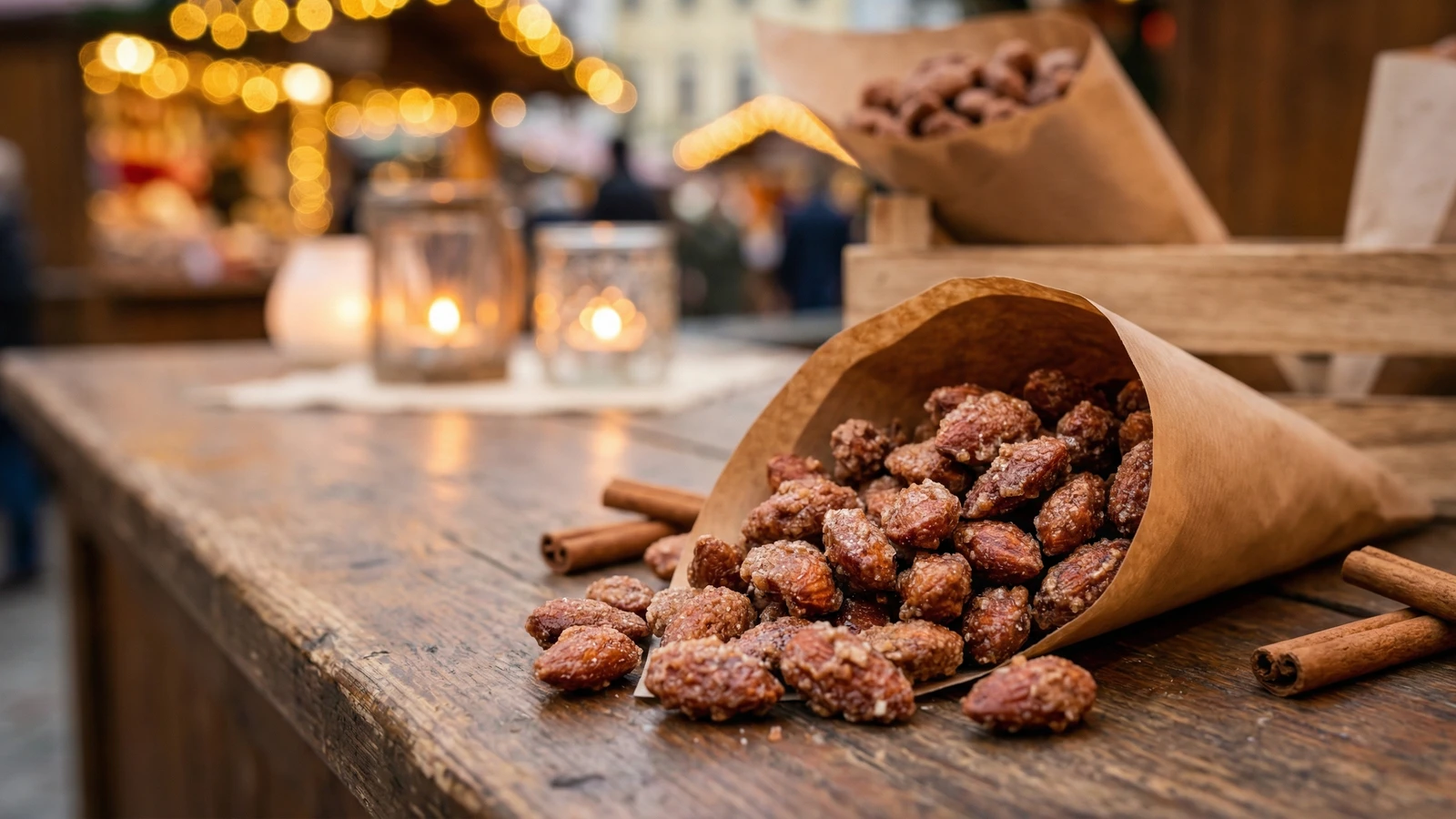
Christkindlmarkt candied almonds roasted in cinnamon sugar until they crackle and shine, the scent that finds you before the market does and pulls you through the cold to the copper pan.
Desserts
Austrian
Christmas
Holiday
5 min
Active Time
12 min cook•17 min total
YieldAbout 300g (fills 4 paper cones)
You smell them before you see the stall. Cinnamon and caramelizing sugar cutting through December air so cold it burns your nose. That smell is the Christkindlmarkt. It's the first thing that hits you when you turn the corner into the Domplatz in Salzburg, past the cathedral and into the glow of wooden stalls and candlelight. Gebrannte Mandeln. Burnt almonds, though "burnt" is the wrong word in English. Gebrennt means fire-roasted, transformed by heat into something new.
Gretel and my grandmother Eva used to take me to the Salzburger Christkindlmarkt every December on our annual trips. I was maybe seven the first time I watched a man in a wool cap standing over a massive copper pan, turning almonds through boiling sugar with a wooden paddle as wide as my arm. The sugar went from liquid to sandy to glossy in what seemed like seconds, and then he tipped the whole lot onto a marble slab and the almonds tumbled out in clusters, crackling as they cooled. Gretel bought a paper cone for each of us. Eva told me to wait because they'd burn my tongue. I didn't wait.
The technique at home is the same, just smaller. Almonds, sugar, water, cinnamon, one pan, ten minutes of your attention. The sugar dissolves, boils, crystallizes into a white sandy coating, and then, if you keep stirring, melts again into a thin caramel shell around each nut. That second transformation is where the magic lives. You have to trust the process and keep the almonds moving. Walk away for thirty seconds and you'll have a scorched mess welded to your pan. Stay with it and you'll have a kitchen that smells like the Domplatz in December.
Gebrannte Mandeln have been sold at Central European Christmas markets since at least the 16th century, when sugar became affordable enough for street vendors to use. The tradition of the Christkindlmarkt itself dates to Vienna's December Market of 1298, making it one of the oldest continuous market traditions in Europe. The copper pans used by market vendors aren't just for show: copper conducts heat so evenly that the sugar caramelizes uniformly around every nut, which is why the best Mandeln stalls still insist on them.
The technique, the tradition, and the story behind every dish.
Put the sugar, vanilla sugar, cinnamon, and water into a heavy-bottomed pan or deep skillet. Stir to dissolve roughly, then add the almonds. Everything goes in together, cold pan, cold ingredients. Don't heat it first. You want the almonds to be in the liquid from the start so they absorb flavor as the sugar cooks.
Use Vanillezucker, not vanilla extract. Extract is liquid and will throw off the sugar ratio. Austrian Vanillezucker is dry, and it gives a warmer, rounder flavor than extract ever could. You can make your own by burying a split vanilla pod in a jar of sugar for a week.
2
Boil the sugar syrup
Set the pan over medium-high heat and bring everything to a boil, stirring often. The sugar will dissolve completely into the water and the liquid will start bubbling vigorously around the almonds. Keep stirring. The almonds should be tumbling freely in the syrup. This stage takes about three to four minutes.
3
Let the sugar crystallize
Keep the heat at medium-high and keep stirring. The water will evaporate and the sugar syrup will start to thicken. Then, quite suddenly, it will seize up and turn white and sandy. The almonds will look like they're coated in rough, dry sugar crystals. This is the crystallization and it happens fast. Don't panic and don't stop stirring. This is supposed to happen. Every almond should be covered in a gritty white crust.
The crystallization stage looks wrong. The pan will seem dry and sandy and you'll think something has gone badly. It hasn't. The sugar is exactly where it needs to be. Keep going.
4
Caramelize the coating
Reduce the heat to medium and keep stirring steadily. The crystallized sugar will begin to melt again, turning glossy and amber where it touches the hot pan. This is the caramelization. Stir constantly so every almond gets an even coating and nothing scorches. The color will deepen from white to golden to a rich cinnamon brown. You'll smell the sugar turning to caramel, sweet and slightly smoky. This takes two to three minutes. Pull the pan from the heat the moment the almonds are evenly glossy and deep golden. If you wait for them to look perfect on the heat, they'll burn from residual warmth.
5
Cool and separate
Tip the almonds immediately onto a sheet of baking parchment. Spread them out quickly with a wooden spoon or spatula and separate any clusters while they're still warm enough to move. They will be extremely hot. Don't touch them with your fingers yet. Let them cool completely, about fifteen minutes. As they cool, the sugar shell will harden and crack when you bite into it. The almond inside stays warm and toasted. That contrast, crunchy sweet shell, warm nutty center, is the whole point.
6
Serve in paper cones
Roll a piece of parchment or brown paper into a cone, fill it with cooled almonds, and hand it to someone you love. That's how they're served at every Christkindlmarkt. Straight from the paper, eaten standing up, one handful at a time. Mahlzeit!
Chef Tips
•Buy whole almonds with the skin still on. The brown skin gives the finished Mandeln a better texture and a nuttier, more complex flavor. Blanched almonds look paler and taste flatter.
•The pan matters more than you think. Use the heaviest pan you own. Thin pans create hot spots that scorch the sugar before the almonds on the other side have finished caramelizing. If you have a copper pan, this is its moment.
•Don't double the recipe in one batch. The almonds need to be in a single layer in contact with the pan, or the sugar won't caramelize evenly. If you want more, do two batches. The second one goes faster because you already know what to look for.
•Store in an airtight tin, not a plastic container. Gebrannte Mandeln keep for about two weeks, but humidity is their enemy. Any moisture in the air will soften the sugar shell. A proper tin keeps them crackling.
Advance Preparation
•Gebrannte Mandeln keep for up to two weeks stored in an airtight tin at room temperature. Keep them away from humidity or the sugar coating will turn sticky.
•These make beautiful gifts. Fill small cellophane bags or paper cones and tie with kitchen twine. Gretel always said the best Christmas gifts come from the kitchen, and these prove her right.
Frequently Asked Questions
Nutrition Information
1 serving (about 75g)
Calories
395 calories
Total Fat
25 g
Saturated Fat
2 g
Trans Fat
0 g
Unsaturated Fat
22 g
Cholesterol
0 mg
Sodium
1 mg
Total Carbohydrates
38 g
Dietary Fiber
7 g
Sugars
29 g
Protein
11 g
Where cooking meets culture.
Culinary guides, cultural storytelling, and the editorial depth that makes cooking meaningful.