
Chef Elsa
Gebrannte Mandeln
Christkindlmarkt candied almonds roasted in cinnamon sugar until they crackle and shine, the scent that finds you before the market does and pulls you through the cold to the copper pan.
A cooking platform built around craft, culture, and the stories behind what we eat.
Created by
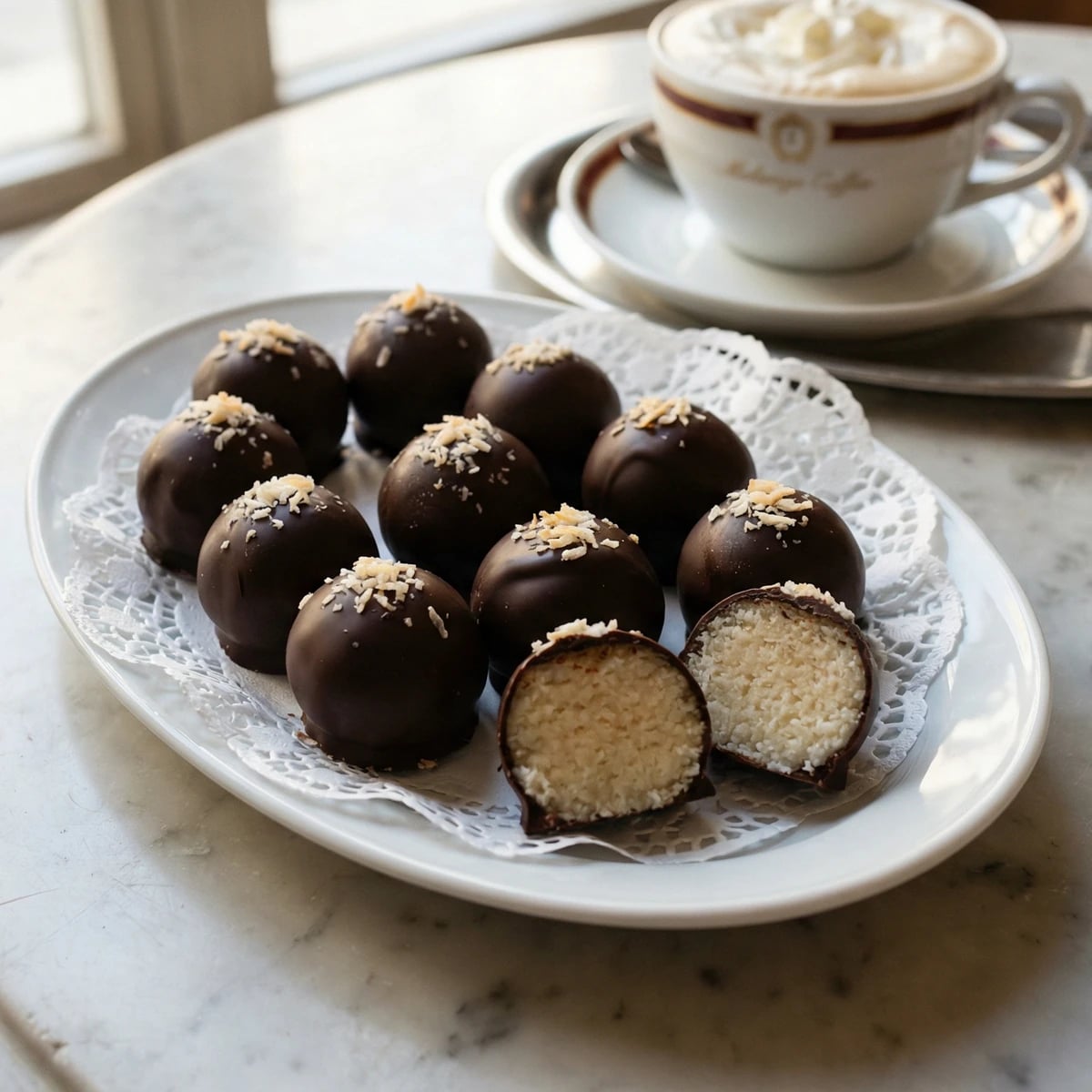
Toasted coconut and condensed milk rolled into small firm balls, dipped in dark chocolate, and left to set with a glossy snap. The kind of confection every Austrian Konditorei puts in the window come December.
Every December, the Konditoreien in Salzburg fill their display cases with rows of tiny, perfect confections. Rum truffles, marzipan potatoes, Vanillekipferl, and always, always Kokoskugeln. Coconut balls dipped in dark chocolate, lined up in little paper cases, catching the light.
Gretel always said that Austrian sweets tell you what season it is. In summer, you eat fruit. In winter, you make things that keep. Kokoskugeln are winter food. They sit in a tin and get better over a few days as the coconut softens and the rum comes forward. My grandmother Eva used to start making them the first week of Advent, and the tin lived on top of the wardrobe where she thought I couldn't reach it. I could reach it. She knew.
The recipe is almost absurdly simple. Toasted coconut, condensed milk, rum, vanilla sugar, rolled into balls and dipped in good dark chocolate. No baking, no complicated technique, nothing that should intimidate anyone. What matters is the details. Toast the coconut properly and you get a warm, nutty depth that raw coconut can't give you. Use real Vanillezucker instead of extract. Don't skip the rum: Austrians use Inländer-Rum for baking and confections, and it's the background note that makes the whole thing taste like Christmas in Vienna instead of a generic coconut candy.
These are the sweets I set out on the counter at my restaurant when the Christmas markets open. Regulars expect them. If the Kokoskugeln aren't there by the first of December, someone will ask.
Kokoskugeln belong to the Austrian tradition of Weihnachtsbäckerei, the weeks of holiday baking that begin with Advent and fill every household and Konditorei with confections meant to be stored, gifted, and shared. Coconut arrived in Central European kitchens through colonial trade routes in the 19th century and was quickly adopted into the Habsburg confectionery tradition, where it joined existing nut-based sweets like Marzipankartoffeln and Nussecken. The use of Inländer-Rum, a distinctly Austrian spirit created as a domestic alternative to imported Caribbean rum, marks these as specifically Austrian rather than generally European.
Quantity
200g
Quantity
200g
Quantity
1 packet (8g)
Quantity
1 tablespoon
Quantity
pinch
Quantity
200g
Quantity
1 tablespoon
Quantity
30g
for finishing
| Ingredient | Quantity |
|---|---|
| desiccated coconut | 200g |
| sweetened condensed milk | 200g |
| vanilla sugar (Vanillezucker) | 1 packet (8g) |
| rum (Inländer-Rum or dark rum) | 1 tablespoon |
| salt | pinch |
| dark chocolate (70% cocoa) | 200g |
| coconut oil or cocoa butter | 1 tablespoon |
| desiccated coconut (optional)for finishing | 30g |
Spread the 200g of desiccated coconut in a dry pan over medium-low heat. Stir it constantly with a wooden spoon. You're looking for a pale gold color and a warm, nutty smell that fills the kitchen. This takes about four to five minutes. The moment you see the first golden flecks, pay close attention. Coconut goes from toasted to burnt in seconds. Pull the pan off the heat a shade before you think it's ready, because residual heat will carry it the rest of the way. Tip it onto a plate immediately so it stops cooking.
Let the toasted coconut cool for five minutes, then combine it in a bowl with the condensed milk, Vanillezucker, rum, and a pinch of salt. Stir until everything comes together into a thick, sticky mass. The mixture should hold its shape when you press it between your fingers. If it's too loose and won't hold a ball, add a tablespoon more coconut. If it's too stiff to work with, a tiny splash more condensed milk loosens it. Trust your hands here. They'll tell you when the texture is right.
Dampen your hands with cold water. Pinch off small portions, about a heaped teaspoon each, and roll them between your palms into smooth, compact balls roughly two centimeters across. Set them on a baking sheet lined with parchment. You should get about thirty. Don't rush the shaping. If the surface is cracked or rough, the chocolate won't coat evenly. Smooth, firm balls. That's what you want. Once they're all shaped, put the tray in the fridge for at least thirty minutes. Cold filling and warm chocolate is the principle. If the centers are soft when you dip them, they'll fall apart in the chocolate.
Chop the dark chocolate finely. The smaller the pieces, the more evenly it melts. Set a heatproof bowl over a pot of barely simmering water. The bottom of the bowl should not touch the water. Add two thirds of the chopped chocolate and stir gently until it melts completely and feels smooth. Take the bowl off the heat and stir in the remaining third. This cools the chocolate down and gives it the snap and shine of properly handled chocolate. Add the coconut oil or cocoa butter and stir until incorporated. The fat thins the chocolate just enough to coat cleanly without pooling at the base of each ball.
Take the chilled coconut balls from the fridge. Drop one into the melted chocolate. Use two forks to turn it gently until it's completely coated, then lift it out, letting the excess chocolate drip back into the bowl. Set it on a clean sheet of parchment. If you want to finish some with a pinch of toasted coconut on top, do it now, while the chocolate is still wet. Work steadily but don't rush. If the chocolate starts to thicken, set the bowl back over the warm water for thirty seconds, no more.
Leave the dipped Kokoskugeln at cool room temperature until the chocolate sets firm and glossy, about one hour. If your kitchen is warm, put them in the fridge for twenty minutes to speed things along, but room temperature gives you a better finish. When the chocolate no longer yields to a light touch, they're done. Arrange them on a plate, in a tin, or in small paper cases. They keep beautifully in a cool place for up to two weeks, though in my experience they never last that long.
1 serving (about 22g)
Culinary guides, cultural storytelling, and the editorial depth that makes cooking meaningful.
Discover Culinary Explorer
Chef Elsa
Christkindlmarkt candied almonds roasted in cinnamon sugar until they crackle and shine, the scent that finds you before the market does and pulls you through the cold to the copper pan.

Chef Elsa
Golden caramel shattered through with toasted hazelnuts, the Austrian confection that turns up inside Torten, on top of ice cream, and in the pockets of anyone passing through a Konditorei before Christmas.

Chef Elsa
Real sweet violets painted with egg white and dusted in sugar, one petal at a time, until they become the fragile, sparkling confections that Demel has been selling from glass cases in Vienna for two hundred years.

Chef Elsa
Smooth chestnut confections dipped in dark chocolate, the kind the Konditorei puts in the window when the Maronibrater carts start smoking on every Salzburg street corner in October.