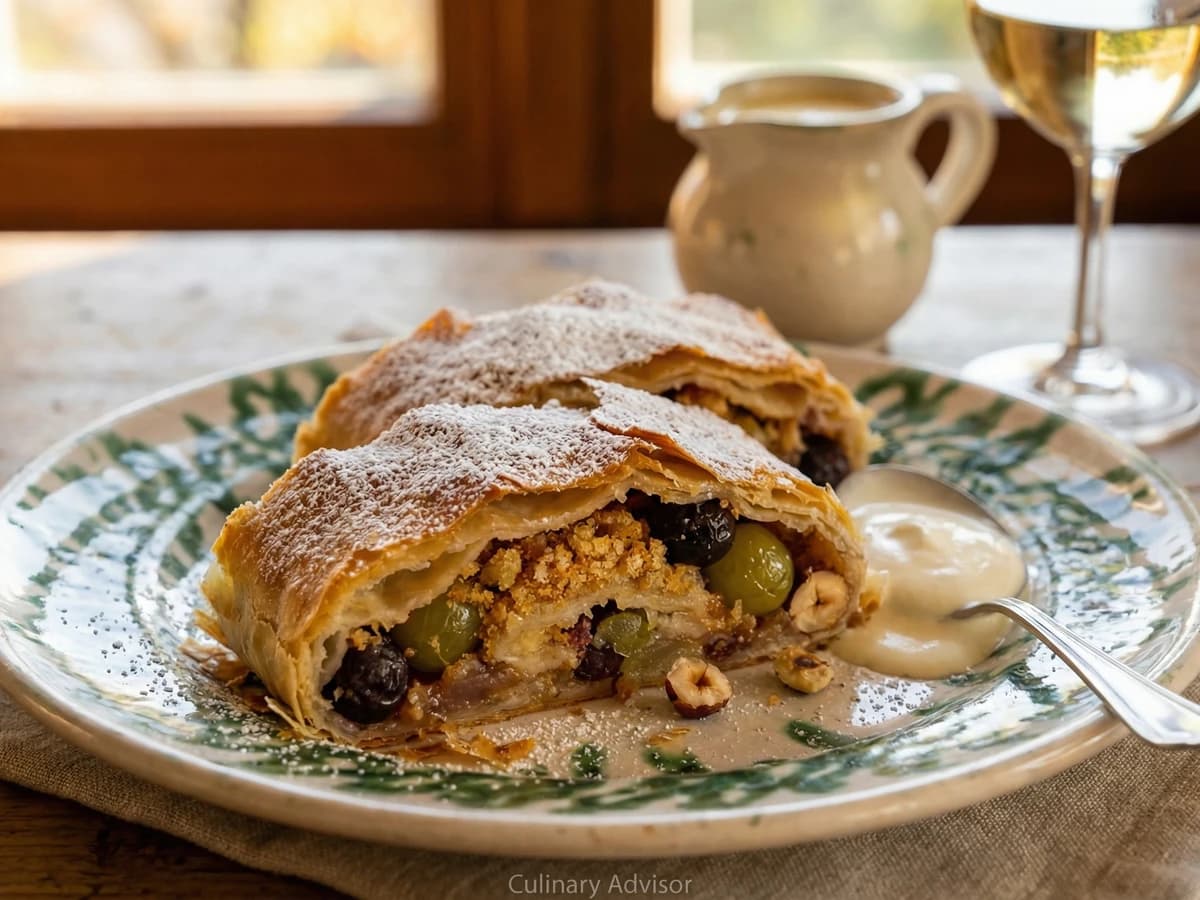
Soft marzipan crescents pressed into sliced almonds and baked until golden, both ends dipped in dark chocolate. The quietest, most elegant cookie on the Austrian Christmas plate.
Pastries & Cookies
Austrian
Christmas
Holiday
Special Occasion
45 min
Active Time
15 min cook•2 hr total
YieldAbout 30 cookies
Gretel always said that the best Christmas cookies are the ones that don't shout. Vanillekipferl crumble softly. Linzer Augen peek through their jam windows. And Mandelbogen sit on the plate like a whispered promise, two little chocolate-tipped arcs that taste entirely of almonds and almost nothing else.
I remember these from Eva's kitchen every December. They appeared on the big platter alongside a dozen other Weihnachtsbäckerei, the Christmas baking that Austrian families spend weeks preparing. The Mandelbogen were always the ones I reached for first. Not because they were the sweetest or the most decorative, but because they were the most honest. Marzipan, almonds, good dark chocolate. Three ingredients carrying the whole performance. You bite through the crisp layer of toasted sliced almonds, hit the soft, fragrant marzipan center, and the chocolate on the ends ties it together with just enough bitterness to keep the sweetness grounded.
The shaping takes a bit of time. You roll each one by hand, curve it gently, press on the almonds. There is no shortcut for this, and that's part of the point. Weihnachtsbäckerei is meant to be slow. You put on music, you make coffee, you work through the dough piece by piece. By the time you're done, the kitchen smells like toasted almonds and the tin is full and you've earned every single one.
Mandelbogen belong to the Austrian tradition of Weihnachtsbäckerei, the elaborate Christmas cookie baking that begins in late November and fills household tins by the first week of Advent. Austrian families traditionally bake between five and twelve varieties, each stored in separate tins and brought out for visitors throughout the holiday season. The marzipan-based recipes in this tradition reflect Austria's long trade connections to the Mediterranean almond groves, with almonds arriving via Venice and Trieste when those cities were part of the Habsburg empire.
The technique, the tradition, and the story behind every dish.
Grate the marzipan on the coarse side of a box grater into a large bowl. This sounds fussy but it matters. Marzipan straight from the block is dense and stubborn, and if you try to knead it directly with the other ingredients, you'll end up with lumps that no amount of mixing can fix. Grating breaks it down so it incorporates evenly. Add the powdered sugar, Vanillezucker, one egg white, and the Kirschwasser if you're using it. Work everything together with your hands until the mixture is smooth and uniform. It will feel slightly sticky and soft, like modeling clay that's been warmed in your palms.
The quality of your marzipan decides the quality of your Mandelbogen. Read the label. Good marzipan lists almonds first, with at least 50% almond content. The cheap stuff is mostly sugar with almond flavoring and it tastes like it.
2
Add the flour
Sift the flour and salt over the marzipan mixture and fold it in gently until just combined. You want a dough that holds its shape when you roll it but still feels pliable and slightly tacky. If it's too wet, add flour a teaspoon at a time. If it's too dry and cracking, your marzipan was old. Add a few drops of egg white to bring it back. Wrap the dough in cling film and refrigerate for thirty minutes. The dough needs to firm up so you can shape it without it sticking to everything in your kitchen.
Don't overwork this dough. The flour is there for structure, not for strength. Too much kneading develops gluten and you'll lose the tender, sandy crumb that makes these cookies special.
3
Shape the arcs
Preheat your oven to 170°C (340°F). Line two baking sheets with parchment paper. Pinch off a walnut-sized piece of dough and roll it between your palms into a log about eight centimeters long, slightly thicker in the middle and tapered at both ends. Curve it gently into a crescent, an arc, not a full half-circle. The shape should look like a gentle smile. Place the sliced almonds on a shallow plate. Brush each arc lightly with beaten egg white, then press it gently into the sliced almonds, turning to coat all sides. The almonds should cover the surface in a rough, overlapping layer. Don't press too hard or they'll crack.
4
Bake until golden
Arrange the almond-coated arcs on the prepared baking sheets, leaving two centimeters between them. They won't spread much but they need room for the almonds. Bake for 12 to 15 minutes, until the sliced almonds turn a light golden color and the kitchen smells like toasted marzipan. Watch them carefully after ten minutes. The almonds go from golden to burnt in about sixty seconds and there's no saving a burnt Mandelbogen. Let them cool completely on the baking sheet. They're fragile when warm and will firm up as they cool.
5
Dip in dark chocolate
Chop the dark chocolate finely and melt two-thirds of it in a heatproof bowl set over barely simmering water. The bowl should not touch the water. When it's smooth, remove it from the heat and stir in the remaining third of chopped chocolate, a handful at a time, until melted and glossy. This simple tempering gives you chocolate that sets with a clean snap instead of a dull, chalky finish. Dip both ends of each Mandelbogen into the chocolate, letting the excess drip back into the bowl. Set them on parchment paper and let the chocolate set completely at room temperature. Don't rush this into the fridge. Chilled chocolate blooms gray and loses its shine.
If your chocolate seizes up and turns grainy, a drop of water got into the bowl. Start over with fresh chocolate. There's no recovering seized chocolate for dipping.
6
Store and serve
Once the chocolate is fully set, layer the Mandelbogen between sheets of parchment paper in a tin with a tight-fitting lid. They keep beautifully for two to three weeks in a cool place, and they actually improve after a few days as the marzipan softens and the flavors settle into each other. This is a cookie that rewards patience. Serve them alongside a cup of strong Viennese coffee and let the quiet elegance of pure almond do the talking.
Chef Tips
•Buy marzipan from a German, Austrian, or Scandinavian brand if you can. Lubeck marzipan from northern Germany sets the standard: high almond content, fine texture, not too sweet. Avoid anything labeled 'almond paste' unless you've read the ingredients and confirmed it's real marzipan.
•If your marzipan has been sitting in the cupboard for months and feels hard and dry, grate it and knead in a teaspoon of Kirschwasser or a few drops of egg white to bring it back. Stale marzipan will crack when you try to shape it, and cracked Mandelbogen won't hold their almonds.
•Toast a few extra sliced almonds in a dry pan and eat them while you work. You'll understand exactly what color you're looking for in the oven: pale gold, not brown.
•These are one of the few Christmas cookies that genuinely improve with time. After three or four days in a sealed tin, the marzipan center softens and the almond coating stays crisp. If you can resist eating them for that long, you'll be rewarded.
Advance Preparation
•The marzipan dough can be made a day ahead and refrigerated, wrapped tightly in cling film. Let it come to cool room temperature for fifteen minutes before shaping, or it will crack.
•Mandelbogen without the chocolate dip can be baked up to three days before dipping. Store them in a tin between layers of parchment.
•Fully finished Mandelbogen keep for two to three weeks in a sealed tin stored in a cool room. They do not need refrigeration and they should not be frozen. Freezing ruins the texture of the marzipan.
Frequently Asked Questions
Nutrition Information
1 serving (about 22g)
Calories
110 calories
Total Fat
6 g
Saturated Fat
2 g
Trans Fat
0 g
Unsaturated Fat
4 g
Cholesterol
0 mg
Sodium
8 mg
Total Carbohydrates
10 g
Dietary Fiber
1 g
Sugars
6 g
Protein
3 g
Where cooking meets culture.
Culinary guides, cultural storytelling, and the editorial depth that makes cooking meaningful.