
Chef Graziella
Agnolotti del Plin
The tiny pinched parcels of Piedmont, filled with braised meat and sealed with a gesture that has passed from grandmother to granddaughter for centuries. The pinch is both technique and signature.
A cooking platform built around craft, culture, and the stories behind what we eat.
Created by
The golden gnocchetti of Sardinia, shaped by hand against ridged baskets the way Sardinian grandmothers have done for centuries. Saffron colors the dough. Your thumb creates the curl.
Sardinia stands apart from the Italian mainland in its cooking, its language, and its pasta. Malloreddus proves this separation. These small ridged shells, colored gold with saffron, belong to the island and nowhere else. The name means 'little calves' in Sardinian dialect, though why anyone named pasta after young cattle remains unclear. Perhaps it is the plump shape. Perhaps it is simply what the word became over centuries of repetition.
The dough is semolina and water, nothing more. No eggs. The semolina gives it structure and a pleasant chew that egg pasta cannot match. The saffron, which Sardinia has cultivated since the Phoenicians brought it, provides color and a subtle floral bitterness that disappears into the sauce.
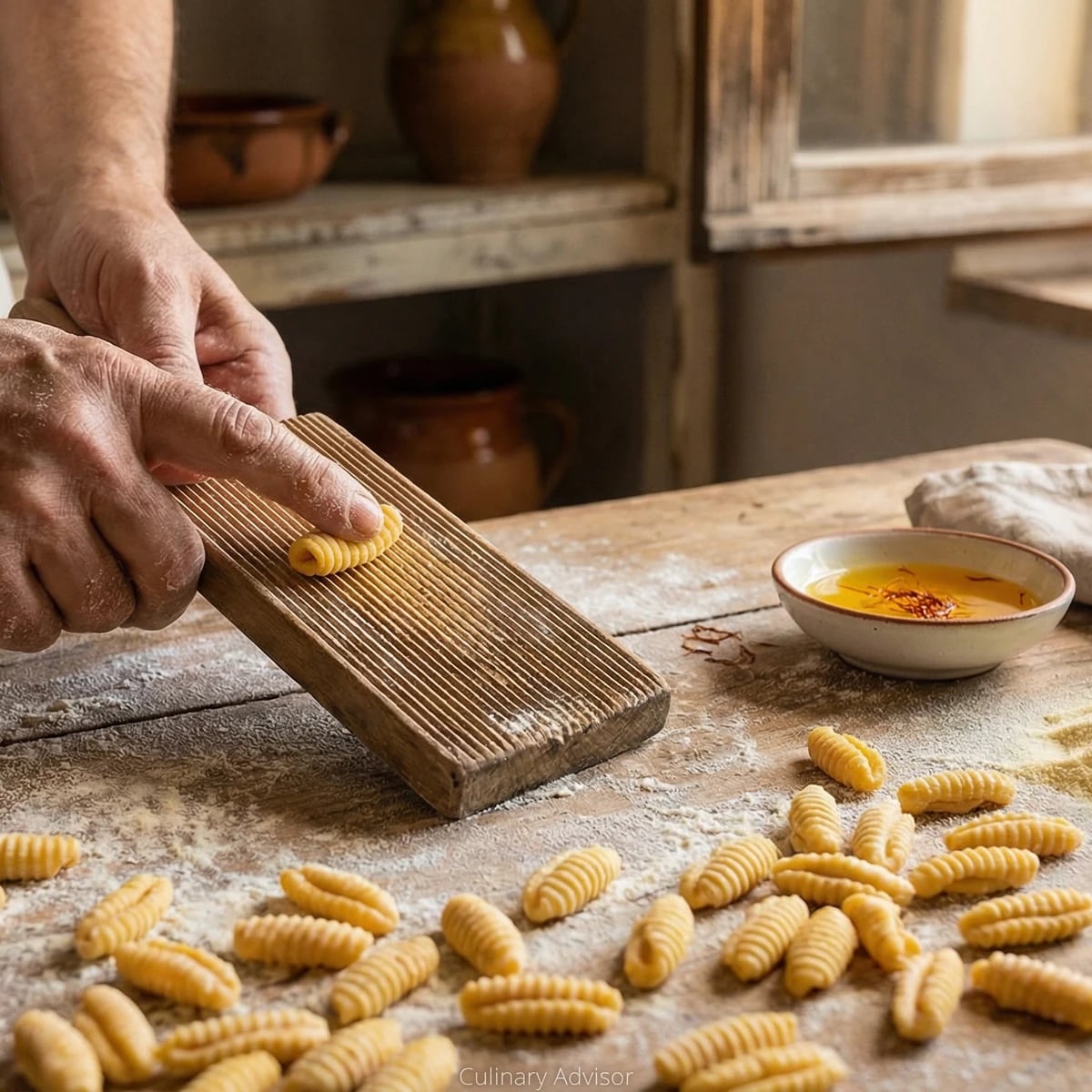
Shaping requires a ridged surface and your thumb. The motion is simple: press, drag, curl. The ridges catch sauce. The hollow interior traps it. Every groove and curve serves a purpose. This is not decorative. This is engineering developed over generations of home cooks who understood that form must follow function.
Simple does not mean easy. The dough resists at first. Your thumb will tire. Your first attempts will look like nothing. Then, somewhere around your thirtieth malloreddu, the motion will become automatic. This is how skill develops. There is no shortcut.
Malloreddus date to Sardinia's agrarian past, when shepherds and farmers needed pasta that could dry completely and store for months. The saffron, introduced by Phoenician traders around 1000 BCE, became so integral to Sardinian cooking that the island remains Italy's primary saffron producer. The town of San Gavino Monreale in Campidano holds an annual saffron festival each November, and their malloreddus alla Campidanese, made with pork sausage and tomato, remains the definitive preparation.
Quantity
300g
Quantity
1/4 teaspoon (about 0.25g)
Quantity
150ml
Quantity
1/2 teaspoon
| Ingredient | Quantity |
|---|---|
| semola rimacinata | 300g |
| saffron threads | 1/4 teaspoon (about 0.25g) |
| warm water | 150ml |
| fine sea salt | 1/2 teaspoon |
Warm the water until it steams but does not boil. Crumble the saffron threads between your fingers and drop them into the water. Let this steep for at least 15 minutes. The water will turn deep gold, almost orange. This is the color of Sardinian pasta, and you cannot rush it. The saffron must release its pigment and perfume completely.
Mound the semolina on a wooden board or clean work surface. Make a well in the center. Add the salt to the saffron water and pour it into the well. Using a fork, begin drawing flour from the inner walls of the well into the liquid, stirring continuously. When the mixture becomes too thick to stir, switch to your hands. Bring the dough together, incorporating all the flour. It will feel rough and dry at first. This is correct for semolina dough.
Knead the dough firmly for 10 to 12 minutes. Push it away from you with the heel of your hand, fold it back, turn it a quarter, and repeat. The dough will transform from rough and crumbly to smooth and supple. When finished, it should feel like firm clay and spring back slowly when pressed. Wrap tightly in plastic and rest at room temperature for 30 minutes. This rest is not optional. The gluten must relax or the dough will fight you during shaping.
You need a ridged surface. A gnocchi board (rigagnocchi) is ideal and costs very little. The back of a butter paddle works. In Sardinia, they use a small woven basket called a ciuliri, which creates the traditional pattern. Dust your work surface and the ridged board lightly with semolina. Have a sheet pan dusted with semolina ready to receive the finished pasta.
Cut the rested dough into four pieces. Keep three pieces covered while you work with one. Roll the dough piece into a rope about half an inch thick. The thickness matters: too thick and the pasta will be gummy in the center, too thin and the ridges will not form properly. Cut the rope into pieces roughly half an inch long. Each piece should be about the size of a chickpea.
Place one dough piece on the ridged surface. Using your thumb, press down firmly and drag the dough toward you in one motion. The pasta should curl around your thumb as it slides across the ridges, forming a small shell with grooves on the outside and a hollow interior. The motion is press, drag, release. Each malloreddu takes perhaps two seconds once you learn the rhythm.
Transfer the shaped malloreddus to the semolina-dusted sheet pan in a single layer. They should not touch. Continue with the remaining dough. Let the pasta dry at room temperature for at least one hour before cooking. For longer storage, dry completely (several hours) and store in an airtight container at room temperature for up to two weeks.
Bring abundant salted water to a rolling boil. The water should taste like the sea. Add the malloreddus and stir immediately to prevent sticking. Fresh malloreddus cook in 3 to 4 minutes. Dried ones take 8 to 10. They are done when tender throughout but with pleasant resistance. Bite one to check. Drain and sauce immediately. These are traditionally served with sausage ragù, tomato and saffron sauce, or simply with aged pecorino and olive oil.
1 serving (about 155g)
Culinary guides, cultural storytelling, and the editorial depth that makes cooking meaningful.
Discover Culinary Explorer
Chef Graziella
The tiny pinched parcels of Piedmont, filled with braised meat and sealed with a gesture that has passed from grandmother to granddaughter for centuries. The pinch is both technique and signature.

Chef Graziella
The little hollowed shells of Puglia and Molise, shaped with nothing more than two fingers and a wooden board. The motion takes practice. The result catches sauce like nothing else.

Chef Graziella
Rome's broad egg ribbons, the pasta that made Alfredo famous before Americans drowned it in cream. Master the dough and the roll, and you master a foundation of Italian cooking.

Chef Graziella
Sardinia's ancient hand-rolled semolina pasta, toasted until golden brown to develop the nutty, almost bread-like flavor that makes it unlike any other pasta in the Italian repertoire.