
Chef Lupita
Birria Tacos with Consome
Jalisco's goat birria, born around Cocula and carried into Guadalajara's markets, slow-braised in ancho, guajillo, cascabel, and chile de arbol, then tucked into corn tortillas crisped in its own red fat.
A cooking platform built around craft, culture, and the stories behind what we eat.
Created by
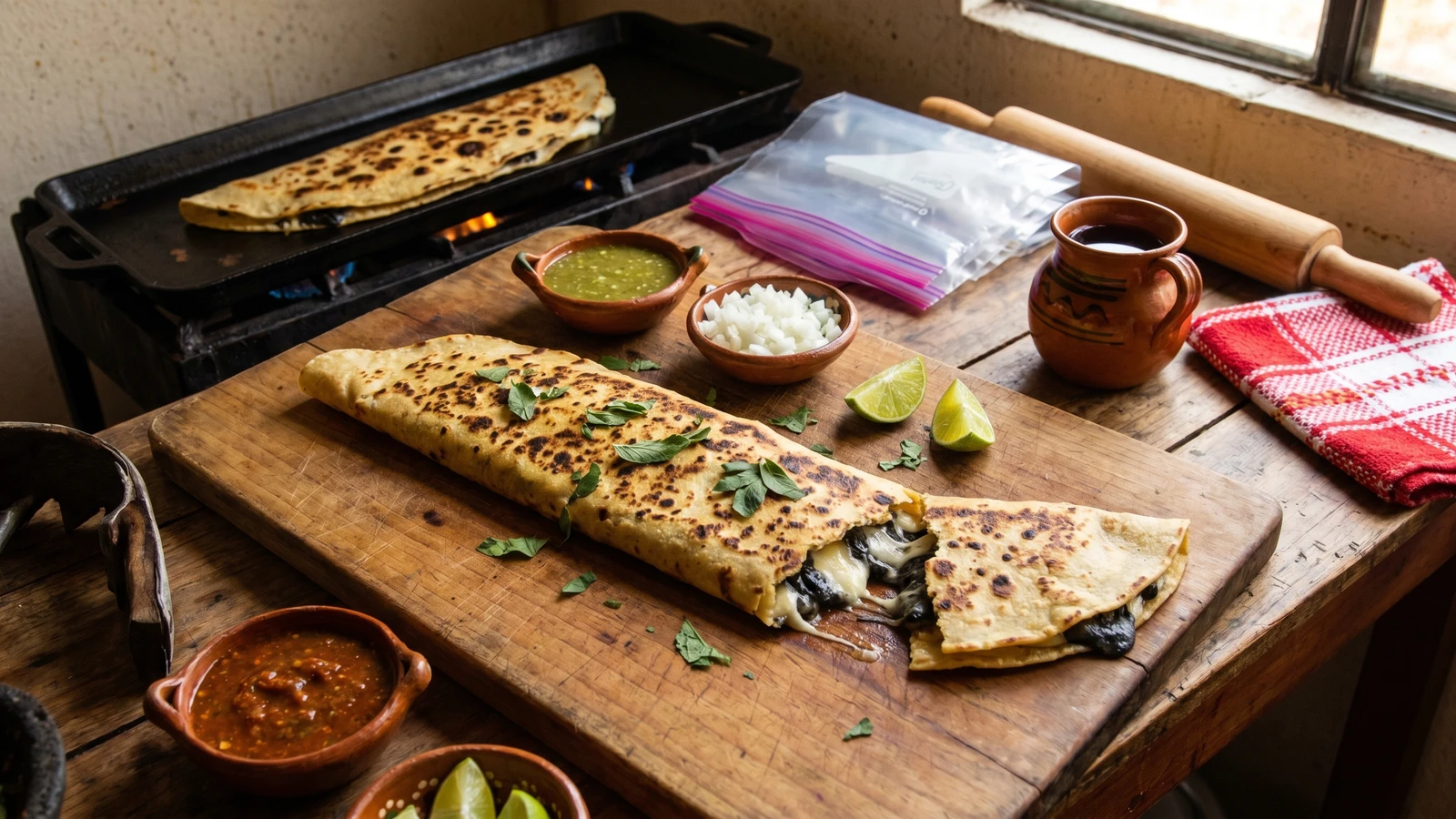
Colonia Guerrero's two-foot corn quesadilla stretched on the comal and stuffed with quesillo, huitlacoche, flor de calabaza, or chicharron prensado. Named for the blade it resembles. Torn and passed around the table.
The machete is from Ciudad de México. Specifically from Colonia Guerrero, the working-class barrio just north of the Centro Historico where the puestos along Calle Zarco have been stretching masa into two-foot quesadillas since the 1980s. The name tells you the shape. A long, narrow blade of corn, cooked on a comal built wide enough to hold it.
This is street food in the truest sense, food invented by cooks for the people who walked past their stand at midnight, leaving the cantinas or finishing the night shift. The machete fills four hungry people for the price of two tacos. It is built to share. You tear it with your hands. You pass salsa down the table. You do not order one for yourself.
The fillings are the classic CDMX quesadilla guisados, raised to a bigger scale: huitlacoche with epazote, flor de calabaza with serrano, chicharron prensado already swimming in chile, and always quesillo from Oaxaca because nothing else melts the way it does. My mother did not make machetes. She made quesadillas. But when I moved out and started cooking for friends in a tiny apartment in Colonia Roma, I learned to stretch one machete and feed six people on a budget. Saber cocinar es saber vivir, and the machete is proof.
The machete emerged in Colonia Guerrero in the early 1980s as a vendor's innovation, an attempt to stretch the basic quesadilla into something more substantial and more shareable for the neighborhood's working-class clientele. The dish has no pre-Columbian lineage; it is purely a 20th-century urban invention tied to the rise of street-stall economies in postwar Mexico City, where vendors competed by offering more food for less money. The name 'machete' references the rural agricultural blade, an ironic gesture in the dense urban barrio where the dish was born, and the form of the quesadilla, stretched two feet long and folded over its fillings, remains a Colonia Guerrero signature that has only recently spread to other parts of the capital.
Quantity
4 cups (500 grams)
Quantity
2 1/2 cups, plus more as needed
Quantity
1 teaspoon
Quantity
2 tablespoons
softened
Quantity
1 pound
shredded by hand
Quantity
1 pound
Quantity
1 pound
stems and pistils removed
Quantity
1 pound
fresh or frozen
Quantity
1 cup
roughly chopped, divided
Quantity
2 tablespoons
Quantity
1 small
finely diced
Quantity
3
minced
Quantity
2
minced
Quantity
to taste
Quantity
for serving
Quantity
for serving
Quantity
for serving
Quantity
for serving
| Ingredient | Quantity |
|---|---|
| masa harina for tortillas (Maseca or Minsa) | 4 cups (500 grams) |
| warm water | 2 1/2 cups, plus more as needed |
| kosher salt | 1 teaspoon |
| lard (manteca de cerdo) for the masasoftened | 2 tablespoons |
| Oaxaca cheese (quesillo)shredded by hand | 1 pound |
| chicharron prensado in chile sauce | 1 pound |
| flor de calabaza (squash blossoms)stems and pistils removed | 1 pound |
| huitlacoche (corn fungus)fresh or frozen | 1 pound |
| fresh epazote leavesroughly chopped, divided | 1 cup |
| lard (manteca de cerdo) for the guisados | 2 tablespoons |
| white onionfinely diced | 1 small |
| garlic clovesminced | 3 |
| chile serranominced | 2 |
| kosher salt | to taste |
| salsa verde cruda (optional) | for serving |
| salsa roja de molcajete (optional) | for serving |
| sliced raw white onion (optional) | for serving |
| lime wedges (optional) | for serving |
In a wide bowl, combine the masa harina and salt. Add the softened lard and rub it through the dry flour with your fingertips until it disappears. Pour in the warm water and bring it together with one hand. Knead for five minutes inside the bowl. The masa should feel like soft, cool earlobe. If it cracks at the edges when you press it, it needs more water, a tablespoon at a time. If it sticks to your palm, it needs a little more masa. Cover with a damp cloth and let it rest for 20 minutes. The masa needs to hydrate fully or it will crack the moment you try to stretch it two feet long.
Heat one tablespoon of lard in a skillet over medium. Add half the diced onion, half the garlic, and cook until translucent, about three minutes. Add the huitlacoche and cook, stirring, for eight to ten minutes until the liquid releases and reduces back into the pan and the mixture turns inky black. Stir in half the chopped epazote in the last minute. Salt to taste. Set aside. Huitlacoche without epazote is unfinished. The two are a pair. Pregunta a las senoras del mercado de Jamaica si no me crees.
In the same skillet, heat the second tablespoon of lard over medium. Add the remaining onion, garlic, and the minced serrano. Cook three minutes. Add the squash blossoms in handfuls, letting each wilt before adding the next. Cook five minutes total, just until the petals collapse and turn deep gold. Stir in the rest of the epazote. Salt to taste. Pull off the heat. The blossoms should still have body, not turn to mush.
Heat the chicharron prensado in a small pan over low heat for five minutes, just to loosen the chile sauce and warm it through. This one is already seasoned by the carnicero who made it. Do not add salt. Do not add anything. Set aside in a warm spot.
Divide the rested masa into four equal balls. Take a heavy-duty zipper bag and cut down both sides so it opens like a book. Lay one piece flat on the counter. Place one ball of masa in the center. Press it down with your palm into a thick oval. Cover with the second sheet of plastic. Now use a rolling pin to stretch the masa into a long, narrow oval, about 20 to 24 inches long and 5 inches wide. Work from the center out, rolling lengthwise. The shape is the dish. A round quesadilla is not a machete.
Set a large cast iron comal, a flat griddle, or your widest cast iron skillet over medium-high heat. Let it come up for five full minutes. A flicked drop of water should dance and skitter, not sit and steam. A cold comal sticks. A hot comal releases. This is the difference between a machete and a tragedy.
Peel the top plastic off the stretched masa. Flip the masa onto your free hand, then lay it gently onto the hot comal. Peel off the second plastic. Cook for about 90 seconds, until the underside has light brown freckles and lifts easily. Flip with two spatulas or a long bench scraper. Immediately scatter a quarter of the Oaxaca cheese down the center third of the machete, lengthwise. Layer on a quarter of one filling, this is your machete de huitlacoche, or chicharron, or flor de calabaza. One filling per machete. Do not mix them. Each machete is its own dish.
Using two spatulas, fold one long side over the filling, then the other, like closing a book lengthwise. Press gently with the back of the spatula. Cook two more minutes per side, lowering the heat slightly if the masa is browning faster than the cheese is melting. The outside should be deeply freckled and crisp. The inside should be molten. When you press the top of the machete, it should give and then spring back. Asi se hace y punto.
Slide the finished machete onto a long wooden board or a hand-woven mat. Repeat with the remaining three balls of masa and the other fillings. Bring all four to the table at once. Tear them apart with your hands. Pass the salsa verde, the salsa roja, the raw white onion, and the lime. A machete is not a single-person dish. It is built for a group, the way the puestos on Calle Zarco serve them at midnight after a long shift or a long night.
1 serving (about 395g)
Culinary guides, cultural storytelling, and the editorial depth that makes cooking meaningful.
Discover Culinary ExplorerChef Lupita
Jalisco's goat birria, born around Cocula and carried into Guadalajara's markets, slow-braised in ancho, guajillo, cascabel, and chile de arbol, then tucked into corn tortillas crisped in its own red fat.

Chef Lupita
Sonora's working morning burrito: chicharrón de cáscara stewed in chile colorado with diced potato, rolled tight in a paper-thin tortilla sobaquera and eaten standing up at the carreta.

Chef Lupita
Mocorito's pork chilorio, shredded and confited in lard with chile ancho and pasilla, rolled into a thin handmade flour tortilla. The burrito Sinaloa sends out into the world.

Chef Lupita
Sonora's morning burrito of mashed pinto frijoles puercos and melted queso asadero, wrapped in a paper-thin sobaquera and seared on the comal until the cheese pulls in long strings.