
Chef Fai
Sticky Rice Dumplings in Coconut Cream (Bua Loi)
Glutinous rice flour, palm sugar, coconut cream, and a pinch of salt. Thai dessert follows the same governing rules as every savory dish. The system doesn't stop at the sweet course.
A cooking platform built around craft, culture, and the stories behind what we eat.
Created by
Palm sugar is the sweet pillar. Coconut cream is the medium. Pandan is the soul. Thai dessert follows the same system as every curry and stir-fry: principles first, recipes second. This is the proof.
Thai dessert is not a separate world. It follows the same governing system as every gaeng, every stir-fry, every som tam you've ever eaten. Ajarn always said the four pillars don't stop at savory food. They define Thai cuisine. All of it. And the sweet pillar, nam tan pip (palm sugar), is the one that rules khanom thai.
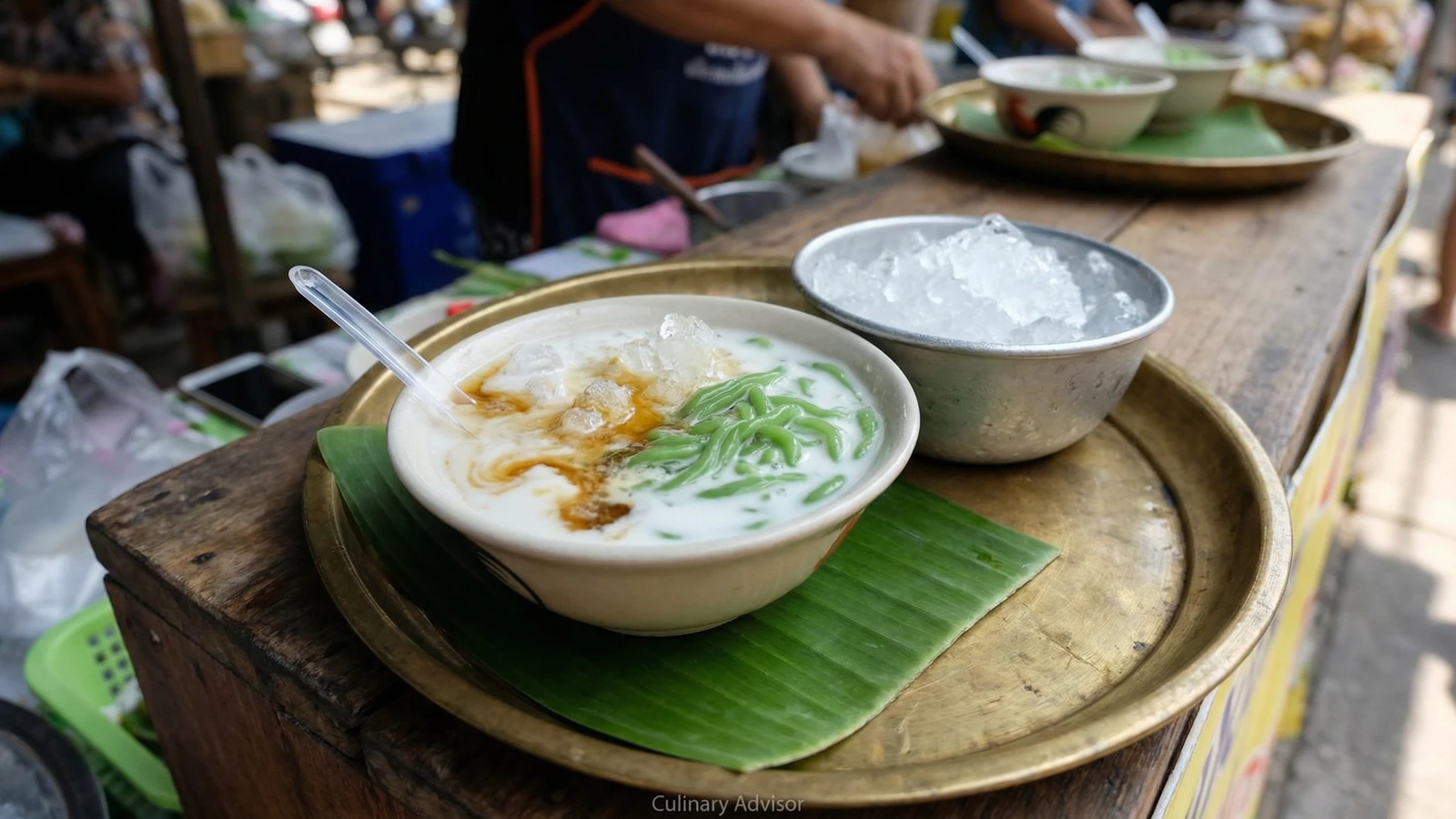
Lod chong is the clearest demonstration. Two components: pandan noodles and sweetened coconut milk. That's it. And both are governed by rules. The noodles get their green from bai toey (pandan leaves), pounded or blended and squeezed for juice. Not extract. Not food coloring. The real leaf, with its grassy, floral fragrance that no bottle can replicate. The flour is paeng khao jao (regular rice flour), not glutinous, combined with paeng man sampalang (tapioca starch) for that slippery, chewy bite. Cook the dough on the stove until it goes translucent and thick, then press it through a mold into ice water. The cold shock sets the noodles. Physics.
The coconut milk side is where people go wrong. Granulated sugar is not palm sugar. Cow's milk is not coconut cream. These aren't creative substitutions. They're violations of the system. Nam tan pip gives a caramel depth, a smokiness, a complexity that white sugar can't touch. Hua kati (thick coconut cream, the first press) gives richness that no dairy replicates. A pinch of salt pulls the sweetness forward. That salt-sweet tension is pure Thai thinking.
I learned lod chong from a vendor at Khlong Toei market who'd been pressing noodles through a brass mold for thirty years. Her ice water bucket sat right next to the charcoal stove where she cooked the dough. Hot to cold in two seconds. The noodles came out perfect every time, bright green, firm, slippery. She never weighed anything. She knew the dough by feel: too wet and the noodles dissolve, too dry and they crack. That knowledge lives in the hands, not in measuring cups. But I'll give you the measurements so you can get there.
Lod chong (ลอดช่อง, literally 'passed through a mold') is a Central Thai dessert with deep roots in the broader Southeast Asian family of pandan-flour-in-coconut-milk sweets, related to Indonesian es cendol and Malaysian cendol. The Thai version distinguishes itself through the exclusive use of nam tan pip (palm sugar) rather than gula melaka or cane sugar, and through the specific flour combination of rice flour and tapioca starch that gives the noodles their characteristic firm, slippery texture. Lod chong has been a fixture of Thai temple fairs (ngan wat) and market dessert stalls for generations, often served alongside other coconut-milk khanom as part of the Thai dessert tradition that predates the Portuguese-influenced egg sweets introduced in the Ayutthaya period.
Quantity
100g
Quantity
50g
Quantity
15 leaves
cut into 1-inch pieces
Quantity
200ml
Quantity
pinch
Quantity
400ml
preferably fresh-pressed
Quantity
200ml
Quantity
200g
shaved or chopped
Quantity
2 leaves
tied into a knot
Quantity
80ml
Quantity
1/4 teaspoon
Quantity
for serving
| Ingredient | Quantity |
|---|---|
| rice flour (paeng khao jao) | 100g |
| tapioca starch (paeng man sampalang) | 50g |
| pandan leaves (bai toey), for noodle doughcut into 1-inch pieces | 15 leaves |
| water, for pandan juice | 200ml |
| salt, for noodle dough | pinch |
| coconut cream (hua kati)preferably fresh-pressed | 400ml |
| coconut milk (hang kati) | 200ml |
| palm sugar (nam tan pip)shaved or chopped | 200g |
| pandan leaves (bai toey), for coconut milktied into a knot | 2 leaves |
| water, for palm sugar syrup | 80ml |
| salt, for coconut milk | 1/4 teaspoon |
| crushed ice | for serving |
Cut 15 pandan leaves into rough 1-inch pieces. Throw them into a blender with 200ml of water. Blend until the leaves are completely pulverized and the liquid is a deep, vivid green. Strain through a cheesecloth or fine-mesh sieve, squeezing hard to extract every drop. You should get about 150ml of concentrated pandan juice. This is where your color and fragrance come from. If the juice isn't a deep forest green, you used too much water or not enough leaves. Real pandan smells grassy and floral, almost vanilla-like. No extract or food coloring comes close.
In a mixing bowl, combine the rice flour (paeng khao jao) and tapioca starch (paeng man sampalang). This ratio matters. The rice flour gives body. The tapioca starch gives that slippery, chewy, almost bouncy quality that makes lod chong feel right on your tongue. Add a pinch of salt. Pour in the pandan juice gradually, stirring as you go, until you have a smooth, pourable batter with no lumps. It should be the consistency of thick pancake batter. Not all 150ml may be needed. Stop when the consistency is right.
Pour the batter into a medium saucepan over medium-low heat. Stir constantly with a wooden spoon or silicone spatula. Constantly. Don't stop. The batter will start to thicken within 3 to 4 minutes. Keep stirring. It will go from liquid to paste to a thick, glossy, translucent green mass that pulls away from the sides of the pot. That translucency is the starch gelatinizing. It should look like a bright green mochi dough, smooth and cohesive. This takes about 8 to 10 minutes total. If it's still opaque and floury-looking, keep cooking. The dough is done when it's completely translucent and holds together in a ball.
While the dough cooks, fill a large bowl with ice water. Plenty of ice. The noodles need to hit cold water immediately to set their shape and firm up. If the water isn't cold enough, they'll be soft and sticky. This is the shock that gives lod chong its snap.
Work quickly while the dough is still hot. Scoop the dough into a lod chong mold (a flat perforated press) or a colander with holes about 1cm wide. Press the hot dough through the holes with a spatula or the back of a spoon, letting the noodles drop directly into the ice water. They'll fall in short, worm-like strands, 2 to 3 inches long. The cold water sets them instantly. If you don't have a mold, you can pinch off small pieces of dough and roll them into short, finger-width logs by hand, dropping each one into the ice bath. Let the noodles sit in the ice water for at least 5 minutes to firm completely. Drain and set aside.
In a small saucepan, combine the palm sugar (nam tan pip) with 80ml of water over medium heat. Stir until the sugar dissolves completely. Let it simmer for 2 to 3 minutes until slightly thickened. The syrup should be a deep amber, almost the color of dark honey, with a smoky caramel fragrance that white sugar could never produce. This is the sweet pillar doing its work. Strain through a fine sieve if your palm sugar had impurities. Let it cool to room temperature.
In a separate saucepan, gently warm the coconut cream (hua kati) and coconut milk (hang kati) together over low heat with the knotted pandan leaves and salt. Stir slowly. You're not cooking this, you're warming it just enough to dissolve the salt and let the pandan perfume the milk. About 3 to 4 minutes. Do not boil. Boiling breaks the coconut cream and makes it grainy. Remove from heat, discard the pandan knot, and let it cool to room temperature, then chill.
Divide the drained pandan noodles among small bowls or cups. Spoon the chilled coconut milk over the noodles generously, enough so they're swimming. Drizzle palm sugar syrup over the top to taste, starting with 2 tablespoons per serving. Add a generous scoop of crushed ice. The contrast hits you at once: cold coconut milk, slippery green noodles, the deep sweetness of palm sugar cutting through the richness of the cream, the floral whisper of pandan in everything. Stir once with a spoon and eat. This is the sweet pillar in its purest form.
1 serving (about 290g)
Culinary guides, cultural storytelling, and the editorial depth that makes cooking meaningful.
Discover Culinary ExplorerChef Fai
Glutinous rice flour, palm sugar, coconut cream, and a pinch of salt. Thai dessert follows the same governing rules as every savory dish. The system doesn't stop at the sweet course.

Chef Fai
Portuguese fios de ovos arrived in Ayutthaya and Thailand rewrote the rules: palm sugar replaced white, jasmine water replaced plain, and a foreign technique became Thai the moment it followed the system.

Chef Fai
Palm sugar and coconut cream frozen on a street cart with nothing but salted ice and strong arms. The sweet pillar of Thai cuisine in its coldest, purest form. Three ingredients in the base. A lifetime of principle behind them.

Chef Fai
Two layers, one principle: palm sugar for sweet, coconut cream for richness, pandan for fragrance, salt on top to prove that Thai cuisine balances even its desserts. The system governs everything, including sweets.