
Chef Lupita
Acitrón de Cidra Conventual
Puebla's convent-style acitrón, made from cidra peel instead of endangered biznaga, built through repeated syrup soakings until the cubes turn firm, translucent, and ready for rosca or chiles en nogada.
A cooking platform built around craft, culture, and the stories behind what we eat.
Created by
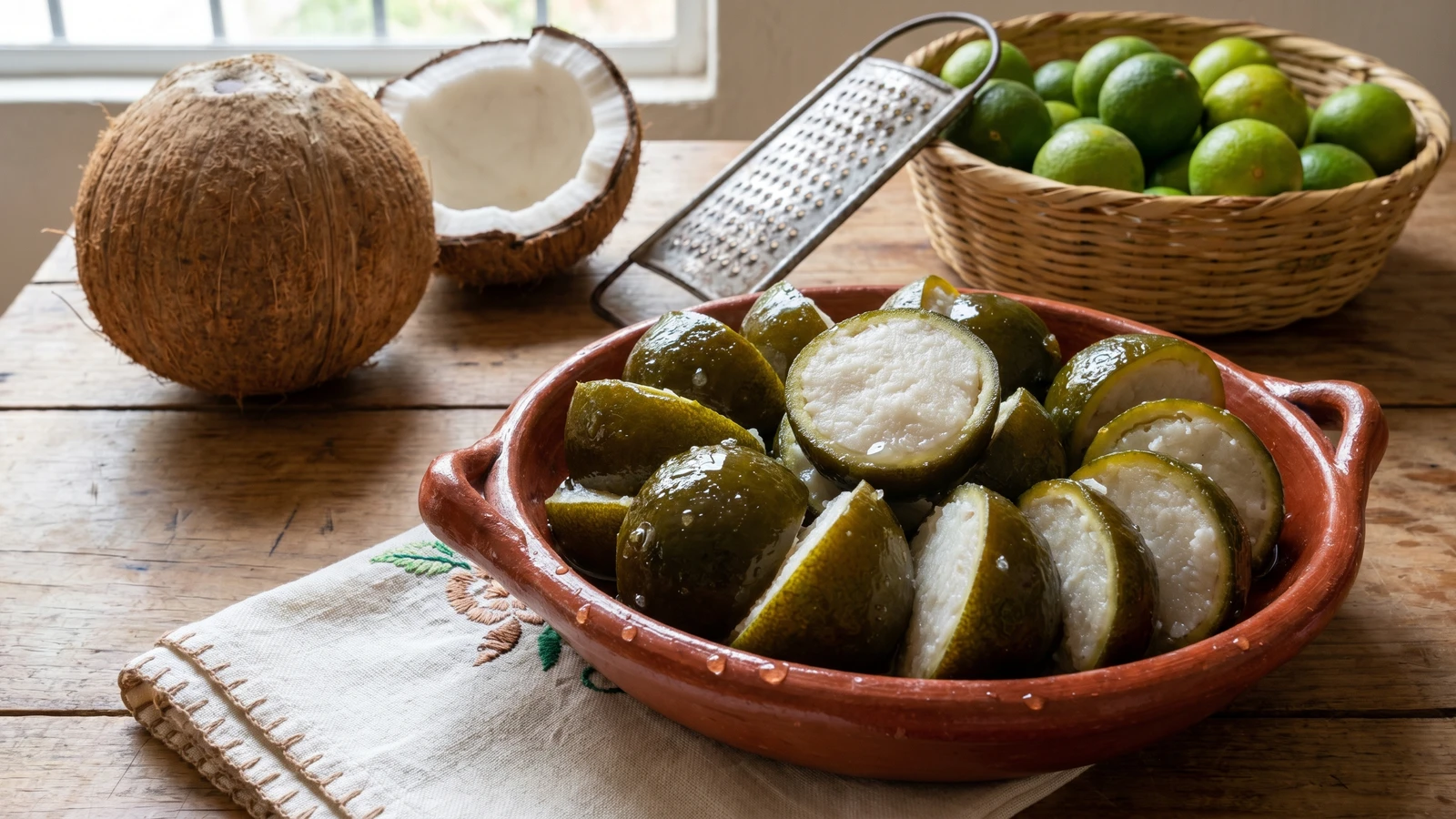
Colima's coconut-stuffed limes are coastal candy: bitter lime rinds softened, sweetened over several days, then packed with a dense paste of fresh coconut and sugar.
Colima owns this sweet through geography. Tecoman gives you the lime groves, the coast gives you the coconut palms, and the women in home kitchens turn both into candy that waits patiently on the table for baptisms, Christmas trays, and family visits.
This is not a quick dessert. The lime rinds have to be softened, emptied without tearing, soaked to pull out the bitterness, then candied slowly until they turn translucent and firm enough to hold the coconut. No me vengas con atajos. If the rind is still harsh, the syrup will not save it. If the coconut is dry and old, the filling will taste like paper.
I learned a version of this in Colima from a señora who kept the limes under a clean cloth on her kitchen table and changed the soaking water like a ritual. She used fresh coconut, piloncillo only when the coconut was not sweet enough, and a clay dish from Comala for serving. Nothing precious. Just discipline, fruit, sugar, and time. Saber cocinar es saber vivir.
Colima became one of Mexico's major coconut and lime states in the 19th and 20th centuries, especially around Tecoman and the coastal corridor toward Manzanillo. Limones rellenos de coco belong to a wider Mexican tradition of convent and home confectionery, where fruit peels were preserved in sugar after the colonial expansion of cane cultivation. The Colima version is distinct because it joins two local crops, lime and coconut, in a candy that is built around preservation rather than immediate serving.
Quantity
24
firm, thin-skinned, unblemished
Quantity
1 tablespoon
Quantity
10 cups, divided, plus more for soaking
Quantity
5 cups
Quantity
1 cup
finely chopped
Quantity
1
Quantity
1/2 teaspoon
Quantity
4 cups
Quantity
1 1/2 cups
Quantity
1 cup
Quantity
1 teaspoon
| Ingredient | Quantity |
|---|---|
| small Mexican limesfirm, thin-skinned, unblemished | 24 |
| pickling lime (cal) or food-grade calcium hydroxide | 1 tablespoon |
| water | 10 cups, divided, plus more for soaking |
| granulated sugar | 5 cups |
| piloncillofinely chopped | 1 cup |
| Mexican cinnamon stick | 1 |
| kosher salt | 1/2 teaspoon |
| freshly grated coconut | 4 cups |
| whole milk | 1 1/2 cups |
| granulated sugar for the coconut filling | 1 cup |
| pure vanilla extract | 1 teaspoon |
Scrub the limes well. With a sharp paring knife, cut a small lid from the stem end of each lime, no wider than a coin. Save the lids. Use a small spoon or the handle of the spoon to loosen and remove the pulp without tearing the rind. Work slowly. A torn lime will leak syrup and refuse to hold the coconut.
Stir the pickling lime into 6 cups cold water until cloudy. Add the hollowed lime shells and lids. Let them sit for 4 hours, then rinse them very well under running water. Cal keeps the rind from collapsing during candying. Use food-grade cal, not construction lime. Así se hace y punto.
Put the rinsed lime shells in a pot and cover with fresh water. Bring just to a gentle boil, cook 5 minutes, then drain. Repeat this boiling and draining two more times. After the third drain, cover the limes with cold water and let them soak 48 hours, changing the water morning and night. The water pulls out the sharp bitterness. The rind should still taste like lime, not medicine.
Combine 5 cups sugar, the piloncillo, 4 cups water, the cinnamon stick, and salt in a wide heavy pot. Bring to a simmer and stir until the sugar dissolves. Add the drained lime shells and lids. Cook uncovered over low heat for 45 to 60 minutes, turning gently, until the rinds look glossy and slightly translucent. Let them cool in the syrup overnight.
Combine the grated coconut, whole milk, 1 cup sugar, and vanilla in a heavy saucepan. Cook over medium-low heat, stirring often, until the milk reduces and the coconut gathers into a thick, spoonable paste, 25 to 35 minutes. It should hold its shape when pushed with a spoon. Fresh coconut matters here. Bagged sweetened coconut is already someone else's candy.
Lift the limes from the syrup and set them opening-side down on a rack for 30 minutes. Fill each shell generously with coconut paste, pressing lightly so there are no hollow spaces. Put the small lime lids back on top if they fit. The candy should look full, not stingy.
Arrange the stuffed limes in a shallow clay dish and let them rest at room temperature for at least 2 hours, or refrigerate overnight. The rind and coconut need time to settle into each other. Serve whole or halved, with a little of the syrup spooned around them if you like. Recetas probadas y garantizadas.
1 stuffed lime (about 75g)
Culinary guides, cultural storytelling, and the editorial depth that makes cooking meaningful.
Discover Culinary ExplorerChef Lupita
Puebla's convent-style acitrón, made from cidra peel instead of endangered biznaga, built through repeated syrup soakings until the cubes turn firm, translucent, and ready for rosca or chiles en nogada.

Chef Lupita
Ciudad de México's Tulyehualco alegría is popped huautli folded into piloncillo honey, pressed with peanuts, pepitas, and raisins, then cut into the rectangular bars that built a pueblo's identity.

Chef Lupita
Oaxaca's pre-Columbian amaranth bar, popped on a hot comal and bound with piloncillo, honey, and the sacred Zapotec grain that the Spanish tried, and failed, to outlaw.

Chef Lupita
Querétaro's mercado candy of popped amaranto pressed with dark piloncillo syrup, pepitas, pecans, and cacahuate, a Bajío sweet that respects the seed before it decorates the table.