
Chef Elsa
Allerheiligenstriezel
A rich, buttery braided bread that Austrian godfathers bring their godchildren on All Saints' Day. The golden six-strand braid is as much ritual as recipe, and the kitchen smells like love while it bakes.
A cooking platform built around craft, culture, and the stories behind what we eat.

Created by
Lye-dipped Austrian bread sticks with a deep mahogany crust, soft milky crumb, and a crunch of coarse salt on top. The shape Austrians actually eat, not the twist tourists expect.
Every morning in Salzburg, the bakeries fill their windows with Laugenstangerl before the city is properly awake. Not twisted pretzels. Sticks. Glossy, dark, scored down the middle, with coarse salt crystals catching the light. That's the Austrian shape. When tourists ask me why my restaurant serves sticks instead of twists, I tell them: because this is Austria, not Bavaria. The Stangerl is ours.
I fell in love with Laugengebäck on those childhood trips with Gretel and my grandmother Eva. We'd stop at a bakery on the way to the Grünmarkt and Gretel would buy a bag of Stangerl still warm from the oven. She'd tear one open right there on the pavement and show me the inside: soft, slightly chewy, with that particular milky sweetness that only lye-dipped bread has. The crust would shatter into dark, salty flakes. I thought it was the most perfect thing in the world. I still do.
The trick to Laugenstangerl is the lye bath. It's what gives them that impossible mahogany color and the flavor you can't get any other way. At home, you have two choices: food-grade lye, which is what every bakery uses and gives you the real thing, or a baking soda bath, which gets you close but not all the way there. I'll walk you through both. Either way, the dough itself is simple. Flour, milk, butter, yeast, salt. You can have these shaped and in the oven in under two hours, and your kitchen will smell like a Salzburg Bäckerei.
Laugengebäck, lye-dipped breads, have been part of Austrian and southern German baking since at least the 14th century. The stick form, Stangerl, is the dominant shape in Austrian bakeries, while the twisted Brezel is more associated with Bavaria and Swabia. In Austria, Laugenstangerl are an everyday bread, eaten at Jause (the afternoon snack), packed into school bags, and served alongside beer and Leberkäse at any self-respecting Gasthaus. The word Lauge refers to the alkaline lye solution that transforms the dough's surface, triggering a Maillard reaction at lower temperatures and producing the characteristic dark, glossy crust that no egg wash or milk brush can replicate.
Quantity
500g
Quantity
7g
Quantity
300ml
lukewarm
Quantity
30g
softened
Quantity
10g
Quantity
10g
Quantity
1 liter
Quantity
30g
Quantity
60g
Quantity
for topping
| Ingredient | Quantity |
|---|---|
| plain flour (Type 550 or strong white flour) | 500g |
| instant yeast | 7g |
| whole milklukewarm | 300ml |
| unsalted buttersoftened | 30g |
| fine salt | 10g |
| granulated sugar | 10g |
| cold water (for lye bath) | 1 liter |
| food-grade sodium hydroxide | 30g |
| baking soda (alternative to lye) (optional) | 60g |
| coarse sea salt or pretzel salt | for topping |
Combine the flour, yeast, sugar, and salt in a large bowl. If you're using fresh yeast, crumble it into the lukewarm milk first and let it dissolve for five minutes. Add the milk and softened butter to the flour. Mix with a wooden spoon until it comes together into a rough, shaggy mass, then turn it out onto a clean surface and knead. Ten minutes by hand, seven in a stand mixer with a dough hook. You're looking for a smooth, elastic dough that springs back when you press it with your finger. It should feel slightly tacky but not sticky. If it clings to your hands, resist adding more flour. A slightly soft dough makes a better crumb.
Shape the dough into a ball and place it in a lightly oiled bowl. Cover with a clean tea towel and let it rise in a warm spot for about one hour, until it has doubled in size. The butter and milk in this dough mean it rises a little slower than a lean bread dough. Don't rush it. The flavor develops during this rest.
Turn the risen dough onto your work surface and press it gently to release the gas. Divide it into eight equal pieces. A kitchen scale helps here. Each piece should weigh about 105 grams. Roll each piece into a stick about 18 to 20 centimeters long, slightly tapered at the ends and fatter in the middle. Use the flat of your palms, not your fingertips, and roll from the center outward. If the dough springs back and won't hold its shape, let it rest under a towel for five minutes and try again. The gluten is fighting you. Give it time to relax.
Place the shaped Stangerl on a baking tray lined with parchment paper, leaving a few centimeters between each one. Cover loosely with cling film and refrigerate for thirty minutes. This cold rest firms up the dough so it holds its shape when you dip it in the lye bath. Soft, room-temperature dough goes floppy in the liquid and you'll lose your clean shape. Cold dough behaves.
This is the step that makes a Laugenstangerl what it is. You have two options. For the real thing: fill a deep stainless steel or glass container with one liter of cold water. Wearing rubber gloves, slowly add 30 grams of food-grade sodium hydroxide to the water. Always add the lye to the water, never water to lye. Stir gently with a metal or wooden spoon until dissolved. For the home-friendly version: bring one liter of water to a boil, add 60 grams of baking soda, and let it cool to room temperature. The baking soda method gives you a lighter color and milder flavor, but it's a respectable result and nobody will judge you for choosing it.
Preheat your oven to 220°C (fan-assisted) or 240°C (conventional). Line a fresh baking tray with parchment paper or a silicone mat. Take each chilled stick and lower it into the lye bath for 20 to 30 seconds, turning it once so every surface is coated. Lift it out with a slotted spoon or your gloved hands and place it on the prepared tray. The dough will feel slightly slippery. That's the alkaline solution doing its work on the surface proteins. When it hits the heat of the oven, those proteins will turn deep mahogany brown and develop that distinctive Laugengebäck flavor: malty, almost savory, with a faint bitterness that makes you reach for another bite.
Using a sharp knife or a razor blade, make one long, confident slash down the center of each stick, about half a centimeter deep. Don't saw. One clean stroke. The cut will open in the oven and expose the pale, soft interior against the dark crust, which is half the beauty of a Laugenstangerl. Sprinkle coarse salt generously along the top of each stick. Press it in gently so it sticks. The salt is not decoration. It's the counterpoint to the malty sweetness of the crust.
Bake for 16 to 18 minutes. You want a deep, glossy mahogany brown, not golden, not tan. If they look like regular bread rolls, they're not done. The color should be dark enough to make you slightly nervous. That's when you know the Maillard reaction from the lye bath has done its job properly. The slash down the center should have opened wide, showing a pale, soft crumb inside. Pull them from the oven and let them cool on a wire rack for just five minutes. Laugenstangerl are best eaten warm, when the crust still has its snap and the inside is soft and yielding. Mahlzeit!
1 serving (about 95g)
Culinary guides, cultural storytelling, and the editorial depth that makes cooking meaningful.
Discover Culinary ExplorerChef Elsa
A rich, buttery braided bread that Austrian godfathers bring their godchildren on All Saints' Day. The golden six-strand braid is as much ritual as recipe, and the kitchen smells like love while it bakes.

Chef Elsa
Austria's rye sourdough farmhouse loaf, dark-crusted and tangy, laced with hand-crushed Brotgewürz, the kind of bread that fills a kitchen with the smell of caraway and makes everything else on the table taste better.
Chef Elsa
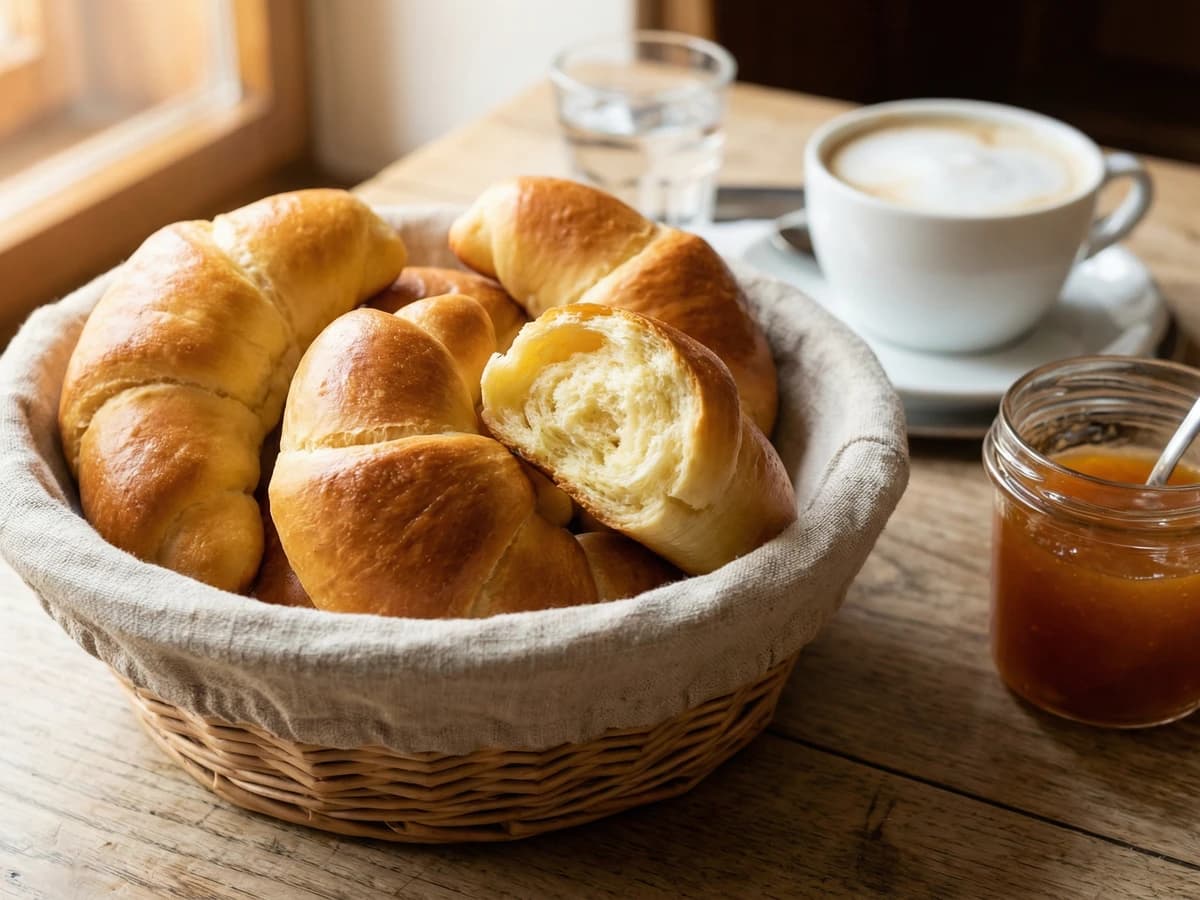
Buttery Viennese crescents, golden with egg wash and soft as a Sunday morning, shaped the way Viennese bakers have shaped them for eight hundred years.

Chef Elsa
Vienna's five-petaled imperial roll, hand-folded into a star and baked until the crust shatters at first touch, with a crumb so soft and airy it barely weighs a thing.