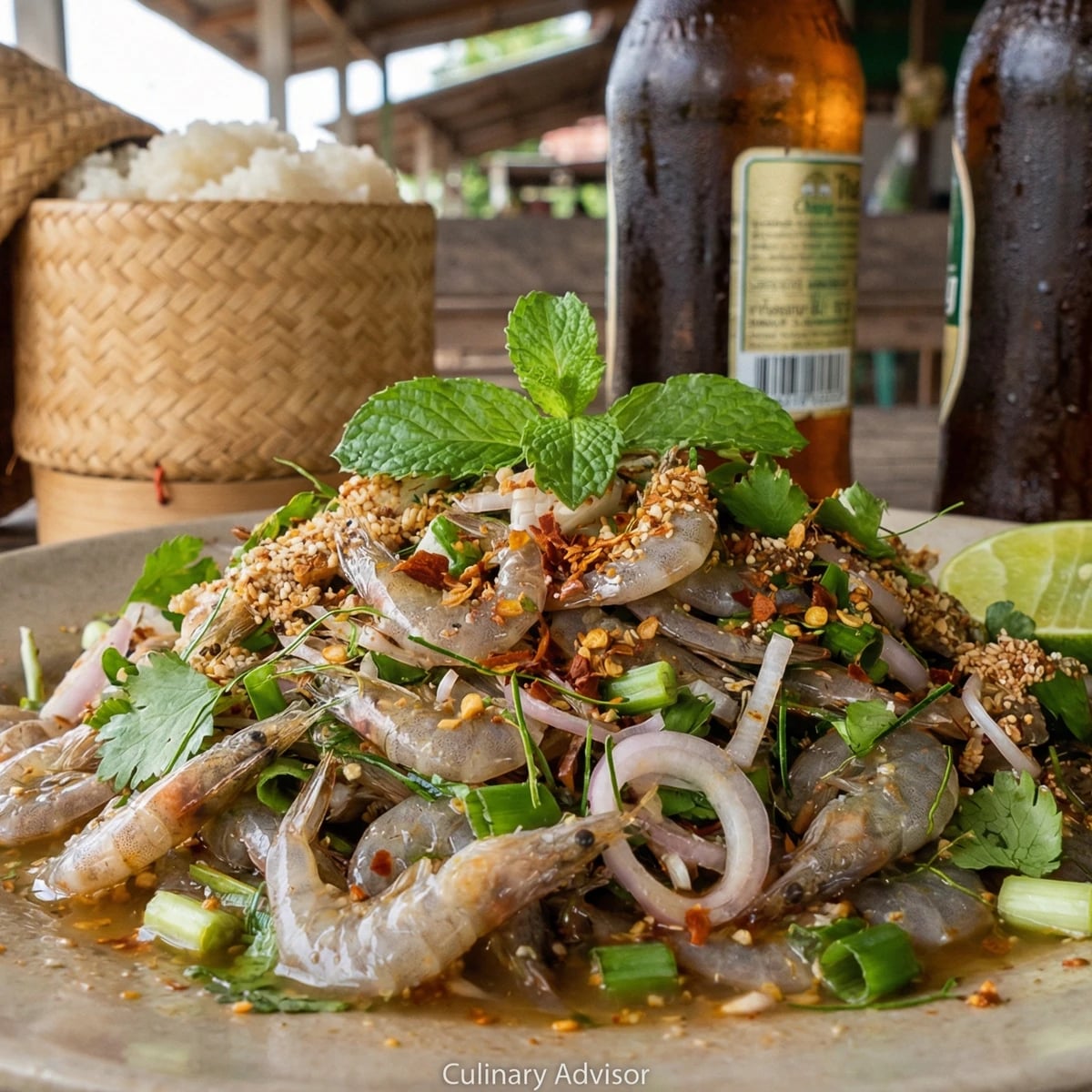
Live shrimp, lime juice, fish sauce, toasted rice powder. They jump because the acid hits them. This is Isan at its most raw, most honest, most alive. The four pillars with nothing to hide behind.
Salads
Thai
Special Occasion
10 min
Active Time
0 min cook•10 min total
Yield2 servings
This dish terrifies people. Good. It should wake you up.
Kung ten is the purest expression of the four-pillar system I can think of. There's no heat source. No wok. No mortar. No paste. Just live freshwater shrimp tossed in nam pla (fish sauce) for salt, nam manao (lime juice) for sour, prik pon (dried chili flakes) for heat, and khao khua (toasted rice powder) for that smoky Isan crunch. The shrimp jump because the citric acid hits their nervous system. That's where the name comes from: kung ten, dancing shrimp. They're alive in the bowl. You eat them moving.
Ajarn always said that Thai cooking is a system, not a menu. Kung ten proves it. Strip away every technique, every tool, every piece of equipment. What's left? The governing principles. Salt, sour, spice, and the raw ingredient itself. If your fish sauce is good, your limes are fresh, your chilies have bite, and your shrimp are alive and clean, you have a dish. You have kung ten. Principles, not recipes.
I'll be straight with you: this is a raw preparation. The shrimp are not cooked. The lime juice denatures some surface protein, the way ceviche works, but the shrimp are consumed essentially live and raw. In Isan, this is eaten at roadside stalls, at celebrations, on long drives through the plateau with cold beer and sticky rice. The shrimp come from clean freshwater sources, rivers, ponds, rice paddies. Freshness isn't a preference. It's a safety requirement. If the shrimp aren't alive and kicking when you start, don't make this dish. Full stop.
My mother's family in Isan would make kung ten when someone brought back a bucket of live shrimp from the paddy. It was celebration food. Impromptu, fast, shared. Everyone standing around a big bowl, pinching sticky rice, grabbing a shrimp, laughing. That's the context. This isn't a dish you plate carefully on a white plate. It's a dish you eat with your hands, standing up, with people you love.
Kung ten (กุ้งเต้น, literally "dancing shrimp") is an Isan and Lao preparation with roots in the subsistence cuisine of Thailand's northeast, where freshwater shrimp from rice paddies and rivers were dressed raw as a fast, communal dish. It belongs to the same family of Isan raw preparations as larb dip (raw larb) and koi pla (raw fish salad), dishes that predate refrigeration and depend entirely on the freshness of the catch. The dish's association with celebration and roadside eating culture has kept it alive despite modern food safety concerns, particularly in Isan provinces like Udon Thani, Khon Kaen, and Nong Khai, where live shrimp vendors still set up along highways.
The technique, the tradition, and the story behind every dish.
bird's eye chilies (prik khi nu) (optional)bruised
to taste
Equipment Needed
•Large mixing bowl with a plate or lid to cover
•Colander for rinsing shrimp
•Small scissors for trimming rostrum (optional)
Instructions
1
Prepare the dressing
Combine the nam pla (fish sauce), nam manao (lime juice), prik pon (dried chili flakes), and khao khua (toasted rice powder) in a large mixing bowl. Stir once. Taste it. Sour should lead. Salty behind it. Heat building. The toasted rice powder gives it body and that smoky, nutty Isan signature. This is a Thai vinaigrette. The same structure as larb dressing. If you understand larb, you understand kung ten. Same principle, different protein.
Make the khao khua yourself. Dry-toast raw sticky rice in a pan over medium heat, shaking constantly, until deep golden and fragrant. Pound in a mortar to a coarse powder. Store-bought khao khua is stale. Freshly made has a smoky aroma that changes the whole dish.
2
Prepare the herbs
Add the sliced shallots, green onion, lemongrass, chiffonaded kaffir lime leaves, and bruised fresh chilies to the bowl with the dressing. Toss to combine. The herbs should sit in the dressing for a minute while you prepare the shrimp. This lets the shallots soften slightly and the lemongrass release its oils.
3
Clean the live shrimp
Rinse the live shrimp in several changes of clean water. You're removing mud and debris. The shrimp must be alive and active. If any are dead or sluggish, discard them. This is non-negotiable. You are eating these raw. Only living, vigorous shrimp go into the bowl. Drain them well in a colander. Some cooks trim the rostrum (the sharp spike on the head) with scissors for comfort. Your call.
Source matters more than anything in this dish. These must be freshwater shrimp from a clean, trusted source. In Isan, they come straight from rice paddies and rivers. Outside Thailand, find a live seafood market where you can inspect the shrimp yourself. If you can't get live freshwater shrimp you trust, don't make this dish. There's no substitute.
4
Combine and cover
This is the moment. Transfer the live shrimp into the bowl with the dressing and herbs. Immediately cover the bowl with a plate or lid. The shrimp will jump. That's the ten in kung ten. The acid from the lime juice hits them and they react. The cover keeps them in the bowl. Give it a shake. You'll hear them moving against the sides.
5
Toss and serve
After about 30 seconds, remove the cover. The shrimp will still be moving but slower as the lime acid begins denaturing the surface protein. Add the mint leaves and cilantro. Toss everything together quickly with a spoon. Transfer to a serving plate immediately. Serve with sticky rice (khao niew) and raw vegetables: cabbage wedges, long beans, fresh mint sprigs. Eat with your hands. Pinch sticky rice, grab a shrimp, add an herb leaf. That's a bite. Don't overthink it. Eat fast. This dish is alive.
Some versions in Isan add a splash of pla ra (fermented fish sauce) instead of, or alongside, regular fish sauce. It's more pungent, more funky, more traditionally Isan. If you have pla ra and the nerve, use a tablespoon. It's the original seasoning.
Chef Tips
•Kung ten is not a cooked dish. The lime juice provides some acid denaturation on the surface, similar to ceviche, but the shrimp are consumed essentially raw and alive. In Isan, this is normal. The tradition depends on extremely fresh, clean, live shrimp. If you have any doubt about your source, this is not the dish to experiment with. Parasitic infection from raw freshwater shrimp is a real risk. Isan families know their water sources. You need to know yours.
•Toasted rice powder (khao khua) is the signature of Isan cuisine. It appears in larb, nam tok, and kung ten. Make it fresh every time. Toast raw sticky rice grains in a dry pan until deep golden brown, then pound in a mortar to a coarse powder. The smokiness and crunch are structural elements, not garnish. Without khao khua, this stops being an Isan dish.
•The dressing is identical in structure to larb: fish sauce, lime, chili, toasted rice powder. That's not coincidence. It's the Isan system at work. Once you understand this dressing, you can apply it to any protein. Larb is minced. Nam tok is sliced. Kung ten is whole and alive. Same principle. Different format.
•Sticky rice (khao niew) is the only accompaniment. Not jasmine rice. Not regular steamed rice. Khao niew. This is Isan. Sticky rice is the table. Everything else is a side dish to the rice. Serve it in a kratip (woven bamboo basket) and eat with your hands.
Advance Preparation
•The dressing can be mixed and the herbs sliced up to 30 minutes ahead. Keep covered at room temperature.
•Khao khua (toasted rice powder) can be made ahead and stored in an airtight container for up to a week, though freshly made is always better.
•The shrimp must be alive at the moment of assembly. There is no advance preparation for the protein. Buy them, rinse them, dress them, eat them. That's the timeline.
Frequently Asked Questions
Nutrition Information
1 serving (about 210g)
Calories
155 calories
Total Fat
1 g
Saturated Fat
0 g
Trans Fat
0 g
Unsaturated Fat
1 g
Cholesterol
150 mg
Sodium
1540 mg
Total Carbohydrates
15 g
Dietary Fiber
2 g
Sugars
3 g
Protein
23 g
Where cooking meets culture.
Culinary guides, cultural storytelling, and the editorial depth that makes cooking meaningful.