
Chef Fai
Southern Cucumber Relish (Ajad)
The one Thai condiment where vinegar replaces lime as the sour pillar, and the system still holds. Palm sugar for sweet, nam pla for salt, prik for heat. Ajad is the four pillars in a jar.
A cooking platform built around craft, culture, and the stories behind what we eat.
Created by
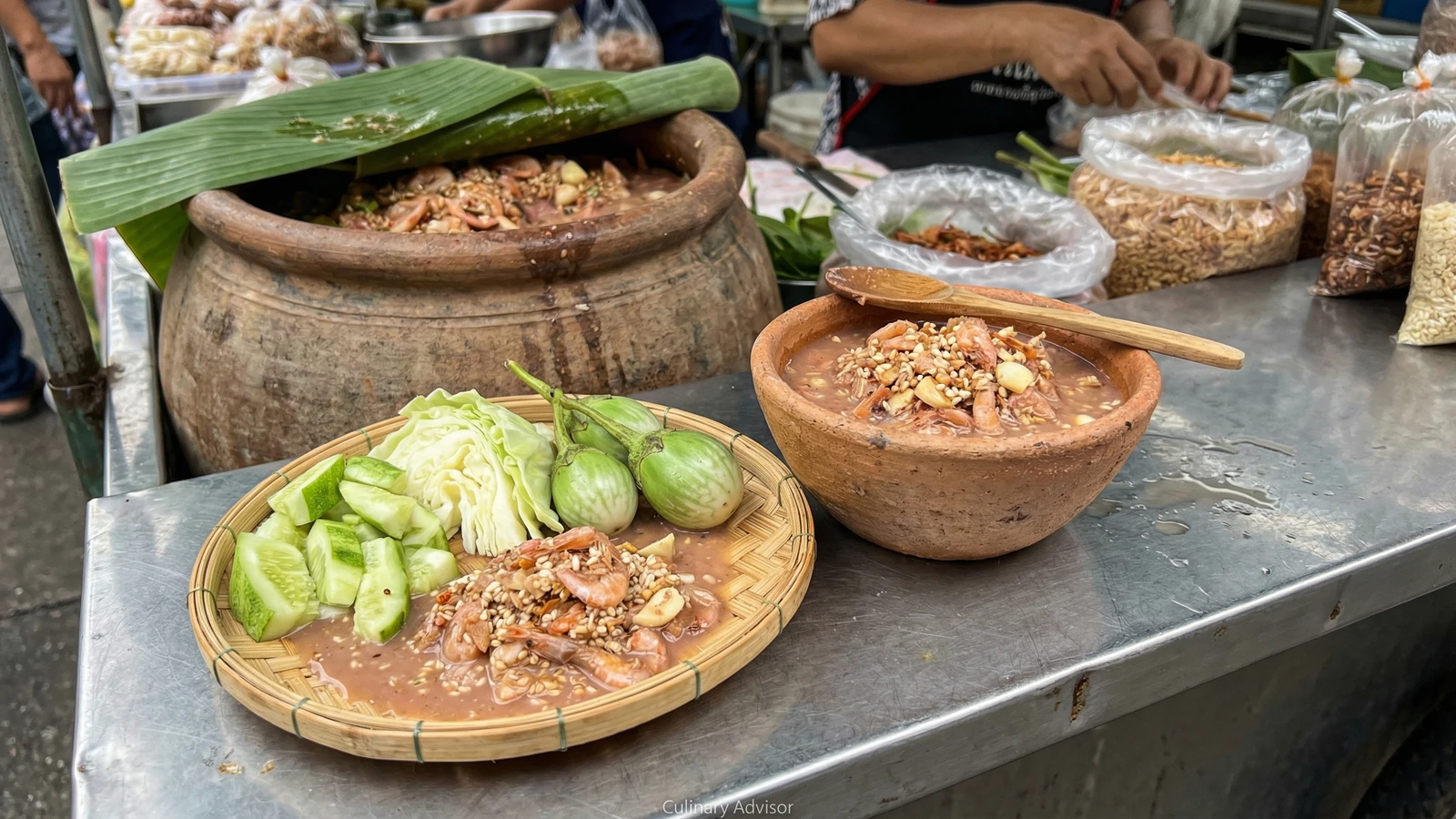
Three ingredients, five days, and salt-tolerant bacteria do the rest. Kung jom is kapi's rougher, chunkier ancestor: the ferment that taught Thai cooks what shrimp could become.
Fermentation is the invisible pillar beneath all of Thai cooking. Every time you reach for fish sauce, you're reaching for a ferment. Every time you spoon kapi (shrimp paste) into a kreung tam, you're using a ferment. Nam pla, kapi, pla ra, tua nao: these aren't just ingredients. They're the products of time, salt, and microorganisms doing work that no technique can replicate. Ajarn always said: "Before you learn to cook, learn what fermentation gives you. Without it, Thai food doesn't exist."
Kung jom is fermentation at its most stripped-down. Three ingredients. Tiny shrimp, coarse salt, roasted rice. You mix them. You pack them into a jar. You wait. That's it. No pounding, no drying, no processing. The salt creates an environment where only halophilic (salt-tolerant) bacteria and lactic acid bacteria survive. Everything else dies. The roasted rice (khao khua) provides starch, carbohydrates for those lactic acid bacteria to feed on. As they eat the starch, they produce lactic acid, dropping the pH, souring the mixture, and preserving the shrimp. The proteins in the shrimp break down into amino acids, which is where the umami comes from. That's not magic. That's microbiology.
Kapi is the refined cousin. Kapi gets pounded smooth, dried in the sun, compressed into blocks. Kung jom skips all of that. The shrimp stay whole, chunky, rough. You can see individual shrimp bodies in the jar. It's the condiment that coastal and riverine communities made before anyone had time to process shrimp paste into something polished. It's raw, pungent, and proudly unfinished. That roughness is the identity.
You eat kung jom the way you eat any Thai condiment: alongside rice, with raw vegetables, folded into a nam prik, or fried quickly in a wok with chili and garlic to take the edge off. It's salty, funky, and deeply savory. If you understand what kung jom does, you understand why fish sauce exists, why kapi exists, why Thai food tastes like nothing else on earth. The ferment is the foundation. Remove it and you remove the identity.
Kung jom (กุ้งจ่อม) belongs to the broader Southeast Asian tradition of salt-fermented seafood that predates written Thai culinary records. Found primarily in coastal provinces and along major river systems in Central and Eastern Thailand, it represents the simplest form of shrimp preservation: whole shrimp fermented with salt and rice, without the additional pounding and sun-drying that transforms the product into kapi. The word "jom" (จ่อม) refers specifically to the technique of salt-fermenting small aquatic creatures with roasted rice, a method also applied to freshwater fish (pla jom) and crabs in Isan and Central Thai river communities.
Quantity
500g
heads on, rinsed and thoroughly drained
Quantity
150g (30% of shrimp weight)
Quantity
3 tablespoons
for roasting and pounding
Quantity
1 piece
| Ingredient | Quantity |
|---|---|
| very fresh tiny shrimp (kung foy or small coastal shrimp)heads on, rinsed and thoroughly drained | 500g |
| coarse sea salt | 150g (30% of shrimp weight) |
| raw sticky rice (khao niew)for roasting and pounding | 3 tablespoons |
| banana leaf or cheesecloth (optional) | 1 piece |
This is where food safety starts. Your shrimp must be impeccably fresh. Tiny freshwater shrimp (kung foy) or small coastal shrimp, no bigger than your thumbnail. They should smell like the sea or the river, clean and briny, not fishy, not ammonia. If they smell off, walk away. Fermentation amplifies whatever you start with. Fresh shrimp become deeply savory. Questionable shrimp become dangerous. Rinse them thoroughly in cold water, removing any debris, mud, or broken shells. Drain them completely in a colander for 10 minutes. Excess water dilutes the salt ratio, and that ratio is your safety net.
Put a dry wok or small pan over medium heat. Add the sticky rice. No oil. Stir constantly. The grains will go from translucent white to golden to deep amber over about 5 minutes. You'll smell it before you see it: a nutty, toasty aroma that fills the kitchen. This is khao khua (ข้าวคั่ว), roasted rice, the same technique used in larb. Pull it off the heat when the grains are evenly golden-brown. Let them cool completely. Then pound them in a mortar to a coarse powder. Not flour. Coarse. You want visible fragments. This roasted rice is food for the lactic acid bacteria. The starch feeds the microorganisms that do the fermenting. Without it, you're just salting shrimp. With it, you're creating a living system.
In a large clean bowl (glass or ceramic, not metal), combine the drained shrimp with the coarse sea salt. Use your hands. Work the salt into the shrimp thoroughly, making sure every tiny body is coated. The salt will immediately start drawing moisture from the shrimp. You'll see liquid pooling at the bottom within minutes. That's osmosis at work: the salt pulling water out of the cells, creating brine. This brine is the fermentation medium. Everything happens in this liquid. Don't drain it. It's essential.
Sprinkle the coarsely pounded roasted rice over the salted shrimp. Mix thoroughly with clean hands or a clean spoon. Now pack the mixture tightly into a clean clay jar or glass jar. Press down firmly to eliminate air pockets. Air is the enemy of fermentation. The shrimp should be submerged in their own brine. If there isn't enough liquid to cover them, press harder. The salt will continue drawing moisture over the first few hours. Leave about 2 centimeters of headspace at the top. The fermentation will produce gases and the mixture may expand slightly.
Cover the jar with a piece of banana leaf or cheesecloth, then place the lid on loosely. Set the jar in a cool, shaded spot. Not in the sun. Not in the fridge. Room temperature in Thailand is 28 to 35 degrees Celsius, and that's the range where these bacteria thrive. If you're in a cooler climate, find the warmest spot in your kitchen. The fermentation takes a minimum of 3 to 5 days in tropical heat, up to 7 to 10 days in cooler environments. You'll know it's working: by day two, small bubbles will form on the surface. The liquid will turn from clear and salty to cloudy and slightly pinkish. The smell will shift from raw shrimp to something pungent, sour, and deeply savory. That's the lactic acid bacteria and halophilic bacteria doing their work.
After 3 to 5 days, taste it. Use a clean spoon. The shrimp should be soft but still hold their shape. The flavor should be intensely salty, with a sour tang from the lactic acid and a deep, rounded umami that raw shrimp don't have. The roasted rice will have mostly dissolved, absorbed into the brine. If the flavor is too mild, let it go another day or two. Once it reaches the intensity you want, transfer to the refrigerator. Cold temperatures slow the fermentation almost to a stop. Kung jom keeps for months refrigerated. Bring it to room temperature before serving for the fullest flavor.
1 serving (about 25g)
Culinary guides, cultural storytelling, and the editorial depth that makes cooking meaningful.
Discover Culinary ExplorerChef Fai
The one Thai condiment where vinegar replaces lime as the sour pillar, and the system still holds. Palm sugar for sweet, nam pla for salt, prik for heat. Ajad is the four pillars in a jar.

Chef Fai
Every grilled dish in Isan answers to this dip. Roasted dried chilies, nam pla, manao, khao khua, and shallots: the four pillars in a condiment that's structural, not optional.
Chef Fai
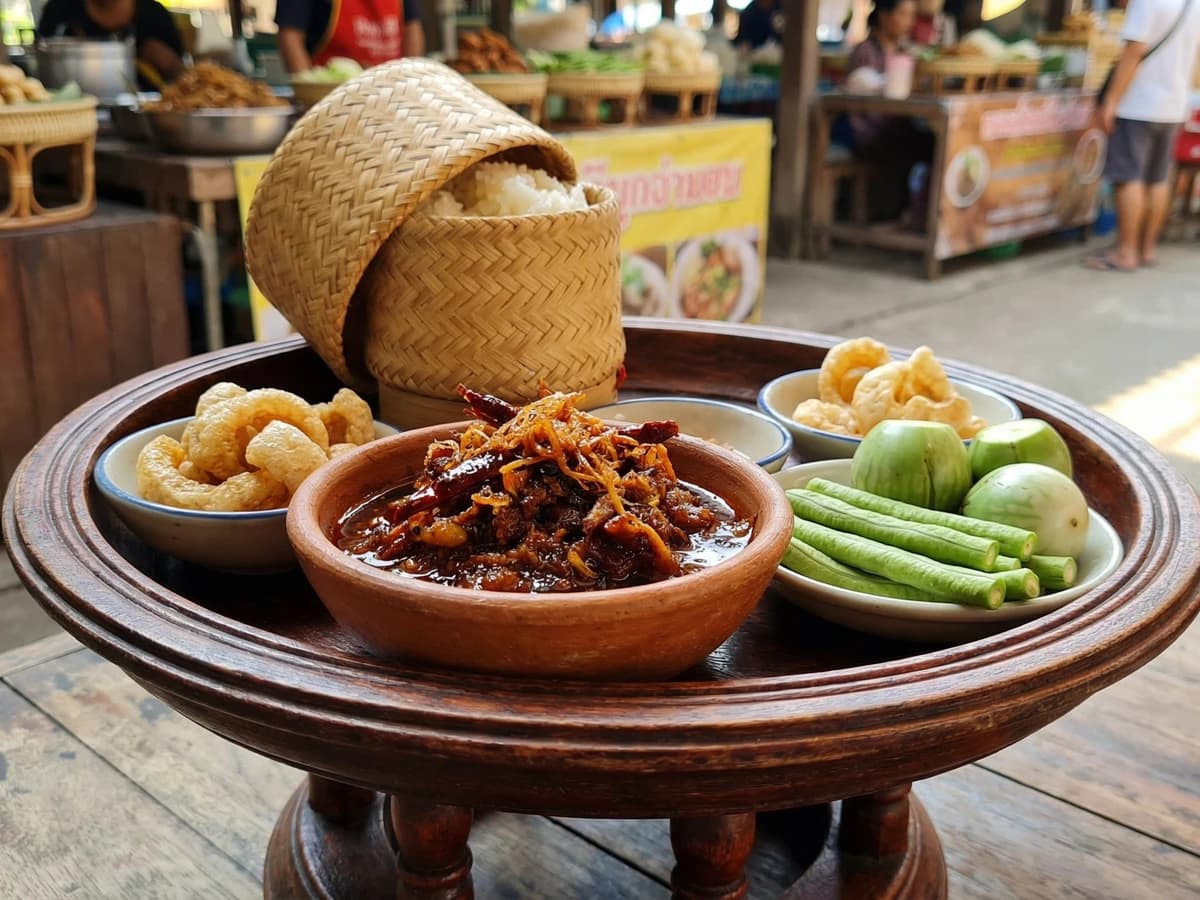
Roasted dried chilies and galangal pounded to a rough paste, folded with shredded pork skin and palm sugar until it becomes something sweet, smoky, and chewy that belongs on every khantoke tray in Chiang Mai.
Chef Fai
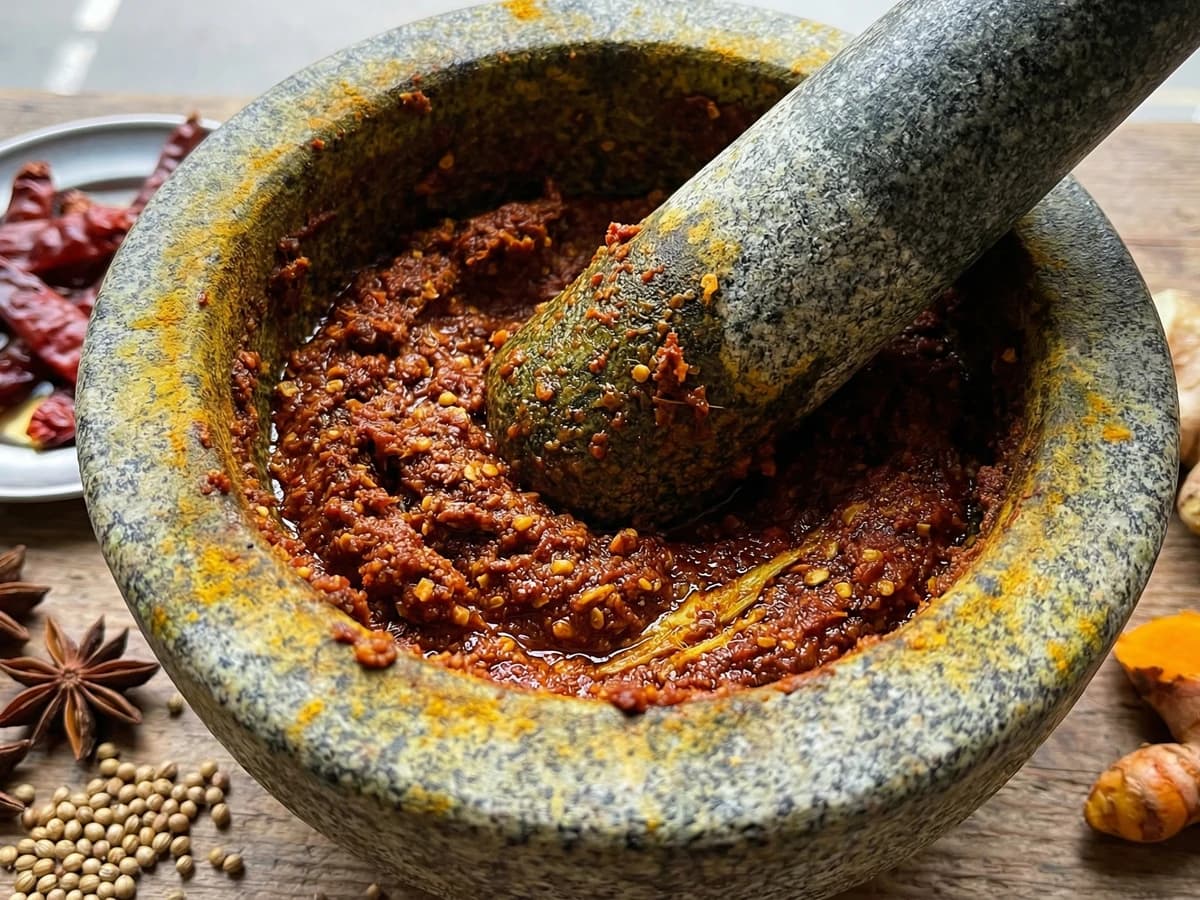
The kreung tam that proves the system adapts. Ginger instead of galangal, cumin and star anise alongside lemongrass. Lanna's mortar holds the whole Burma-to-Chiang Mai trade route in a single paste.