
Chef Fai
Dry Egg Noodles (Ba Mee Haeng)
The four pillars live at the bottom of the bowl before the noodles ever touch it: nam pla for salt, sugar for sweet, vinegar for sour, chili for heat. Every noodle cart in Bangkok runs on this principle.
A cooking platform built around craft, culture, and the stories behind what we eat.
Created by
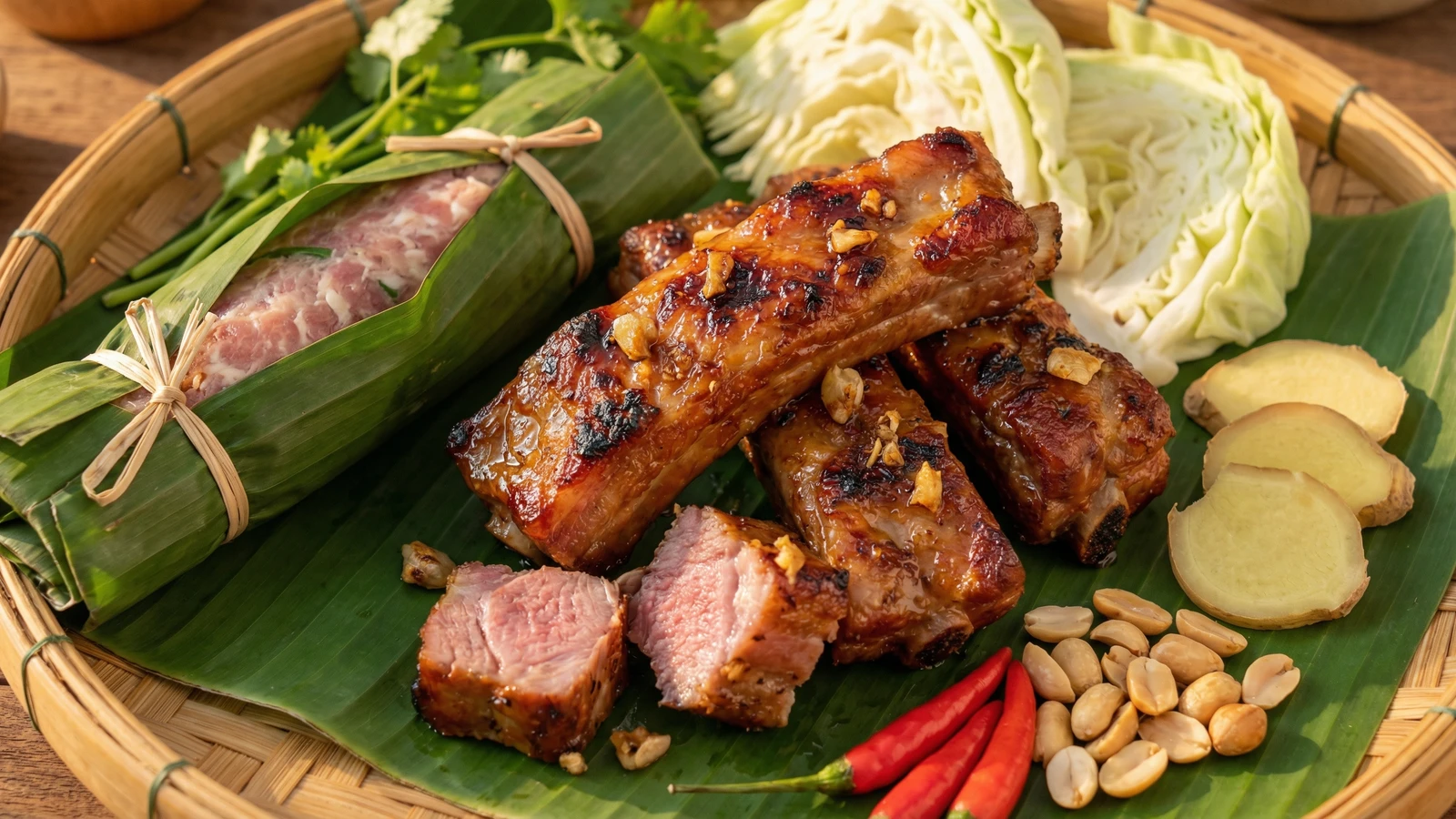
Lactic acid bacteria turn sticky rice into sour gold around bone-in pork ribs. Three days wrapped in banana leaves. The same naem science that's preserved Thai pork for centuries, applied to the richest cut on the animal.
Fermentation is the oldest sourness in Thai food. Older than limes. Older than tamarind. Before anyone squeezed a citrus fruit into a mortar, Thai cooks were wrapping meat with garlic and rice and letting time do the work.
Ajarn always said the four pillars are fish sauce for salt, palm sugar for sweet, tropical fruit acids for sour, chili for heat. Naem cracks open that third pillar and reveals something most people miss. The sourness here doesn't come from a lime or a fruit. It comes from Lactobacillus, lactic acid bacteria that feed on the sugars in cooked sticky rice and produce acid as waste. That acid drops the pH, preserves the meat, and creates the tang that defines naem. The same science behind yogurt, sauerkraut, kimchi. Thai cooks understood this centuries before anyone owned a microscope. They just called it "leaving it for a few days."
Naem si krong moo takes that principle and wraps it around bone-in spare ribs. The technique is the same as regular naem: pounded garlic, salt, sticky rice, raw pork, wrapped tight, left in a warm place. But ribs change the equation. The bone holds moisture. The fat marbling around the bone stays soft while the lactic acid works through the lean meat. After three days the whole thing is tangy, garlicky, and funky in the best possible way. Then you grill it. The fat renders, the acid caramelizes on the surface, the char meets the sour, and you get something that no other cooking method can produce. You can't rush this. You can't fake it. The bacteria don't negotiate with your schedule.
This is a dish that asks you to trust the process. Billions of microorganisms are doing the cooking for you. Your job is to give them what they need: sugar from the rice, protein from the pork, salt to keep the bad bacteria out, and an airtight wrap to create the anaerobic conditions they thrive in. Then you walk away. That's the hardest part for most cooks. Doing nothing. But doing nothing is the technique.
Naem (แหนม) is a fermented pork preparation rooted in Lanna (Northern Thai) and Isan preservation traditions, developed in an era before refrigeration when wrapping meat with sticky rice, garlic, and salt in banana leaves was the primary method of protein storage. The si krong moo (rib) variation evolved in rural communities practicing whole-animal butchery, where every cut needed a preservation strategy. While standard naem uses ground pork, the rib version preserves bone-in cuts that would otherwise spoil fastest due to their moisture content near the bone. Chiang Mai and the wider Lanna region remain the heartland of naem production, with some villages specializing entirely in fermented pork products for regional markets.
Quantity
1 kg
cut into individual ribs, then into 2-inch sections
Quantity
1 head, about 12-15 cloves
peeled
Quantity
1/2 cup
cooled to room temperature
Quantity
1 1/2 tablespoons
Quantity
1 teaspoon
freshly ground
Quantity
several large squares, about 12 inches each
briefly wilted over flame
Quantity
as needed
Quantity
for serving
Quantity
for serving
sliced thin
Quantity
for serving
Quantity
for serving
Quantity
for serving
sprigs
| Ingredient | Quantity |
|---|---|
| pork spare ribs (si krong moo)cut into individual ribs, then into 2-inch sections | 1 kg |
| garlic (kratiem)peeled | 1 head, about 12-15 cloves |
| cooked sticky rice (khao niew suay)cooled to room temperature | 1/2 cup |
| fine sea salt | 1 1/2 tablespoons |
| white peppercorns (prik thai)freshly ground | 1 teaspoon |
| banana leavesbriefly wilted over flame | several large squares, about 12 inches each |
| kitchen string or rubber bands | as needed |
| bird's eye chilies (prik khi nu) (optional) | for serving |
| fresh ginger (khing) (optional)sliced thin | for serving |
| roasted peanuts (thua lisong khua) (optional) | for serving |
| raw cabbage leaves (optional) | for serving |
| fresh cilantro (pak chi) (optional)sprigs | for serving |
Peel the garlic and drop it into your granite mortar (krok hin). Pound it to a rough paste. Not smooth, not liquefied. You want it crushed and broken so the allicin releases, that sharp garlic burn you smell when you crush a clove. That allicin is doing two jobs here: flavor and antimicrobial protection. It suppresses the bad bacteria during the first hours of fermentation while the Lactobacillus establishes itself. Add the ground white peppercorns and pound them into the garlic. Ten seconds. Done.
Rinse the rib sections under cold water and pat them completely dry with paper towels or a clean cloth. Moisture on the surface is fine, but standing water dilutes the salt concentration and creates uneven fermentation. Your butcher can cut the ribs into 2-inch sections for you, or use a heavy cleaver at home. Each piece should have bone with meat attached. Don't trim the fat. That fat is going to render when you grill later, and during fermentation it keeps the meat from drying out.
In a large bowl, combine the rib pieces, pounded garlic and peppercorn mixture, salt, and cooled sticky rice. Use your hands. Get in there. Every surface of every rib needs contact with garlic and rice. The sticky rice should be clinging to the meat in a thin layer, not clumped in one spot. Knead and press the rice against the pork. The starch on the rice surface is the food source for the bacteria. Where there's no rice touching meat, there's no fermentation happening. Spend five minutes on this. Be thorough.
Wilt banana leaf squares over a gas flame or in a hot pan for a few seconds per side. They'll turn darker green and become pliable instead of brittle. Place 4-5 rib pieces on a banana leaf, fold it into a tight parcel, pressing out as much air as possible. The bacteria you want are anaerobic: they work without oxygen. Air in the package means aerobic spoilage organisms get a foothold. Wrap tightly. Tie with kitchen string or secure with rubber bands. Then wrap the entire bundle again in a second layer of banana leaf or plastic wrap for extra insurance. You should not be able to squeeze any air out of the finished parcel.
Place the wrapped bundles in a spot that stays between 25-32°C (77-90°F). A Thai kitchen counter is perfect. A warm cupboard works. Don't refrigerate. Cold temperatures slow or stop the Lactobacillus. The bacteria need warmth to multiply and produce acid. After 24 hours, you'll notice the packages feel slightly firmer and may be starting to bulge from carbon dioxide production. That's good. That's life happening. Leave them alone. At 48 hours, unwrap one package and smell it. You should detect a clean, sharp sourness, like vinegar's gentler cousin. Taste a small piece of the rice clinging to the meat. It should be distinctly tangy. If it's tangy at 48 hours but you want more depth, rewrap and give it another day. Three days is the minimum. Five days gives you a deeper, funkier sour. Beyond five days the acid can become harsh. Trust your nose. If it smells sour and garlicky, good. If it smells putrid or rotten, something went wrong. Discard it.
When the naem has reached the sourness you want, unwrap the ribs. Don't rinse them. That sticky rice and garlic crust on the surface is flavor. Heat a charcoal grill or a grill pan over medium-high heat. Grill the rib pieces for 3-4 minutes per side. The fat will render and spit. The sugars from the rice and the lactic acid will caramelize into a dark, sticky char. The meat should be cooked through to the bone but still juicy. The inside stays pink-ish from the fermentation, that's normal, it's the acid, not rawness. The smell when that sour garlic crust hits the grill is one of the best things in Thai food. If you prefer deep-frying, heat oil to 170°C (340°F) and fry for 4-5 minutes until the surface is golden and crisped.
Arrange the grilled ribs on a plate or banana leaf. Serve with sliced fresh ginger, whole bird's eye chilies, roasted peanuts, raw cabbage leaves, and cilantro sprigs. The ginger is essential: its sharp, clean bite cuts through the sourness and fat. The peanuts add crunch. The chilies add heat. The cabbage is your edible plate. Tear a piece, place a rib on it, add a slice of ginger and a peanut or two. That's a bite. The combination is the point, just like som tam, just like larb. Thai food is designed to be assembled at the table.
1 serving (about 310g)
Culinary guides, cultural storytelling, and the editorial depth that makes cooking meaningful.
Discover Culinary ExplorerChef Fai
The four pillars live at the bottom of the bowl before the noodles ever touch it: nam pla for salt, sugar for sweet, vinegar for sour, chili for heat. Every noodle cart in Bangkok runs on this principle.

Chef Fai
The kreung tam fried in cracked coconut cream until the oil bleeds red. That's the technique. Concentrated, semi-dry, spooned thick over crispy fish. This is what happens when the four pillars meet restraint.

Chef Fai
Isan foraging in a bowl: wild taro stems stripped of their sting, simmered in padaek broth with a pounded chili paste and yanang leaf extract. The land feeds you if you know the rules.

Chef Fai
Lanna's kreung tam breaks from Central Thai rules: ginger over galangal, cumin and coriander from Burmese spice routes, tamarind for sour instead of lime. The North has its own system, and this curry is its crown.