Culinary Explorer

A cooking platform built around craft, culture, and the stories behind what we eat.
Discover Culinary Explorer
Kürbiskernkipferl (Pumpkin Seed Crescents)

Kürbiskernkipferl (Pumpkin Seed Crescents)

Created by

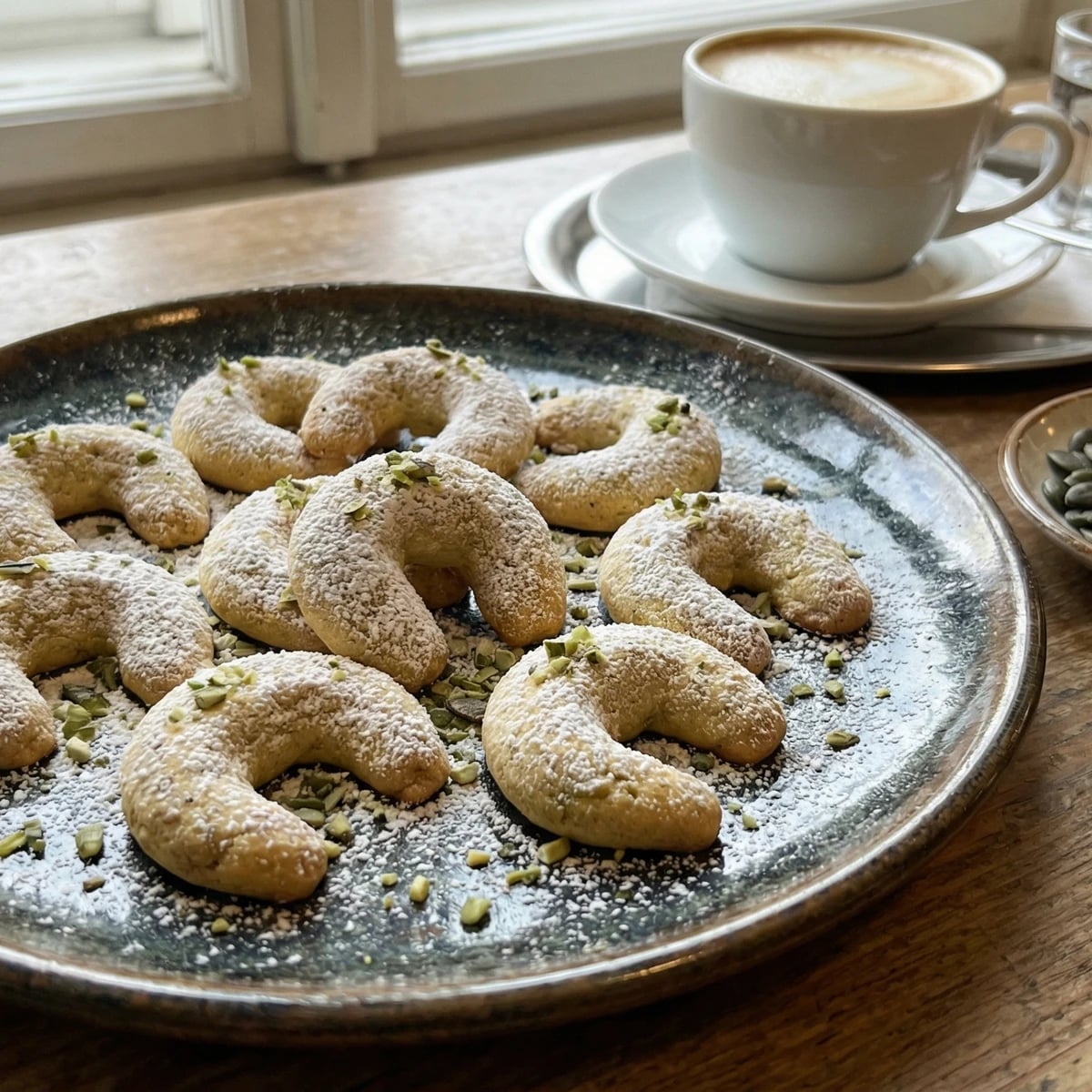
Styrian pumpkin seeds ground into a sandy, crumbly crescent cookie dusted with powdered sugar and scattered with green seed flecks. Styria's proudest contribution to the Austrian Christmas tin.

Pastries & Cookies
Austrian
Christmas
Holiday
Make Ahead
40 min
Active Time
14 min cook2 hr total
YieldAbout 45 cookies

Every Austrian knows Vanillekipferl. They're the crescents made with ground walnuts or almonds that show up on every Weihnachtsteller from November onward. But in Styria, in Austria's green southeast where pumpkin fields stretch to the horizon, they make their Kipferl with something better: Kürbiskerne, dark green pumpkin seeds with a richness that walnuts can only dream about.

Gretel always said that the regional variations of Austrian baking tell you everything about where a cook comes from. A Viennese baker reaches for almonds. A Tyrolean might use hazelnuts. A Styrian reaches for pumpkin seeds the way a Salzburger reaches for Mozartkugeln: it's instinct, it's identity, it's home. These Kürbiskernkipferl carry that Styrian pride in every bite. The ground seeds give the dough a pale green tinge that deepens when baked, and the flavor sits somewhere between toasted walnut and roasted chestnut, but nuttier, earthier, entirely its own thing.

The technique is the same patient method behind every good Kipferl: cold butter rubbed into flour, minimal handling, a proper chill before shaping. You shape them into crescents, bake them gently, and roll them through powdered sugar while they're still warm. The chopped pumpkin seeds pressed into the surface aren't just decoration. They tell anyone who sees the cookie tin exactly which corner of Austria these came from.

I started making these for the restaurant's Adventzeit menu because I wanted something on the plate that wasn't Viennese for once. Austrian baking is so much bigger than Vienna. These cookies are the proof.

The Kipferl shape dates back centuries in Austrian baking, with the most popular legend linking it to the crescent on the Ottoman flag, baked by Viennese bakers to celebrate the end of the Ottoman siege in 1683. Styria's claim on pumpkin seed cuisine is rooted in its protected designation of origin for Steirisches Kürbiskernöl, the region's prized dark green pumpkin seed oil, which has been pressed there since the 18th century. Kürbiskernkipferl are a relatively modern regional invention, emerging as Styrian bakers began substituting their local Kürbiskerne into traditional Kipferl recipes, turning a pan-Austrian cookie shape into something unmistakably Styrian.

The technique, the tradition, and the story behind every dish.

Discover Culinary Explorer

Ingredients

unsalted butter

Quantity

200g

cold and cubed

Steirische Kürbiskerne (Styrian pumpkin seeds)

Quantity

100g

raw and unshelled

powdered sugar

Quantity

80g, plus extra for rolling

Vanillezucker (vanilla sugar)

Quantity

1 packet (8g)

fine salt

Quantity

pinch

plain flour

Quantity

260g

egg yolk

Quantity

1 large

Steirisches Kürbiskernöl (Styrian pumpkin seed oil) (optional)

Quantity

1 teaspoon

Steirische Kürbiskerne (Styrian pumpkin seeds) for finishing

Quantity

30g

finely chopped

Equipment Needed

  • Food processor or spice grinder for grinding seeds
  • Two baking sheets with parchment paper
  • Wire cooling rack
  • Fine-mesh sieve for dusting sugar

Instructions

  1. 1

    Toast and grind the seeds

    Spread the 100g of pumpkin seeds in a single layer in a dry pan over medium-low heat. Shake the pan gently every thirty seconds. In about four minutes the seeds will start popping and the kitchen will smell green and nutty, almost like roasted chestnuts. Pull them off the heat immediately. Pumpkin seeds burn without warning, and burnt seeds taste bitter and oily. Let them cool completely, then grind them in a food processor until fine but not paste. You want a texture like coarse almond meal. A few larger pieces are fine. They'll give the finished cookie some bite.

    Pulse the food processor in short bursts. Pumpkin seeds have a high oil content and will turn into butter if you run the blade too long. Five or six one-second pulses, check, repeat.
  2. 2

    Make the dough

    In a large bowl, combine the flour, ground pumpkin seeds, powdered sugar, Vanillezucker, and salt. Toss the cold butter cubes through the dry mixture, then work everything together with your fingertips. Rub the butter into the flour as if you're making pastry, which you essentially are. When it looks like coarse breadcrumbs with no large butter chunks remaining, add the egg yolk and the pumpkin seed oil if you're using it. Bring the dough together gently. Don't knead. The less you handle it, the more tender the cookie. As soon as it forms a cohesive ball, stop.

    Cold butter is critical. If your kitchen is warm, grate the butter on a box grater and freeze it for ten minutes before starting. Warm butter means greasy dough, and greasy dough means flat, tough Kipferl.
  3. 3

    Rest the dough

    Flatten the dough into a thick disc, wrap it tightly in cling film, and refrigerate for at least one hour. This rest is not a suggestion. The butter needs to firm up again after you worked it, and the flour needs time to hydrate evenly. Cold dough shapes cleanly. Room-temperature dough cracks and crumbles and you'll lose your patience with it by the tenth Kipferl.

    You can make the dough the night before and refrigerate it overnight. If it's very firm the next morning, let it sit at room temperature for ten minutes before shaping. It should yield to gentle pressure without cracking.
  4. 4

    Shape the crescents

    Preheat your oven to 170°C (340°F). Line two baking sheets with parchment paper. Pull off a walnut-sized piece of dough, about 10g, and roll it between your palms into a small log roughly seven centimeters long, slightly thicker in the middle and tapered at the ends. Bend it gently into a crescent. Place each Kipferl on the prepared sheet with a centimeter of space between them. They don't spread much. Work quickly. If the dough starts warming up and getting sticky, put it back in the fridge for fifteen minutes.

    The shape matters here. A Kipferl is a crescent, not a horseshoe. Think of a gentle curve, like the letter C drawn by someone with elegant handwriting. The ends should taper to delicate points.
  5. 5

    Bake until barely golden

    Bake for 12 to 14 minutes, rotating the trays halfway through. The Kipferl are done when the bottoms turn light gold and the tops are still pale with just a hint of color at the edges. Do not overbake. These cookies carry over in heat and will continue to firm as they cool. If they look golden all over in the oven, they're already past their best. Pull them out while you still think they need another minute.

  6. 6

    Finish with sugar and seeds

    Let the Kipferl rest on the baking sheet for three minutes. They're incredibly fragile when hot. Sift powdered sugar generously onto a shallow plate. While the cookies are still warm but firm enough to handle, roll each one carefully through the powdered sugar. The warmth helps the sugar cling. Sprinkle the finely chopped pumpkin seeds over the sugared crescents, pressing them on lightly with your fingertips. The green flecks against white sugar is the whole visual identity of this cookie. Set them on a wire rack to cool completely. They'll be sandy, crumbly, and barely sweet, which is exactly right.

Chef Tips

  • Buy Steirische Kürbiskerne, not the white-shelled pumpkin seeds you find in most supermarkets. Styrian pumpkin seeds are dark green, hull-less, and intensely flavored. They're the whole reason this cookie exists. You can order them online if your local shops don't carry them.
  • If you can find Steirisches Kürbiskernöl, add a teaspoon to the dough. It's a small amount but it deepens the pumpkin seed flavor and pushes the color toward that distinctive mossy green. Don't substitute another oil. If you can't find it, leave it out. The cookies will still be beautiful.
  • Store these in a tin with a sheet of parchment between each layer. They keep for three weeks in a cool place and actually improve after two or three days as the butter and pumpkin seed flavors merge and mellow. This makes them ideal for filling an Advent cookie tin early in December.
  • The powdered sugar coating will absorb into the cookies overnight. If you want them snow-white for serving, give them a second light dusting just before you set them out.

Advance Preparation

  • The dough can be made two days ahead and refrigerated, or frozen for up to one month. Thaw overnight in the fridge before shaping.
  • Baked Kipferl store beautifully in an airtight tin for up to three weeks at cool room temperature. They actually taste better after a few days' rest.
  • The pumpkin seeds can be toasted and ground a week in advance. Store the ground seeds in a sealed jar in the fridge to keep the oils from going stale.

Frequently Asked Questions

Nutrition Information

1 serving (about 15g)

Calories
80 calories
Total Fat
5 g
Saturated Fat
3 g
Trans Fat
0 g
Unsaturated Fat
2 g
Cholesterol
14 mg
Sodium
5 mg
Total Carbohydrates
7 g
Dietary Fiber
0 g
Sugars
3 g
Protein
2 g

Note: Chef personas and recipes are created with AI assistance. Cook with care: follow safe food-handling practices, check doneness with a thermometer when needed, and adapt for allergies and your kitchen.

Where cooking meets culture.

Culinary guides, cultural storytelling, and the editorial depth that makes cooking meaningful.

Discover Culinary Explorer

More from Weihnachtsbäckerei (Austrian Christmas Cookies)

Browse the full collection