
Chef Fai
Dry Egg Noodles (Ba Mee Haeng)
The four pillars live at the bottom of the bowl before the noodles ever touch it: nam pla for salt, sugar for sweet, vinegar for sour, chili for heat. Every noodle cart in Bangkok runs on this principle.
A cooking platform built around craft, culture, and the stories behind what we eat.
Created by
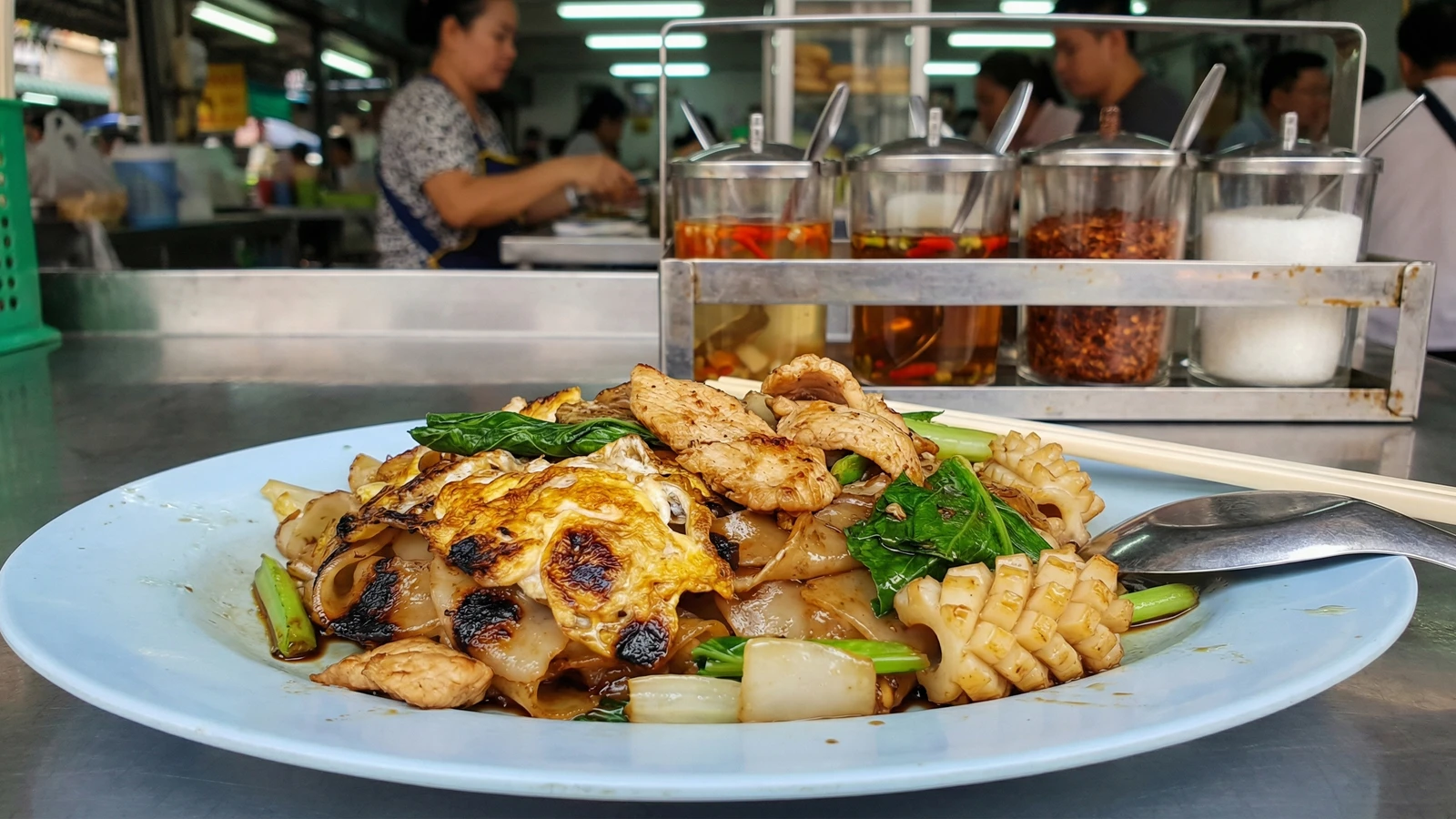
Wide rice noodles seared against a screaming wok until blackened and smoky, tossed with chicken, egg, and squid in seconds flat. No paste, no curry. Just fire, technique, and the four pillars holding it together.
This dish has no paste. No kreung tam. No thirty-minute prep. And it's still governed by the same system Ajarn taught me.
Kuay tiew kua gai is a wok discipline test. You have maybe ninety seconds from the moment oil hits metal to the moment noodles hit the plate. In that window you need to sear wide rice noodles (sen yai) until they char and blister, cook an egg into the surface of those noodles, stir-fry chicken and squid through, and season with the four pillars: fish sauce for salt, a whisper of sugar for sweet, vinegar and pickled chili for sour, white pepper for heat. If you hesitate, the noodles steam instead of char, and you've lost the whole point of the dish.
Ajarn always said Thai food is a system, not a menu. This is a Chinese-origin noodle dish that migrated to Bangkok with Teochew traders generations ago. But the Thai vendor didn't just copy it. She adapted it. Fish sauce went in alongside the soy. Vinegar with sliced chilies appeared on the condiment tray. The flavor profile shifted to follow the governing rules. That's how the system works: it absorbs, it adapts, it holds.
I watched a kuay tiew kua vendor in Chinatown (Yaowarat) cook 200 plates in a single evening. One portion at a time. Same wok, same burner, same motion. She never measured anything. Her hand knew the pour of soy sauce, the splash of fish sauce, the flick of the wrist that folded egg into noodle. That's not a recipe. That's a lifetime of technique encoded in muscle memory. Street food is not casual food. It's the highest expression of single-dish mastery. This vendor understood the principles better than most chefs with degrees. She just never needed to name them.
Kuay tiew kua gai traces directly to the Teochew Chinese community that settled in Bangkok's Yaowarat district during the 19th century, bringing with them the char kway teow tradition of wok-fried rice noodles. Thai vendors adapted the dish by introducing fish sauce alongside soy sauce and serving it with the classic Thai condiment caddy of nam pla prik, chili vinegar, sugar, and dried chili flakes. The dish became a Bangkok street food staple by the mid-20th century, with the best vendors famous for cooking only one plate at a time to maintain the wok hei that defines the dish.
Quantity
400g
separated gently at room temperature
Quantity
150g
sliced thin against the grain
Quantity
100g
cleaned, scored crosshatch, cut into bite-sized pieces
Quantity
2
Quantity
4 cloves
roughly chopped
Quantity
3 tablespoons per portion
Quantity
1 tablespoon
Quantity
1 tablespoon
Quantity
1 tablespoon
Quantity
1 teaspoon
Quantity
1/2 teaspoon
Quantity
2 stalks
cut into 2-inch pieces, stems and leaves separated
Quantity
for serving
Quantity
for serving
Quantity
for serving
Quantity
for the condiment tray
| Ingredient | Quantity |
|---|---|
| fresh wide rice noodles (sen yai)separated gently at room temperature | 400g |
| boneless chicken thighsliced thin against the grain | 150g |
| squid (pla muek)cleaned, scored crosshatch, cut into bite-sized pieces | 100g |
| eggs | 2 |
| garlicroughly chopped | 4 cloves |
| vegetable oil | 3 tablespoons per portion |
| light soy sauce (si ew khao) | 1 tablespoon |
| dark soy sauce (si ew dam) | 1 tablespoon |
| fish sauce (nam pla) | 1 tablespoon |
| granulated sugar | 1 teaspoon |
| white pepper powder (prik thai khao) | 1/2 teaspoon |
| Chinese broccoli (pak kana)cut into 2-inch pieces, stems and leaves separated | 2 stalks |
| chili vinegar (prik nam som) | for serving |
| nam pla prik (fish sauce with sliced chilies) | for serving |
| dried chili flakes (prik pon) (optional) | for serving |
| sugar (optional) | for the condiment tray |
If your fresh rice noodles came refrigerated, let them sit at room temperature for at least 30 minutes. Cold noodles clump and break. Gently separate the sheets with your fingers. Don't yank them apart. Coax them. If they're stuck, drizzle a tiny bit of oil on your hands and work them loose. You want individual wide strips, not a torn-up mess. The noodle is the dish. Treat it with respect.
Line up your mise: chicken slices, squid pieces, eggs cracked into a bowl, garlic, sauces premixed in a small cup (light soy, dark soy, fish sauce, sugar), pak kana stems in one pile and leaves in another, white pepper within reach. Everything sits within arm's length of the wok. Once you start, you do not stop. You do not walk to the fridge. You do not look for the fish sauce bottle. If it's not next to the stove, you're already behind.
Heat your wok over the highest flame you have until it smokes. Add half the oil (about 1.5 tablespoons for one portion). When the oil shimmers and just barely smokes, add half the chicken. Spread it flat against the wok surface. Don't stir for 15 seconds. Let it sear. Then flip, add half the squid, and cook for another 20 seconds. The squid curls almost instantly. The chicken should have color on at least one side. Remove everything to a plate. Don't overcook. You're coming back to it.
Same wok, back on high heat. Add another splash of oil. When it smokes, lay half the noodles flat in a single layer across the wok surface. Now here's the discipline: don't touch them. Let them sit. Thirty seconds. You'll hear a sizzle that deepens into a low crackle. The bottom of the noodles is charring, browning, developing wok hei. When you see the edges darken and the noodles start to smell smoky and toasty, flip them with a spatula. Char the other side. Another twenty seconds. The noodles should have blackened spots and blistered patches. That's not burning. That's the whole point.
Push the noodles to one side of the wok. Crack one egg (or pour half the beaten egg) directly onto the exposed hot wok surface. Let it set for five seconds, just until the bottom firms up but the top is still wet. Now fold the noodles over the egg, pressing them together so the egg cooks into the noodle surface. Flip the whole mass. The egg should be in patches, partly crispy, partly creamy, married to the noodle. Not scrambled separately. Integrated.
Return the seared chicken and squid to the wok. Add the pak kana stems first (they need more time), toss twice, then the leaves. Pour the premixed sauce over everything in one go. Toss aggressively three or four times. The dark soy coats the noodles in a deep brown. The fish sauce hits the hot metal and you'll smell it immediately. Add a pinch of white pepper. One final toss. Plate.
Slide the noodles onto a plate. The whole cook, from oil in the wok to noodles on the plate, should have taken about ninety seconds. Serve immediately with the condiment caddy: prik nam som (chili vinegar), nam pla prik (fish sauce with sliced bird's eye chilies), prik pon (dried chili flakes), and sugar. These aren't optional accessories. They're part of the dish. The Thai tradition of adjusting at the table is built into noodle dishes. The cook gives you the foundation. You finish the balance yourself.
1 serving (about 450g)
Culinary guides, cultural storytelling, and the editorial depth that makes cooking meaningful.
Discover Culinary ExplorerChef Fai
The four pillars live at the bottom of the bowl before the noodles ever touch it: nam pla for salt, sugar for sweet, vinegar for sour, chili for heat. Every noodle cart in Bangkok runs on this principle.

Chef Fai
The kreung tam fried in cracked coconut cream until the oil bleeds red. That's the technique. Concentrated, semi-dry, spooned thick over crispy fish. This is what happens when the four pillars meet restraint.

Chef Fai
Isan foraging in a bowl: wild taro stems stripped of their sting, simmered in padaek broth with a pounded chili paste and yanang leaf extract. The land feeds you if you know the rules.

Chef Fai
Lanna's kreung tam breaks from Central Thai rules: ginger over galangal, cumin and coriander from Burmese spice routes, tamarind for sour instead of lime. The North has its own system, and this curry is its crown.