
Chef Lupita
Aceite de Chiltepin Bajacaliforniano
Baja California's wild chiltepin steeped in olive oil with garlic, orejon, and lime peel, until the oil turns ruby-amber and carries the slow, sneaky burn of the desert coast.
A cooking platform built around craft, culture, and the stories behind what we eat.

Created by
Yucatán's k'óol rojo, the Maya red gravy thickened with strained masa, bloomed with recado rojo, charred xcatic and habanero, and finished with epazote. The sauce that fills the mukbilpollo for Hanal Pixán.
K'óol is from Yucatán. From the Maya peninsula, where the kitchen does not speak the same language as the rest of Mexico. No tomato. No chile guajillo. No cumin-heavy adobo. Down here the gravy is built on masa colada, strained corn liquid, and it is tinted with recado rojo, the brick-red achiote paste that stains the wooden spoons of every Yucatecan kitchen. The word k'óol is Mayan, not Spanish. That tells you what you need to know.
This is the gravy that fills the mukbilpollo, the great banana-leaf pibil baked underground for Hanal Pixán, the Day of the Dead observance that the Yucatán keeps with more ceremony than anywhere else in the country. The bird goes into the pit on top of the masa shell, the k'óol rojo gets poured over it, and the whole thing is sealed and buried. When you open it on the second of November, the gravy has cooked into everything. That is the day this sauce earns its place.
The ingredients are specific. Recado rojo, not paprika. Naranja agria, not lime. Chile xcatic for fragrance. Chile habanero left whole for warmth without burn. Epazote for the green note that ties it all together. Yucatecan oregano, which tastes nothing like the Mediterranean herb sold under the same name. And manteca de cerdo, because this is a Yucatecan recipe and the Yucatecan kitchen runs on lard. No me vengas con atajos.
I spent three weeks in Mérida and Valladolid one October, sitting in the kitchens of women who make this gravy every year for their ancestors. Every household had a slight variation. One used a little tomato. One added a clove. One swore by epazote, another by hierbabuena. What they all agreed on: the masa is strained, the recado is bloomed in lard, and the habanero stays whole. Break those three rules and you have not made k'óol. You have made something else.
K'óol is one of the oldest preparations in the Maya kitchen, a gravy whose name derives from the Yucatec Mayan word for thickened or congealed liquid, and whose technique of binding broth with strained nixtamalized corn predates Spanish contact by centuries. The achiote that gives the modern k'óol rojo its brick-red color is native to the Yucatán peninsula and was used by the Maya as both a food coloring and a body paint long before it became the defining ingredient of the regional recado rojo paste, which itself fuses pre-Columbian achiote with Spanish allspice, cumin, and oregano introduced after the conquest. The gravy's central role in mukbilpollo, the underground-baked Hanal Pixán offering eaten between October 31 and November 2, ties k'óol rojo to one of the most intact pre-Columbian death observances in the Americas, a tradition the Maya peninsula has maintained with greater ceremonial continuity than central Mexican Day of the Dead.
Quantity
8 cups
preferably the broth from cooking the bird for mukbilpollo
Quantity
1 cup
or 1 cup masa harina mixed with 1 1/4 cups warm water
Quantity
3 tablespoons
Yucatecan brand if possible
Quantity
1/4 cup
or substitute 2 tablespoons lime + 1 tablespoon orange + 1 tablespoon grapefruit + a few drops of white vinegar
Quantity
1/4 cup
Quantity
1 small
finely chopped
Quantity
4 cloves
finely minced
Quantity
1
charred whole on a comal (or 1 chile guero if xcatic is unavailable)
Quantity
1
charred whole on a comal, left whole
Quantity
2 large sprigs
Quantity
1 teaspoon
toasted and crumbled
Quantity
1 teaspoon
Quantity
1/2 teaspoon
Quantity
1 teaspoon, plus more to taste
| Ingredient | Quantity |
|---|---|
| turkey or chicken brothpreferably the broth from cooking the bird for mukbilpollo | 8 cups |
| fresh masa for tortillas (masa fresca)or 1 cup masa harina mixed with 1 1/4 cups warm water | 1 cup |
| recado rojo (achiote paste)Yucatecan brand if possible | 3 tablespoons |
| naranja agria (sour orange juice)or substitute 2 tablespoons lime + 1 tablespoon orange + 1 tablespoon grapefruit + a few drops of white vinegar | 1/4 cup |
| pork lard (manteca de cerdo) | 1/4 cup |
| white onionfinely chopped | 1 small |
| garlicfinely minced | 4 cloves |
| chile xcaticcharred whole on a comal (or 1 chile guero if xcatic is unavailable) | 1 |
| chile habanerocharred whole on a comal, left whole | 1 |
| fresh epazote | 2 large sprigs |
| Yucatecan oregano (oregano yucateco)toasted and crumbled | 1 teaspoon |
| ground allspice (pimienta gorda) | 1 teaspoon |
| ground cumin | 1/2 teaspoon |
| kosher salt | 1 teaspoon, plus more to taste |
Place the fresh masa in a large bowl. Pour in 2 cups of the cool turkey broth. Work the masa with your fingers, pinching and squeezing until it dissolves completely into a milky, pale liquid with no lumps. If you are using masa harina, hydrate it first with the warm water until it forms a smooth dough, then dissolve it the same way. This is the body of the k'óol. Lumps now mean a broken sauce later.
Pour the dissolved masa through a fine-mesh strainer set over a clean bowl. Press whatever solids remain through with the back of a wooden spoon. Discard the bran and gritty pieces that stay behind. What you have is masa colada, the strained corn liquid that defines a k'óol. Without this step, you have atole, not a gravy. The straining is the dish.
In a separate small bowl, break up the recado rojo with your fingers. Add the naranja agria and 1/2 cup of the broth. Mash it with a fork or the back of a spoon until the paste dissolves into a smooth brick-red liquid. The recado is ground, not blended into a smoothie. A few specks are fine. A lump is not.
Heat a dry comal over medium-high. Char the xcatic and the habanero whole, turning with tongs, until the skins blister and darken in patches. About 4 minutes total. Do not peel them. Do not chop them. The habanero stays whole and goes into the pot intact. If it breaks open, the gravy turns from background warmth into a five-alarm fire. The xcatic carries fragrance, not heat. The habanero carries presence, not pain. Treat them differently.
In a heavy 4-quart pot or wide clay cazuela, melt the lard over medium heat. La manteca es el sabor. Add the chopped onion with a pinch of salt and cook 4 to 5 minutes until translucent and softened, never browned. Add the garlic and cook 30 seconds more, just until fragrant. Browning the onion makes the gravy bitter and muddies the brick-red color you are about to build.
Add the dissolved recado rojo mixture to the lard and onions. Stir constantly for 2 to 3 minutes. The lard will turn brick-red and the kitchen will smell of achiote, allspice, and the sour orange. This blooming step is non-negotiable. Raw recado tastes muddy and metallic. Bloomed recado tastes like Yucatán.
Pour in the remaining 5 1/2 cups of broth. Stir in the toasted oregano, allspice, and cumin. Drop in the charred xcatic and the whole charred habanero along with the epazote sprigs. Bring to a gentle simmer. Cook uncovered for 15 minutes so the broth takes on the color and the chiles release their fragrance. Taste the broth. The habanero should perfume it without burning it. If the chile has split, fish it out immediately.
Stir the strained masa liquid one more time, then pour it into the simmering broth in a slow, steady stream while whisking constantly. The k'óol will turn from clear broth into a thickened gravy almost immediately. Keep whisking. Reduce the heat to low and cook for 20 to 25 minutes, stirring with a wooden spoon every minute or two, scraping the bottom of the pot. The masa wants to settle and scorch. You will not let it.
Taste for salt. Adjust now, before the gravy cools and the flavor flattens. Remove the epazote stems and the spent xcatic. Leave the whole habanero in if you want the gravy to keep building warmth on the table, or remove it for a milder finish. Let the k'óol rest for 10 minutes off the heat before using. If it is going into a mukbilpollo, ladle it generously over the seasoned bird and around the masa before wrapping in banana leaf. If it is being served alongside, pour it into a warm talavera bowl. Recetas probadas y garantizadas. Así se hace y punto.
1 serving (about 325g)
Culinary guides, cultural storytelling, and the editorial depth that makes cooking meaningful.
Discover Culinary ExplorerChef Lupita
Baja California's wild chiltepin steeped in olive oil with garlic, orejon, and lime peel, until the oil turns ruby-amber and carries the slow, sneaky burn of the desert coast.

Chef Lupita
Puebla's Lenten convent adobo, a brick-red vinegar chile paste of ancho, guajillo, garlic, oregano, and comino made to dress fish for the meatless calendar.
Chef Lupita
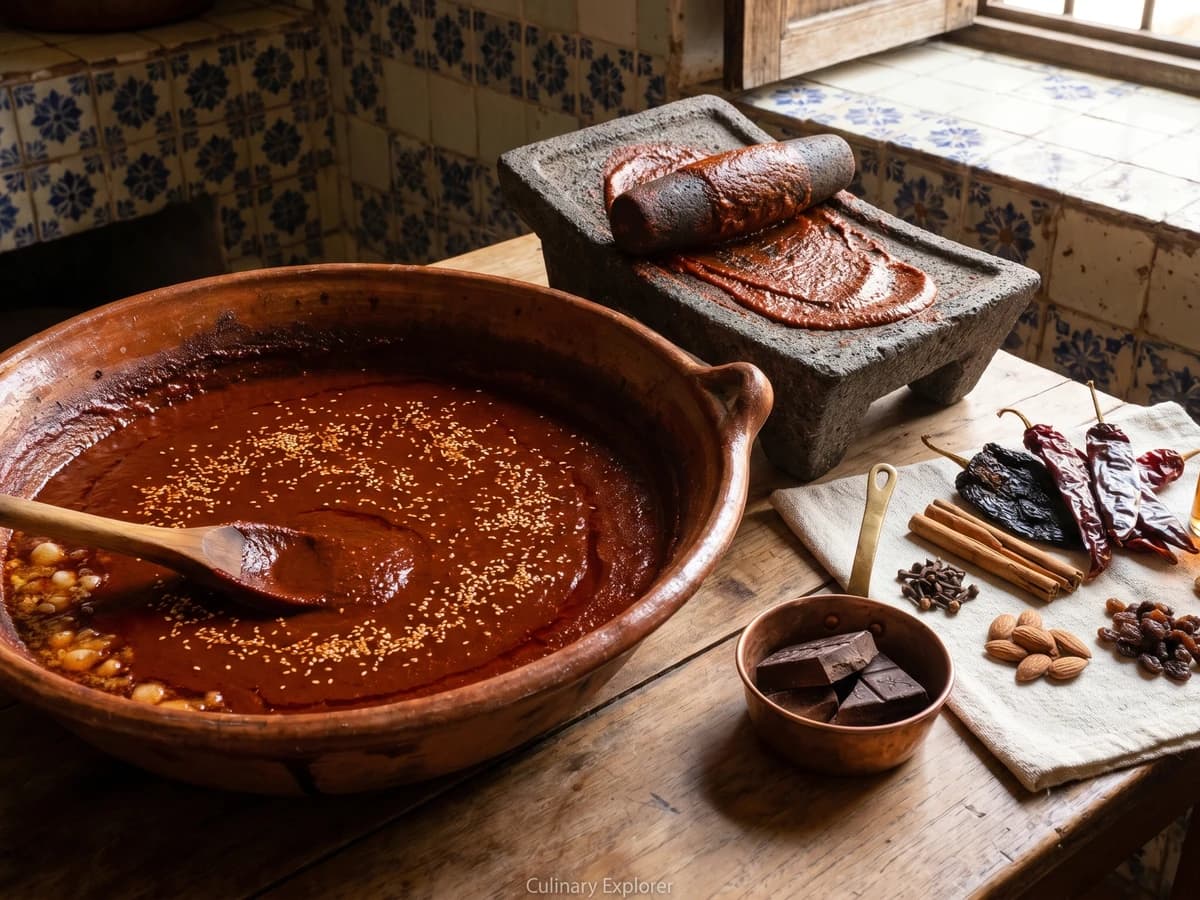
Zacatecas' wedding-table adobo, built from toasted guajillo and ancho, piloncillo, sour orange, chocolate, canela, clavo, almonds, sesame, and lard.

Chef Lupita
Puebla's convent kitchens built this adobo with ancho, guajillo, jerez, almonds, raisins, clove, and lard, a baroque marinade that stains pork loin and finishes as the sauce.