
Chef Jeong-sun
Buldak (Fire Chicken)
Boneless chicken seared until browned, then lacquered in a fierce Korean chili sauce that clings instead of pooling; the modern night-table dish made for heat, rice, and a loud table.
A cooking platform built around craft, culture, and the stories behind what we eat.
Created by
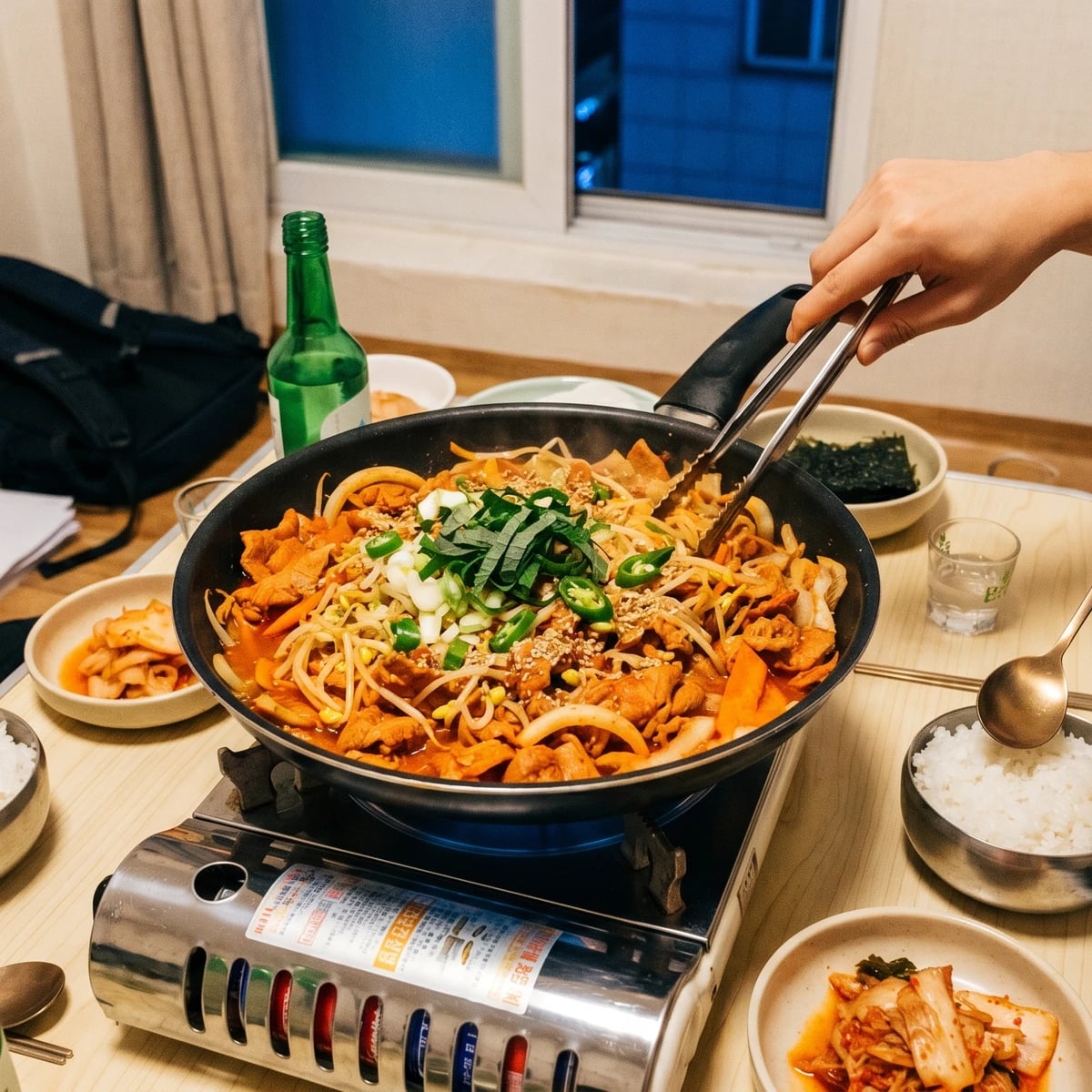
Thin pork and soybean sprouts cooked in a wide pan, the sprouts watering the sauce as they collapse, until spicy glaze clings to every slice and the rice waits underneath.
Kongbul begins with the pan looking unreasonable: a hill of soybean sprouts, sliced pork, and red seasoning piled so high the lid barely agrees. Don't add broth. The sprouts are the broth, and if you trust them for four quiet minutes they give enough liquid to cook the pork and loosen the sauce without drowning it.
This is not old court food, and I won't dress it in silk it never wore. It is modern, cheap, hungry food, the kind students split after class and office workers order when payday is still three days away. That doesn't make it careless. A budget dish needs more exactness, not less, because there is nowhere for a poor cut or a too-sweet sauce to hide.
Tonight it asks for thin pork, 500 grams of true soybean sprouts, and patience before you stir. Notebook 58 says the sauce must be strong in the bowl and restrained in the pan: gochujang for body, gochugaru for clean heat, soy for salt, only 1 tablespoon of sugar. Let it taste like pork and sprouts, not red candy. Serve it over rice while the sprouts still crunch, and the table will go quiet for the first few bites.
Kongnamul-bulgogi is a modern Korean dish usually shortened to kongbul, a contraction of kongnamul (soybean sprouts) and bulgogi. It spread through budget restaurants and university neighborhoods in the 2000s, using the same wide-pan logic as jeyuk-bokkeum and dakgalbi: inexpensive meat, plenty of vegetables, and rice mixed into the sauce at the end. There is no court record to borrow here, and none is needed; its history belongs to student tables, office workers, and restaurants that made one pan feed several people.
Quantity
600g
sliced about 2mm thick and cut into 2-inch pieces
Quantity
500g
rinsed and drained well
Quantity
1 medium (about 180g)
sliced 1/4 inch thick
Quantity
120g
cut into 1-inch strips
Quantity
1 small (about 80g)
cut into matchsticks
Quantity
4
cut into 2-inch lengths
Quantity
1
sliced on the diagonal
Quantity
10 leaves
sliced into 1/2-inch ribbons
Quantity
1 teaspoon
Quantity
3 tablespoons
Quantity
2 tablespoons
medium grind
Quantity
3 tablespoons
Quantity
1 tablespoon
Quantity
1 tablespoon
Quantity
1 tablespoon
minced, about 4 cloves
Quantity
1 teaspoon
grated
Quantity
2 teaspoons
divided
Quantity
1/4 teaspoon
freshly ground
Quantity
1 tablespoon
Quantity
to serve
Quantity
2 cups
Quantity
1 sheet
crumbled
| Ingredient | Quantity |
|---|---|
| thinly sliced pork shoulder (moksal) or pork belly (samgyeopsal)sliced about 2mm thick and cut into 2-inch pieces | 600g |
| soybean sprouts (kongnamul)rinsed and drained well | 500g |
| onionsliced 1/4 inch thick | 1 medium (about 180g) |
| green cabbage or napa cabbagecut into 1-inch strips | 120g |
| carrotcut into matchsticks | 1 small (about 80g) |
| scallionscut into 2-inch lengths | 4 |
| green chili or Cheongyang chili (optional)sliced on the diagonal | 1 |
| perilla leaves (kkaennip) (optional)sliced into 1/2-inch ribbons | 10 leaves |
| neutral oil (optional) | 1 teaspoon |
| gochujang (Korean red chili paste) | 3 tablespoons |
| gochugaru (Korean chili flakes)medium grind | 2 tablespoons |
| soy sauce | 3 tablespoons |
| rice wine or mirim | 1 tablespoon |
| sugar | 1 tablespoon |
| garlicminced, about 4 cloves | 1 tablespoon |
| fresh gingergrated | 1 teaspoon |
| toasted sesame oildivided | 2 teaspoons |
| black pepperfreshly ground | 1/4 teaspoon |
| toasted sesame seeds | 1 tablespoon |
| steamed short-grain rice | to serve |
| cooked short-grain rice (optional) | 2 cups |
| roasted gim (seaweed) (optional)crumbled | 1 sheet |
Rinse the soybean sprouts in cold water, pick out loose skins and any dark heads, then drain them in a colander for 10 minutes. Do not skip the draining. Rinse water thins the sauce before the sprouts have a chance to give their own clean liquid.
Stir together the gochujang, gochugaru, soy sauce, rice wine, sugar, garlic, ginger, 1 teaspoon sesame oil, and black pepper until smooth. Taste a dab. It should be salty, spicy, and a little sweet, stronger than you want the finished dish, because 500 grams of sprouts will water it down in the pan.
Add the sliced pork to the sauce and mix with your hands until every piece is coated. Let it sit 10 minutes while you cut the vegetables. Thin pork takes seasoning quickly; a long soak only makes it salty.
Set a wide 12-inch skillet, shallow jeongol pan, or wok over medium-high heat. If you are using a stainless pan or very lean pork shoulder, rub in 1 teaspoon neutral oil. Pile the soybean sprouts on the bottom, then the cabbage, onion, and carrot. Lay the marinated pork loosely over the top, scraping on every bit of sauce. Add no broth. The sprouts are the liquid.
Cover the pan and cook 4 minutes without stirring. The sprouts will slump and liquid will appear around the edge. This is the part impatient cooks ruin. Lift and stir too early, and the sprouts keep that raw bean smell while the pork starts to stick.
Uncover and toss everything with tongs, separating the pork slices so they cook evenly. Cook 5 to 7 minutes, tossing often, until the pork is fully cooked with no pink left and the sauce boils actively. For safety, the pork should reach at least 63 C or 145 F; with slices this thin, it usually passes that point quickly.
Raise the heat to high and cook 2 to 3 minutes more, tossing until the sauce turns glossy and clings instead of pooling. Add the scallions, chili, and perilla leaves for the last minute so they stay bright. Turn off the heat and finish with the remaining 1 teaspoon sesame oil and the sesame seeds.
Serve at once over hot short-grain rice, while the sprouts still have crunch. For bokkeumbap, leave about 1/2 cup sauce and a few scraps in the pan after the first serving, add 2 cups cooked rice and the crumbled gim, and press it into the pan for 3 to 4 minutes until the bottom catches lightly.
1 serving (about 400g)
Culinary guides, cultural storytelling, and the editorial depth that makes cooking meaningful.
Discover Culinary Explorer
Chef Jeong-sun
Boneless chicken seared until browned, then lacquered in a fierce Korean chili sauce that clings instead of pooling; the modern night-table dish made for heat, rice, and a loud table.

Chef Jeong-sun
Pork large intestine cleaned, simmered, dried, then stir-fried hard with garlic, chilies, cabbage, and perilla leaves, a late-table anju where the fat must brown before the sauce ever touches the pan.

Chef Jeong-sun
Chuncheon's iron-pan chicken, seared with cabbage, sweet potato, rice cakes, and a measured gochujang sauce, then finished properly with fried rice in the leftover pan.

Chef Jeong-sun
Warm blocks of plain tofu set beside sour aged kimchi and pork, fried until the edges darken and the kimchi tastes deeper than when it left the jar.