Culinary Explorer

A cooking platform built around craft, culture, and the stories behind what we eat.
Discover Culinary Explorer
Kokoskuppeln

Kokoskuppeln

Created by

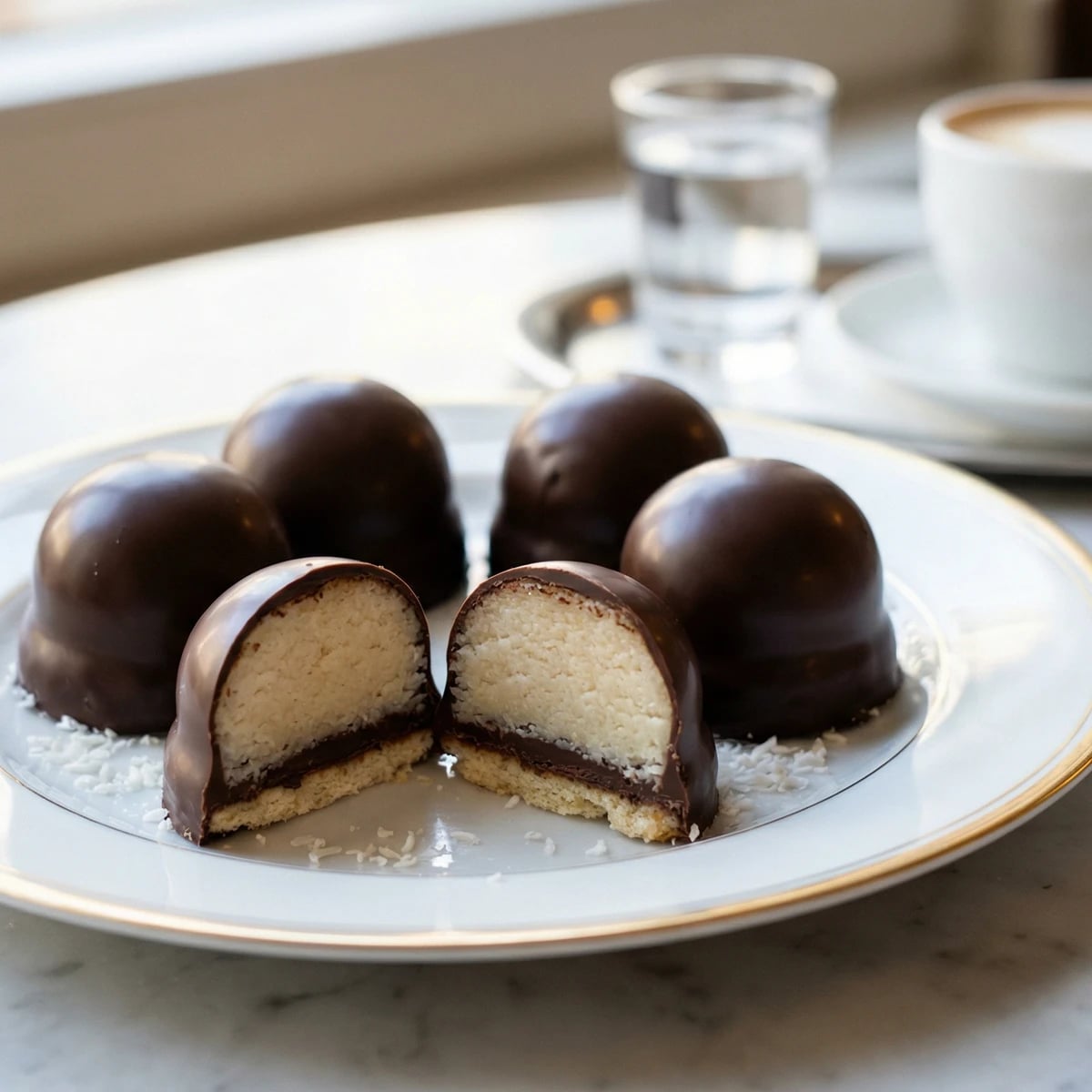
Crisp Oblaten wafers layered with chocolate-hazelnut truffle and crowned with fluffy coconut domes, then cloaked in dark chocolate so glossy you can nearly see yourself in it. Viennese confection architecture in two bites.

Desserts
Austrian
Christmas
Holiday
Special Occasion
50 min
Active Time
15 min cook3 hr total
Yield22-24 pieces

In my grandmother Eva's kitchen in Kent, Gretel kept a tin of Oblaten wafers in the cupboard year-round, but they only came out seriously in November. That was the signal. Advent baking had begun. The two of them would cover the kitchen table in waxed paper and spend an afternoon building things: Punschkrapfen, Rumkugeln, and these, Kokoskuppeln, which Gretel called "the little cathedrals" because of the way the domes rose up from their wafer bases, dark and architectural and almost too pretty to eat.

Kokoskuppeln are a Viennese Konditorei confection built in layers. First, a thin round Oblaten wafer, the same crisp communion-wafer disc that shows up across Austrian baking. On top of that, a slick of chocolate-hazelnut truffle, dark and dense. Then the dome itself: a coconut meringue mixture, warm and pliable, shaped by hand into a soft peak. Once the domes firm up, the whole thing gets dipped in dark Kuvertüre that sets to a shell so smooth it catches the light. You bite through chocolate, into coconut, through truffle, down to the snap of the wafer. Four textures. Four flavors. Two bites.

Gretel always said that Austrian confections reward patience, not talent. Kokoskuppeln take time because each layer needs to set before the next one goes on. But none of the individual steps are difficult. You warm, you shape, you wait, you dip. A twelve-year-old can do this, and I know because I did, standing on that stool in Deal, building my first little cathedrals with chocolate on my fingers and coconut in my hair.

Kokoskuppeln belong to the broader tradition of Oblaten-Konfekt, wafer-based confections that became a cornerstone of Viennese Advent baking in the 19th century. Oblaten themselves trace back to medieval monastery baking, where the same unleavened wafer discs used in communion found a second life as bases for marzipan and chocolate work. Desiccated coconut entered Austrian Konditorei kitchens through the Habsburg empire's trade connections, and by the late 1800s, Kokoskuppeln had become a fixture of Christmas markets and Konditorei display cases across Vienna and Salzburg.

The technique, the tradition, and the story behind every dish.

Discover Culinary Explorer

Ingredients

round Oblaten wafers (5cm diameter)

Quantity

22-24

dark chocolate (minimum 60% cocoa)

Quantity

100g

finely chopped

unsalted butter

Quantity

50g

ground hazelnuts

Quantity

50g

lightly toasted

Staubzucker (powdered sugar)

Quantity

30g

dark rum

Quantity

1 tablespoon

egg whites

Quantity

3 large

caster sugar

Quantity

150g

Vanillezucker (vanilla sugar)

Quantity

1 packet (8g)

desiccated coconut

Quantity

200g

dark Kuvertüre (couverture chocolate, 55-60%)

Quantity

200g

coconut oil or cocoa butter

Quantity

1 tablespoon

Equipment Needed

  • Two heatproof bowls for melting
  • Small pot for the water bath (bain-marie)
  • Small offset spatula or teaspoon for spreading
  • Baking parchment
  • Wire cooling rack (optional, for glazing)

Instructions

  1. 1

    Make the chocolate-hazelnut truffle

    Melt the 100g dark chocolate and butter together in a heatproof bowl set over a pot of barely simmering water. The water should not touch the bottom of the bowl. Stir gently until smooth and glossy. Remove from the heat and stir in the ground hazelnuts, Staubzucker, and rum. The mixture will be thick, dark, and smell like a Konditorei at nine in the morning. Let it cool for five minutes until it thickens just enough to hold its shape when spread.

    Toast the hazelnuts in a dry pan for three to four minutes before grinding them. This wakes up the oils and gives the truffle layer a deeper, rounder flavor. You'll smell when they're ready.
  2. 2

    Build the wafer bases

    Lay out your Oblaten wafers on a sheet of baking parchment. Using a small offset spatula or the back of a teaspoon, spread a thin, even layer of the chocolate-hazelnut mixture onto each wafer, about 3-4 millimeters thick. Leave a narrow rim of bare wafer around the edge. The truffle layer is the foundation, and if you go too thick here, the proportions of the finished Kuppeln will be wrong. You want a slick of intense chocolate, not a mound. Let these set at room temperature for fifteen minutes while you make the coconut domes.

  3. 3

    Warm the coconut dome mixture

    Combine the egg whites, caster sugar, Vanillezucker, and desiccated coconut in a heatproof bowl. Set it over a pot of gently simmering water, the same setup you used for the chocolate. Stir constantly with a wooden spoon or spatula for six to eight minutes. You're warming everything through so the sugar dissolves and the egg whites partially cook, binding the coconut into a pliable mass. The mixture is ready when it feels uniformly warm to the touch, holds together when pressed, and pulls cleanly away from the side of the bowl.

    Don't rush this step with higher heat. If the egg whites cook too fast, you'll get scrambled bits in your coconut mixture instead of a smooth, moldable mass. Low heat, steady stirring, patience.
  4. 4

    Shape the domes

    Remove the coconut mixture from the heat. While it's still warm and workable, wet your hands lightly with cold water and take a walnut-sized portion of the mixture. Roll it into a ball, then shape it into a dome or a tapered peak, pressing the flat base gently onto a chocolate-covered wafer. The warmth of the mixture will help it bond to the truffle layer. Work with purpose because the mixture stiffens as it cools. If it becomes too firm to shape, set the bowl briefly back over the warm water. Each dome should rise about three centimeters above the wafer, round and proud.

    Keep a small bowl of cold water beside you and re-wet your hands between every two or three domes. The coconut sticks to dry fingers and the whole business becomes frustrating. Wet hands solve everything.
  5. 5

    Chill until firm

    Place the assembled Kokoskuppeln on their parchment-lined tray in the refrigerator for at least one hour, until the domes are completely firm and the truffle layer has set solid. This is not optional. If you try to dip soft domes in warm chocolate, they'll collapse or slide off the wafer, and you'll have a mess instead of a confection. Go make a coffee. Read something. The Kuppeln will wait.

  6. 6

    Temper the chocolate glaze

    Finely chop the Kuvertüre and melt two-thirds of it in a clean heatproof bowl over barely simmering water, stirring until it reaches about 45°C (you should be able to feel definite warmth when you touch a drop to your lip). Remove from the heat and add the remaining third of the chopped Kuvertüre and the coconut oil. Stir steadily until every piece has melted and the chocolate is smooth, glossy, and has cooled to around 31°C. It should feel just barely cool against your lip. This simple seeding method gives you a glaze that sets with a clean snap and a proper shine.

    If you don't have a thermometer, the lip test works perfectly. Dab a drop on your lower lip: if it feels warm, it's too hot. If it feels neutral to slightly cool, you're there. Gretel never owned a chocolate thermometer in her life and her Kuvertüre was always flawless.
  7. 7

    Glaze the Kokoskuppeln

    Take a chilled Kokoskuppel and hold it by the wafer base between your thumb and forefinger. Dip it dome-first into the chocolate, submerging the coconut dome and the sides completely, leaving only the wafer base exposed. Lift it out smoothly, let the excess chocolate drip back into the bowl for a few seconds, then give it one gentle shake to encourage an even coat. Place it dome-side up on a clean sheet of baking parchment. Work steadily through the batch. If the chocolate thickens as it cools, set the bowl over warm water for thirty seconds to bring it back, but don't overheat it or you'll lose the temper.

  8. 8

    Set and serve

    Let the glazed Kokoskuppeln set at cool room temperature for at least forty-five minutes. The chocolate should harden to a smooth, glossy shell with a clean snap when you bite through it. If your kitchen is warm, the fridge will speed this up, but room temperature gives you the best shine. Arrange on a plate or pack into a tin lined with parchment. Mahlzeit!

Chef Tips

  • Buy proper Oblaten wafers from an Austrian or German grocery, or order them online. They're thin, crisp, unleavened wafer discs, and nothing else works as the base. Rice paper is too fragile. Crackers are too thick. Oblaten are Oblaten.
  • Use real Kuvertüre, not baking chocolate or chocolate chips. Kuvertüre has a higher cocoa butter content, which is why it melts smoothly and sets with that glossy, snapping shell. The ingredient list should say cocoa butter, not vegetable fat. This is the difference between a Konditorei confection and a craft project.
  • If you want to be precise about your domes, use a small ice cream scoop (the kind for melon balls, about 3cm) to portion the coconut mixture before shaping. It gives you consistent sizes so every Kokoskuppel looks like it came from the same Konditorei window.
  • Store these in a cool place in an airtight tin with parchment between layers. They keep for two weeks easily, and the flavors actually improve after a day or two as the rum in the truffle layer mellows and the coconut softens slightly against the chocolate. If you can keep yourself from eating them all on the first evening.

Advance Preparation

  • The chocolate-hazelnut truffle can be made a day ahead and refrigerated. Let it soften at room temperature for ten minutes before spreading onto the wafers.
  • Assembled but unglazed Kokoskuppeln can be refrigerated overnight. Glaze them the next day when you have a clean stretch of time.
  • Finished Kokoskuppeln keep in an airtight tin at cool room temperature for up to two weeks. They're ideal for making in advance during Advent, which is exactly how Gretel and Eva used to do it: a full afternoon of building, then a tin that lasted through Christmas.

Frequently Asked Questions

Nutrition Information

1 serving (about 40g)

Calories
210 calories
Total Fat
14 g
Saturated Fat
10 g
Trans Fat
0 g
Unsaturated Fat
5 g
Cholesterol
5 mg
Sodium
12 mg
Total Carbohydrates
19 g
Dietary Fiber
3 g
Sugars
14 g
Protein
3 g

Note: Chef personas and recipes are created with AI assistance. Cook with care: follow safe food-handling practices, check doneness with a thermometer when needed, and adapt for allergies and your kitchen.

Where cooking meets culture.

Culinary guides, cultural storytelling, and the editorial depth that makes cooking meaningful.

Discover Culinary Explorer

More from Weihnachtsbäckerei (Austrian Christmas Cookies)

Browse the full collection