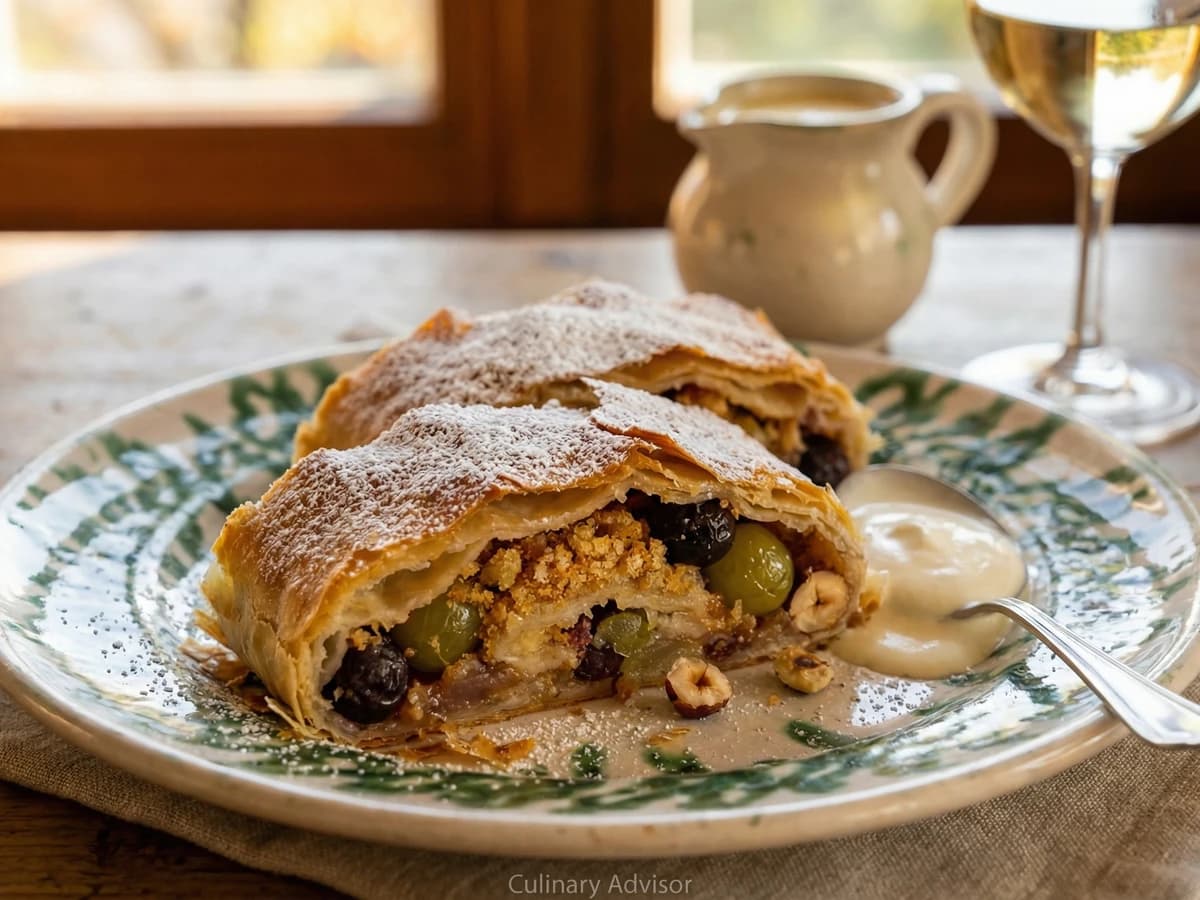
Soft coconut clouds perched on thin Oblaten wafers, golden at the tips and chewy in the middle. Three ingredients do all the work if you treat them right.
Pastries & Cookies
Austrian
Christmas
Holiday
Make Ahead
20 min
Active Time
15 min cook•35 min total
Yield30 cookies
In my grandmother Eva's kitchen in Deal, the Christmas baking started in November and didn't stop until the tins were full. Kokosbusserl were always first. Gretel would stand at the stove with a bowl over simmering water, stirring egg whites and coconut and sugar together with a wooden spoon, and I'd be next to her on my stool, watching the mixture go from loose and grainy to thick and glossy. She'd let me shape them. My early attempts were lopsided little lumps, but they tasted exactly the same as her perfect peaked ones, and that was the first lesson I ever learned about baking: the oven doesn't care what it looks like going in.
Kokosbusserl belong to the Weihnachtsbäckerei, the Christmas cookie tradition that turns Austrian kitchens into small factories every December. Vanillekipferl, Linzer Augen, Lebkuchen, and Busserl of every kind fill tins that get stacked in cool pantries and brought out for visitors all through Advent. Kokosbusserl are the ones children reach for first. They're sweet, they're chewy, and they look like little snow-capped mountains, which appeals to anyone under ten and most people over it.
The technique is almost absurdly simple. You warm the coconut mixture over a water bath to dissolve the sugar and bind the egg whites, mound it onto Oblaten wafers, and bake until the tips turn golden. That's it. Three ingredients and a wafer. But simple food done well is the whole principle of Austrian cooking, and a properly made Kokosbusserl, soft and fragrant with toasted coconut and real Vanillezucker, is proof that you don't need complexity to make something people remember.
Kokosbusserl emerged in Viennese Konditoreien in the late 19th century when colonial trade made desiccated coconut widely available in Central Europe. The word Busserl comes from the Austrian dialect for 'little kiss,' and the family of Busserl cookies, from Kokosbusserl to Nussbusserl to Schokobusserl, became a cornerstone of the Weihnachtsbäckerei tradition. The Oblaten wafer base, a thin unleavened disc originally produced in monasteries, solved the practical problem of sticky macaroon-style mixtures clinging to baking trays and became inseparable from the cookie itself.
The technique, the tradition, and the story behind every dish.
Combine the egg whites, caster sugar, Vanillezucker, desiccated coconut, lemon zest, and salt in a heatproof bowl. Set the bowl over a pot of gently simmering water, making sure the bottom of the bowl doesn't touch the water. Stir continuously with a wooden spoon for about five minutes until the sugar dissolves and the mixture feels warm to the touch, around 50°C. You'll feel the graininess disappear as you stir. This step is the whole secret of a Busserl that holds its shape. Raw egg whites and sugar won't bind the coconut. Warmed together, they become a soft, sticky mass that you can mound and that sets beautifully in the oven.
Don't let the mixture get hot. You're dissolving sugar and gently warming the egg whites, not cooking them. If the whites start to set around the edges, pull the bowl off immediately.
2
Rest the mixture
Remove the bowl from the heat and let the mixture sit for five to ten minutes. As it cools slightly, it will thicken and become easier to shape. If you try to mound it straight away while it's still loose, the Busserl will flatten on the wafers. Patience here takes thirty seconds of extra waiting and saves the whole batch.
3
Shape onto Oblaten
Preheat your oven to 160°C (fan) or 180°C (conventional). Lay the Oblaten wafers out on baking trays lined with baking paper. Using two teaspoons or your fingers dipped in cold water, mound a generous walnut-sized portion of the coconut mixture onto each wafer. Shape it into a soft peak, a little dome with a pointed top. The Busserl should sit entirely on the wafer with none of the mixture spilling over the edge. Don't press down. You want height, not flat discs.
Dip your fingers in cold water between every two or three Busserl. The mixture is sticky and the water keeps it from clinging to your hands. This is the oldest trick in the Weihnachtsbäckerei.
4
Bake until golden
Bake for 12 to 15 minutes, watching carefully from the ten-minute mark. The peaks and edges should turn a warm golden brown while the centers stay pale and soft. The coconut toasts fast once it starts, so the line between golden and burnt is about two minutes. Open the oven door and look. If the tips are turning dark, they're done. Pull them out. The inside should still feel slightly soft when you press gently on the side. They firm up as they cool.
Every oven is different. The first tray is always your test batch. If they flatten completely, your mixture was too warm. If they crack and dry out, your oven is too hot. Adjust and carry on.
5
Cool completely
Let the Kokosbusserl cool on the tray for five minutes, then transfer to a wire rack. They will feel fragile at first but firm up as the coconut and sugar set. Once cool, they should be lightly crisp on the outside, chewy and soft within, with the thin Oblaten wafer providing a gentle snap at the base. Store in a tin with parchment between layers. They keep for two weeks and actually improve after a day or two as the flavors settle. Mahlzeit!
Chef Tips
•Use real Vanillezucker, not vanilla extract. Austrian baking lives and dies by Vanillezucker. Buy it or make your own by burying a split vanilla pod in a jar of caster sugar for a week. The flavor is rounder and warmer than extract, and in a cookie this simple, you taste the difference.
•Oblaten wafers are sold in Austrian and German grocery shops and online. They're thin, edible wafer discs, not communion wafers and not rice paper. If you truly can't find them, line your trays with baking paper, but the Busserl will lose that gentle snap at the base that makes them what they are.
•Gretel always said Kokosbusserl improve after a day in the tin. She was right. On day one they're good. On day two or three, the coconut softens slightly and the flavors merge. Store them in a tin, not a plastic container. Tins breathe just enough.
•The lemon zest is small but it matters. It cuts through the sweetness of the coconut and sugar, gives the whole Busserl a brightness that stops it from being one-note. Don't skip it.
Advance Preparation
•Kokosbusserl store beautifully in a tin with parchment between layers for up to two weeks. They're ideal make-ahead Christmas cookies.
•The shaped, unbaked Busserl on their wafers can be frozen on trays, then transferred to freezer bags. Bake from frozen, adding two to three minutes to the baking time.
Frequently Asked Questions
Nutrition Information
1 serving (about 16g)
Calories
75 calories
Total Fat
4 g
Saturated Fat
4 g
Trans Fat
0 g
Unsaturated Fat
0 g
Cholesterol
0 mg
Sodium
15 mg
Total Carbohydrates
9 g
Dietary Fiber
1 g
Sugars
8 g
Protein
1 g
Where cooking meets culture.
Culinary guides, cultural storytelling, and the editorial depth that makes cooking meaningful.