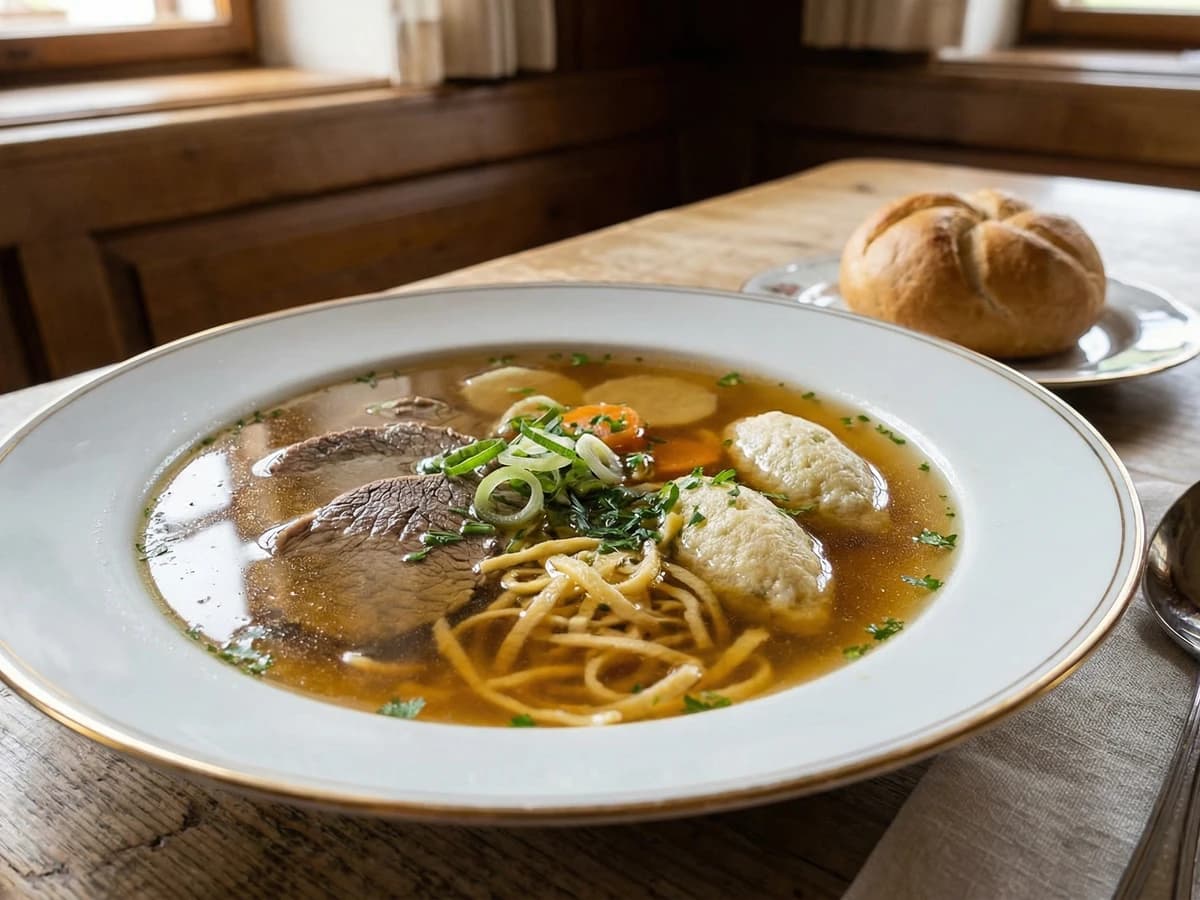
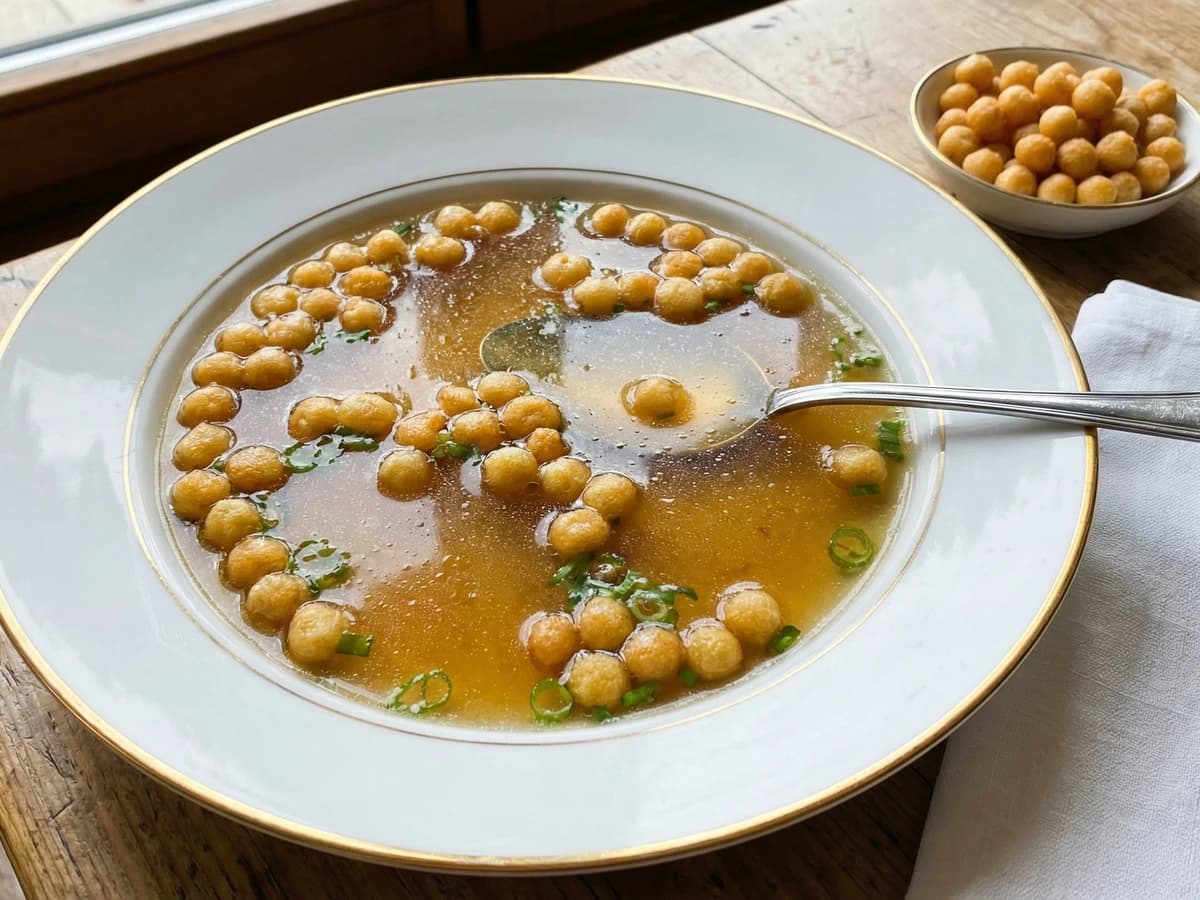
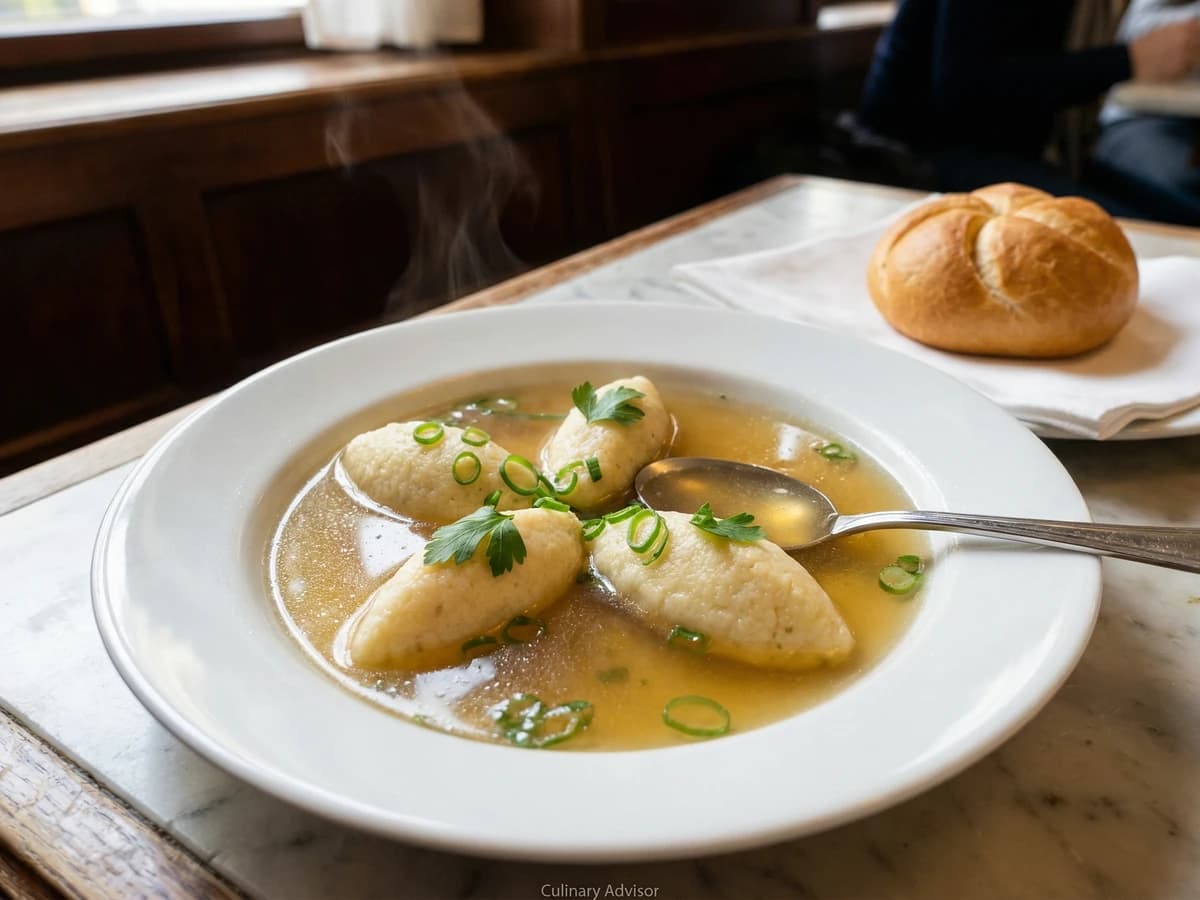
Austria's silky garlic cream soup, slow-cooked until the garlic turns sweet and gentle, finished with a swirl of cream and golden croutons that shatter when your spoon breaks through.
Soups & Stews
Austrian
Weeknight
Comfort Food
15 min
Active Time
35 min cook•50 min total
Yield4 servings
There's a moment when garlic stops being sharp and starts being sweet. You cook it low and slow in butter, watching the slices soften and turn translucent, and somewhere around the ten-minute mark the whole kitchen shifts. That raw bite disappears. What replaces it is something round and warm and almost nutty. That's the moment this soup is built on.
Knoblauchcremesuppe showed up on nearly every Gasthaus menu during my childhood trips to Austria with Gretel and my grandmother Eva. It was always on the daily menu board, chalked up alongside Frittatensuppe and Leberknödelsuppe, the kind of soup that nobody thought twice about ordering because it was always good. Two heads of garlic, good stock, a little cream, bread fried in butter. That's the whole secret. Gretel always said the simplest dishes are the hardest to hide behind, and she was right. When there are only five or six ingredients, every one of them has to earn its place.
The technique here is patience, not complexity. You cook the garlic gently so it gives up its sharpness without turning bitter. You build the base with a proper roux, the old Viennese way, because flour and butter cooked together give the soup body that cream alone can't. And you finish it with croutons fried in butter until they're golden and audibly crunchy, because a cream soup without texture is just a warm drink.
Knoblauchcremesuppe traces its roots to the Bohemian culinary tradition that became woven into Austrian cooking during centuries of Habsburg rule. Garlic soups, called česnečka in Czech, were farmhouse staples across Bohemia and Moravia, brought into Viennese and Austrian Gasthaus kitchens by Bohemian cooks who staffed many of the empire's restaurants and private households. The Austrian version refined the peasant original with a butter roux and cream, transforming it from rustic sustenance into the smooth, composed soup served across the country today.
The technique, the tradition, and the story behind every dish.
day-old white bread (Semmel or Weissbrot)cut into 1cm cubes
3 thick slices
unsalted butter (for croutons)
30g
fresh chivesfinely cut
for garnish
Equipment Needed
•Heavy-bottomed pot (3-liter minimum)
•Stick blender or standing blender
•Small frying pan for croutons
Instructions
1
Cook the garlic gently
Melt the butter in a heavy-bottomed pot over low heat. Add all the sliced garlic and stir to coat every piece in butter. Cook gently for eight to ten minutes, stirring now and then, until the garlic is soft, translucent, and smells sweet rather than sharp. Do not let it brown. Browned garlic turns bitter, and bitter garlic will ruin the entire pot. If you see any color forming, pull the pot off the heat for a moment and turn the flame down. You're coaxing, not frying.
Two full heads of garlic looks like too much. It isn't. The long cooking tames the garlic completely. After simmering and blending, the soup will be mellow and sweet, not aggressive. Trust the process.
2
Build the roux
Sprinkle the flour over the softened garlic and stir constantly for two minutes. The flour needs to cook out its raw, pasty taste before any liquid goes in. You'll see it coat the garlic and form a pale paste at the bottom of the pot. Keep it moving so it doesn't scorch. This roux is what gives the soup its velvety body. Cream alone would make it rich but thin. The roux makes it hold together.
3
Add stock and simmer
Pour in the stock in a steady stream, whisking as you go to prevent lumps. Add the bay leaf and thyme sprigs. Bring to a gentle simmer and let it cook for twenty minutes uncovered. The garlic will break down almost completely. The surface should barely move, just a lazy bubble rising every few seconds. Hard boiling will make the soup cloudy and give it a grainy texture that no amount of blending can fix.
If you have homemade stock, use it here. This soup has so few ingredients that the quality of your stock shapes everything. If you're using store-bought, choose a low-sodium version so you can control the seasoning yourself.
4
Fry the croutons
While the soup simmers, cut the bread into rough one-centimeter cubes. Melt the butter in a small pan over medium heat. When it foams, add the bread cubes in a single layer. Fry them, turning occasionally, until golden and crisp on all sides, about four minutes. They should sound hollow when you tap one with a spoon. Lift them onto a piece of kitchen paper and season with a pinch of salt while still hot. Set aside.
5
Blend until smooth
Remove the bay leaf and thyme sprigs. Blend the soup until completely smooth. A stick blender works well, or you can do it in batches in a standing blender. You're looking for a consistency like heavy cream, smooth enough that you can't detect a single piece of garlic. If it feels too thick, add a splash more stock. If it's too thin, let it simmer uncovered for another five minutes to reduce.
6
Finish with cream and season
Return the blended soup to the pot over low heat. Stir in the cream and let it warm through for two minutes. Season with salt, white pepper, a pinch of freshly grated nutmeg, and the lemon juice. White pepper matters here because black specks in a pale soup look careless. The nutmeg rounds out the garlic. The lemon juice is the quiet hero: just a tablespoon lifts the whole bowl and keeps the richness from feeling heavy. Taste and adjust. Gretel always said: season, taste, season again. Never guess.
Add the lemon juice at the very end. It brightens the soup without making it taste like lemon. If you add it too early, the acid cooks out and you lose the lift.
7
Serve the soup
Ladle the soup into warm bowls. Swirl a small spoonful of cream across the surface if you like. Pile the butter-fried croutons in the center and scatter fresh chives over the top. Serve immediately, while the croutons are still crunchy and the soup is hot. The contrast between the smooth, warm soup and the shattering croutons is what makes this dish work. Mahlzeit!
Chef Tips
•Peel garlic cloves by pressing them firmly with the flat of a wide knife. The skin slips right off. Life is too short to pick at garlic skins with your fingernails.
•Use day-old bread for the croutons. Fresh bread soaks up the butter and goes soft instead of crisping. A stale Semmel fried in butter will stay crunchy in the soup for a good three or four minutes, which is all the time you need.
•If you want to make this more substantial, a soft-poached egg dropped into the center of the bowl turns it into a full meal. Cut into it and let the yolk run into the soup. That's a trick from the Gasthaus kitchens in Styria.
•White pepper is not interchangeable with black pepper here. Black pepper gives you those little dark flecks in an otherwise beautiful ivory soup. White pepper is sharper, cleaner, and invisible. Use it.
Advance Preparation
•The soup base can be made a day ahead through the blending step and refrigerated. Reheat gently and add the cream just before serving.
•Croutons must be fried fresh. They lose their crunch within an hour. If you're making this for guests, fry them while the soup reheats and you'll time it perfectly.
Frequently Asked Questions
Nutrition Information
1 serving (about 350g)
Calories
435 calories
Total Fat
36 g
Saturated Fat
22 g
Trans Fat
1 g
Unsaturated Fat
10 g
Cholesterol
110 mg
Sodium
970 mg
Total Carbohydrates
23 g
Dietary Fiber
1 g
Sugars
3 g
Protein
7 g
Where cooking meets culture.
Culinary guides, cultural storytelling, and the editorial depth that makes cooking meaningful.