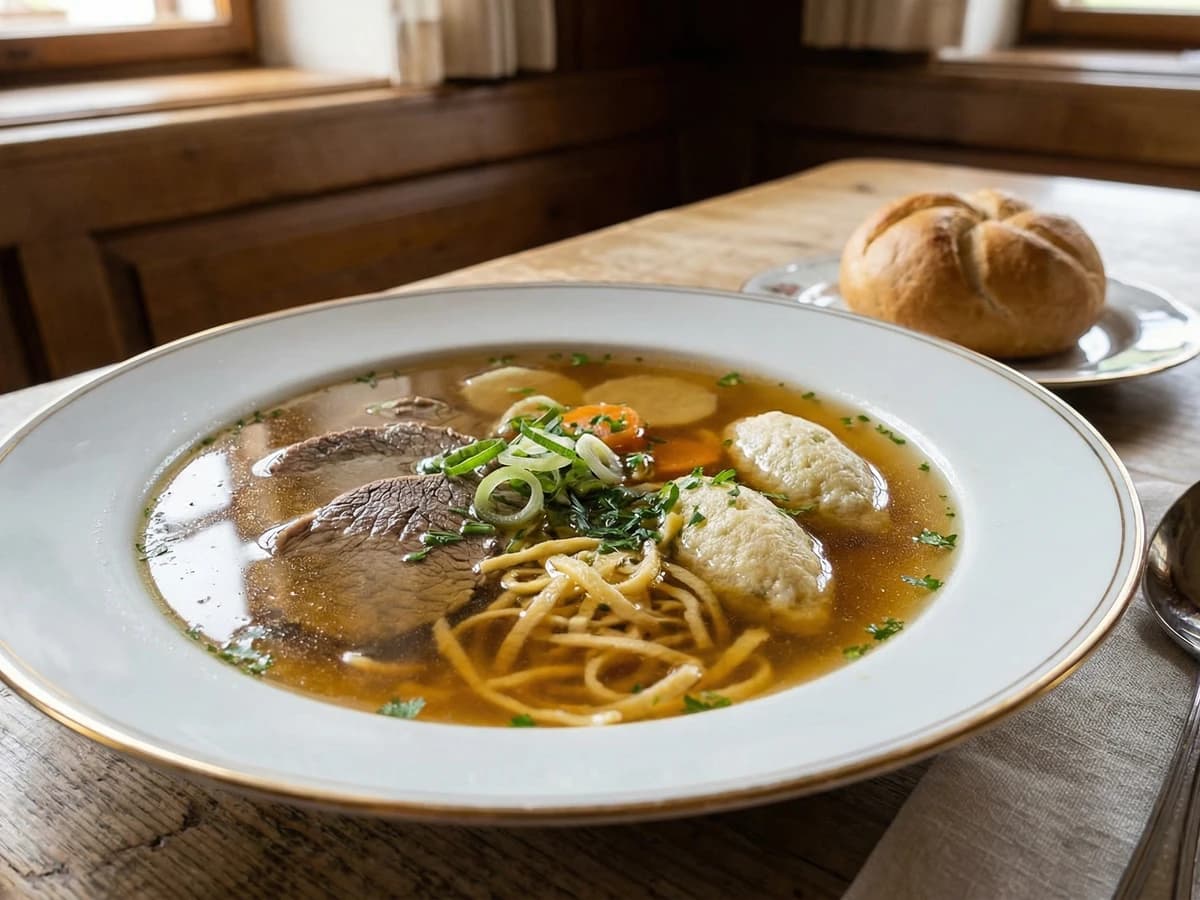
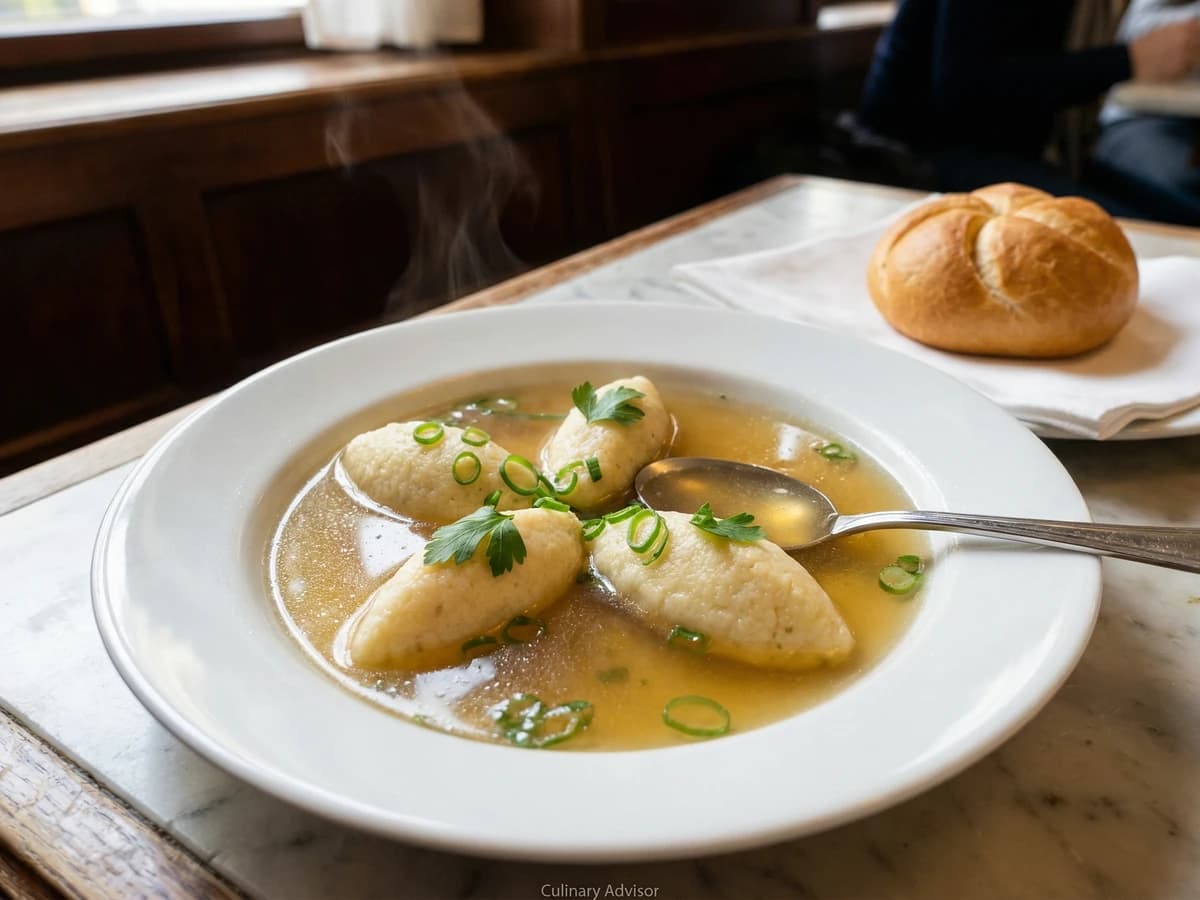
Golden fried batter pearls dropped into clear, honest Rindssuppe, where they bob on the surface before slowly drinking up the broth. The soup that Austrian children ask for by name.
Soups & Stews
Austrian
Weeknight
Quick Meal
25 min
Active Time
15 min cook•40 min total
Yield4 servings
Every Austrian child has a favourite Suppeneinlage, a favourite soup garnish, and if you ask most of them, they'll say Backerbsen before you've finished the question. In my grandmother Eva's kitchen in Kent, I'd stand on my stool and watch her drop tiny beads of batter into a pot of hot oil. They'd puff up into golden little balls, perfectly round, and I'd eat half of them straight off the kitchen paper before they ever reached the soup. Eva would look at Gretel. Gretel would look at Eva. Nobody said a word.
Backerbsen means 'baked peas,' which is a lie on two counts: they're fried, not baked, and they're made of batter, not peas. But they do look like peas when they're done, tiny golden spheres that float on the surface of clear Rindssuppe and bob gently when you carry the bowl to the table. The first ones you eat are still crisp, with a gentle crunch that gives way to the warm broth underneath. By the time you reach the bottom of your bowl, the last few have gone soft and pillowy, soaked through with beef broth and completely different from what they were two minutes ago. You're supposed to enjoy both stages. That's not a flaw; it's the design.
The recipe is almost absurdly simple. Eggs, flour, milk, a grating of nutmeg. You let the batter rest, you drop it into hot oil in tiny amounts, and you fish out golden pearls. The only real skill is controlling the size and keeping your oil at the right temperature. Everything else is patience. What makes this soup sing is what's underneath the Backerbsen: your broth. If the broth is good, if it's real, clear, honest Rindssuppe, then these silly little fried peas become something that grown adults will order at a Gasthaus without a shred of embarrassment.
Backerbsen belong to the vast Austrian tradition of Suppeneinlagen, the soup garnishes that turn a bowl of clear broth into a distinct course. Viennese Bürgerküche of the 19th century developed dozens of these garnishes, from Frittaten to Leberknödel to Grießnockerl, each with its own technique and occasion. Backerbsen were considered the simplest and most homely of the group, a children's Einlage, which is precisely why every Austrian over the age of forty remembers them with disproportionate fondness. The name 'baked peas' predates modern frying terminology, when 'backen' covered both baking and frying in a pan.
The technique, the tradition, and the story behind every dish.
neutral oil (sunflower or rapeseed)for deep frying
500ml
beef broth (Rindssuppe)homemade or best quality
1.2 liters
fresh chivesfinely cut
for serving
Equipment Needed
•Deep heavy saucepan or small pot (at least 16cm diameter, 12cm deep)
•Two teaspoons for shaping
•Slotted spoon for lifting
•Kitchen paper for draining
•Kitchen thermometer (optional but helpful)
Instructions
1
Make the batter
Crack the eggs into a mixing bowl and beat them lightly with a fork. Add the flour, milk, salt, and nutmeg. Whisk until you have a smooth, thick batter with no lumps. It should be about the consistency of heavy cream, thick enough to hold its shape for a second when it drops from a spoon, but fluid enough to fall freely. If it's too stiff, add milk a teaspoon at a time. If it runs like water, you've gone too far and need a spoonful more flour.
The nutmeg is quiet but essential. It should be there in the background the way a double bass holds an orchestra together. One or two passes across a fine grater is all you need.
2
Rest the batter
Cover the bowl and let the batter rest for fifteen minutes. This isn't fussiness. The flour needs time to absorb the liquid fully and the gluten needs to relax. A rested batter drops cleanly from the spoon in round pearls. An unrested batter drags and makes ragged shapes. Walk away, set a timer, let it sit.
3
Heat the oil
Pour the oil into a deep, heavy saucepan. You want at least five centimeters of depth. Heat it over medium-high until it reaches about 170°C. If you don't have a thermometer, drop a tiny bead of batter into the oil. It should sink briefly, then rise to the surface within two seconds and begin to sizzle steadily. If it sits on the bottom, your oil is too cold. If it browns immediately, too hot. Get this right and everything that follows is easy.
Use a tall, narrow pot rather than a wide, shallow one. Less oil, less surface to splatter, and the Backerbsen have room to sink and bob back up the way they should.
4
Fry the Backerbsen
Take two teaspoons. Scoop a tiny amount of batter with one, no more than a small pea's worth, and use the second spoon to push it off into the hot oil. Work quickly, dropping eight to ten pearls at a time. Don't crowd the pot or they'll stick together and the oil temperature will crash. The Backerbsen will sink, rise, and begin turning golden within thirty to forty seconds. Roll them gently with a slotted spoon so they colour evenly. When they're a deep, warm gold all over, lift them out and drain on kitchen paper. Repeat with the remaining batter.
The size is everything. You want them between a pea and a hazelnut. Bigger than that and they stop being Backerbsen and start being Krapfen. Smaller and they vanish in the broth before you've picked up your spoon.
5
Heat the broth
While you fry the last batch, bring your Rindssuppe to a gentle simmer in a separate pot. It should be clear, golden, and fragrant. Taste it. Season with salt if it needs it. If your broth isn't good, the soup won't be good. Backerbsen are honest little things and they can't cover for a weak broth.
6
Serve at the table
Ladle the hot broth into warm soup bowls. Scatter a generous handful of Backerbsen over the surface of each bowl. They'll bob and float, golden against the clear liquid. Some will stay crisp. Some will begin to soften and drink up the broth. That contrast is the whole point. Finish with a scattering of fresh chives. Serve a small dish of extra Backerbsen on the table so people can add more as they eat. They will. Mahlzeit!
Chef Tips
•The broth makes or breaks this soup. If you don't have homemade Rindssuppe, buy the best quality fresh stock you can find. Cubes and powders produce phony soup, and the Backerbsen will tell on you because there's nothing else in the bowl to hide behind.
•Fry in small batches, eight to ten at a time. Crowding drops the oil temperature and gives you pale, greasy Backerbsen that absorb oil instead of puffing up crisp. You want them golden and light, not heavy and soggy.
•Backerbsen keep beautifully in an airtight tin for up to five days. Make a big batch on a Sunday and you have instant weeknight soup all week. They stay crisp as long as they're dry and sealed. Only add them to hot broth at the moment of serving, never before.
•Gretel always said that the way to tell a good Backerbse from a bad one is to eat it dry, straight from the paper. If it's light, crisp, and tastes faintly of nutmeg and good egg, your oil was right. If it's heavy or greasy, your oil was too cool.
Advance Preparation
•Backerbsen can be fried up to five days ahead and stored in an airtight container at room temperature. They stay crisp as long as they're sealed and dry.
•Rindssuppe can be made three days ahead and refrigerated. The fat will solidify on top, forming a natural seal. Remove it before reheating.
•Do not add Backerbsen to the broth until the moment of serving. They begin absorbing liquid immediately and the texture changes within minutes.
Frequently Asked Questions
Nutrition Information
1 serving (about 360g)
Calories
345 calories
Total Fat
21 g
Saturated Fat
3 g
Trans Fat
0 g
Unsaturated Fat
18 g
Cholesterol
95 mg
Sodium
700 mg
Total Carbohydrates
24 g
Dietary Fiber
1 g
Sugars
1 g
Protein
14 g
Where cooking meets culture.
Culinary guides, cultural storytelling, and the editorial depth that makes cooking meaningful.